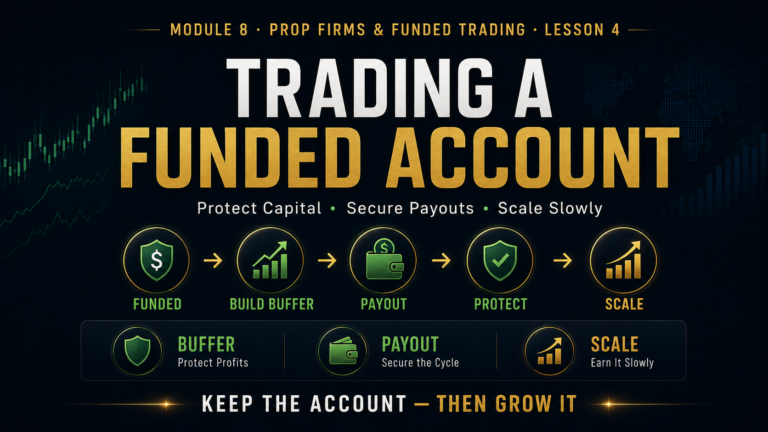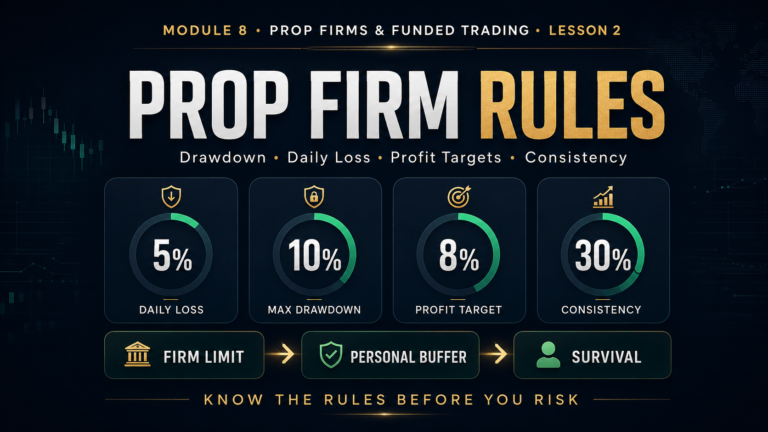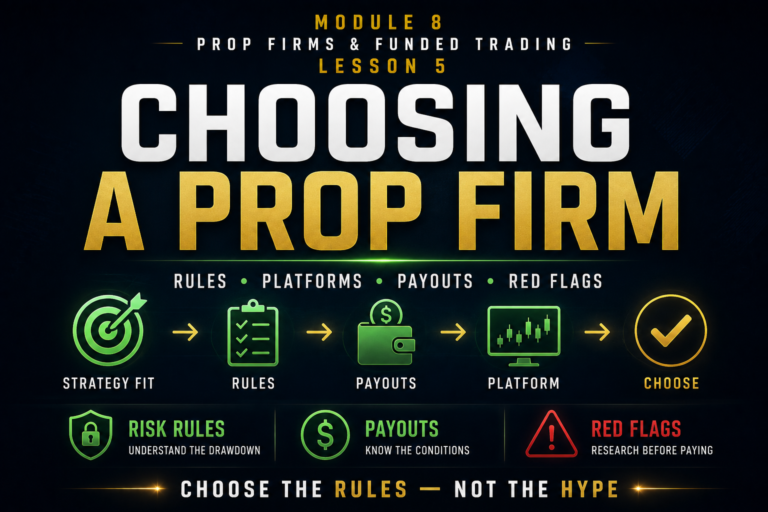
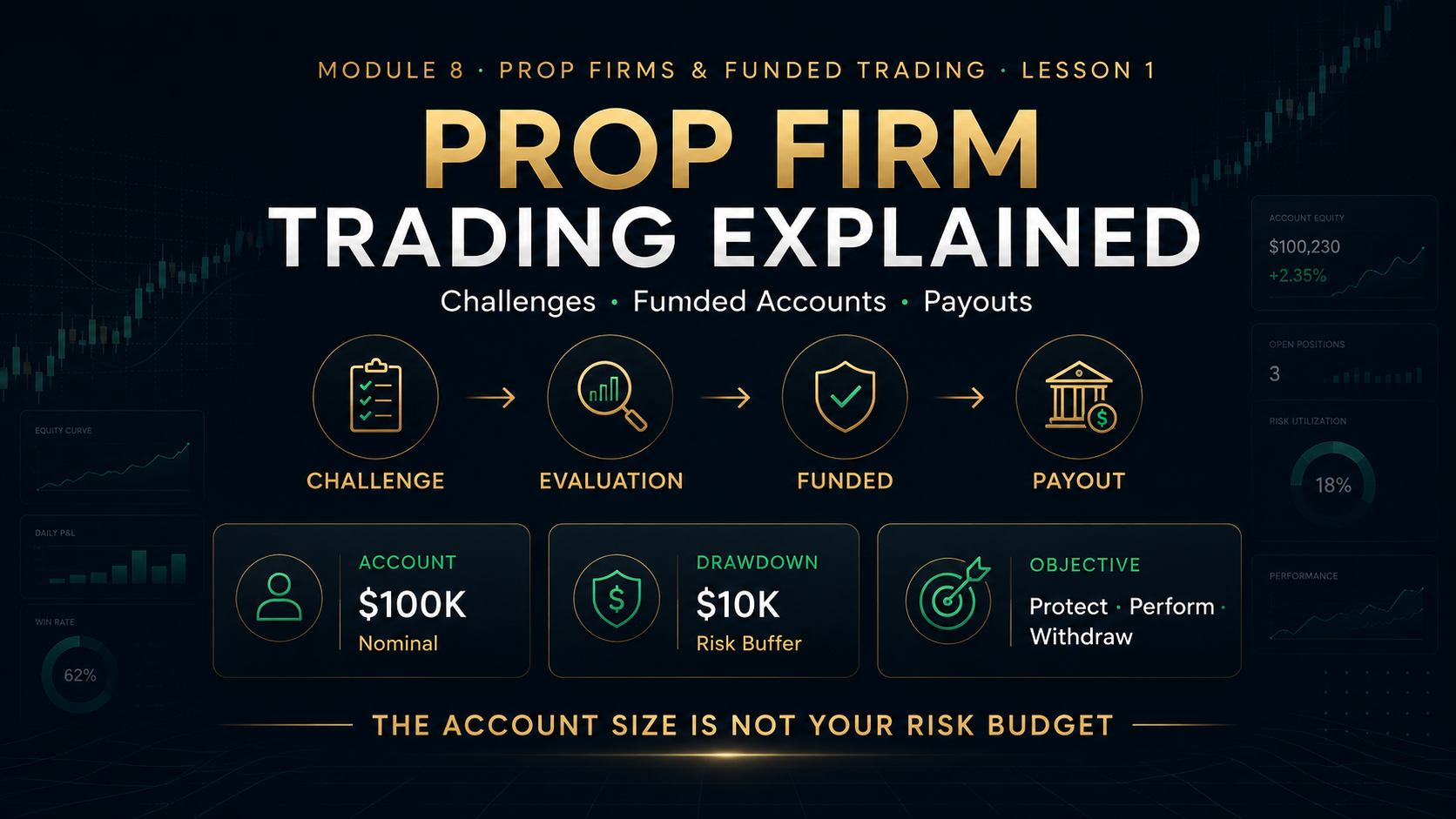
Module 8 · Prop Firms & Funded Trading · Lesson 1
Prop Firm Trading Explained: Challenges, Funded Accounts & How the Model Works
Learn how proprietary trading firms work, what evaluation challenges are designed to test, how funded accounts differ from personal trading accounts and why risk rules matter more than account size.
Prop Firms
Funded Accounts
Trading Challenges
Risk Rules
One of the biggest attractions of prop firm trading is access to a larger nominal account without personally depositing the full amount of capital shown on the dashboard.
But that headline account size can be misleading if you do not understand the rules behind it.
A trader may see a $100,000 funded account and think:
“I have $100,000 to trade.”
In reality, the amount that matters most is usually the amount of drawdown the rules allow before the account fails.
Understanding that difference is the foundation of professional funded-account trading.
Lesson Objectives
What You’ll Learn
✓ What a prop firm is
✓ How evaluation challenges work
✓ What a funded account really represents
✓ Why drawdown matters more than nominal balance
✓ How payouts and profit splits generally work
✓ Why prop trading requires a different mindset
What Is a Proprietary Trading Firm?
A proprietary trading firm, often called a prop firm, is a company that provides traders access to a trading account under a defined set of rules.
Depending on the company and program structure, the trader may be evaluated first and then become eligible to receive a share of trading profits.
Trader → Evaluation → Rule Compliance → Funded Stage → Profit Share
The exact structure varies by firm, but the central idea is that access to the account is conditional on following predefined risk parameters.
Why Traders Use Prop Firms
Access to larger nominal trading accounts
Lower personal capital requirement compared with funding the full account personally
Structured risk limits
Potential access to profit-sharing arrangements
Opportunity to demonstrate consistency
Potential scaling opportunities depending on the program
The Account Balance Is Not the Same as Your Risk Capital
This is one of the most important concepts in funded trading.
Example
Nominal Account Size: $100,000
Maximum Total Drawdown: $10,000
Practical Risk Budget: Much closer to the $10,000 drawdown allowance than the $100,000 headline balance
Prop traders should think in terms of available drawdown, not just the account number displayed on the platform.
What Is a Prop Firm Evaluation?
An evaluation is a period where the trader must demonstrate that they can reach a required performance objective without violating risk rules.
Profit Objective
Maximum Daily Loss
Maximum Total Drawdown
Minimum Trading Days — if applicable
Additional Consistency or Trading Rules — if applicable
The Evaluation Is Really a Risk-Control Test
Traders often focus only on the profit target.
But reaching the target is only half of the challenge.
Target: +8%
Trader quickly makes +5%
Trader increases risk aggressively.
One bad session violates drawdown.
Strong early profits do not matter if the account rules are later breached.
One-Step and Multi-Step Evaluations
Prop firms may structure evaluations differently.
One-Step
Trader completes one evaluation stage before becoming eligible for the funded stage.
Multi-Step
Trader must complete two or more stages, usually with different profit objectives but similar risk limits.
What About Instant Funded Programs?
Some programs provide access to a funded-style account without requiring the traditional challenge phases.
These programs may still include strict drawdown, consistency, payout or risk-management rules.
“Instant funded” does not mean “no rules.”
What Happens After Passing?
After completing an evaluation, a trader may become eligible for the firm’s funded stage.
Evaluation requirements completed
Identity / account requirements completed
Funded-stage credentials issued
Trader continues under funded-account rules
Eligible profits may become withdrawable under payout rules
Passing the Challenge Is Not the Finish Line
Many traders treat the challenge as the hard part.
In reality, keeping the funded account may require even more discipline.
Passing Creates the Opportunity. Risk Control Keeps It.
Understanding Profit Splits
Funded programs generally allow traders to receive an agreed percentage of eligible trading profits.
Eligible trading profit: $5,000
Example trader share: 80%
Example trader payout: $4,000
Profit splits and payout requirements vary between firms and programs. Always review the current terms of the specific program.
What Is a Payout?
A payout is the withdrawal of eligible trading profits from the funded account according to the firm’s rules.
Depending on the program, payout eligibility may involve factors such as:
Minimum number of trading days
Minimum time before first withdrawal
Profit consistency rules
Minimum withdrawal amounts
Maximum withdrawal limits
Account status and rule compliance
Never assume one prop firm’s payout rules apply to another. Read the rules for the exact program you purchased.
Drawdown Is the Real Constraint
The drawdown rule determines how much loss the account can tolerate before it fails.
Headline Account
$100,000
Maximum Loss Allowance
Example: $10,000
From a risk-management perspective, the second number deserves far more attention.
Daily Loss Limits
Many programs restrict how much the account can lose within a trading day.
Trader starts the day poorly.
First trade loses.
Second trade loses.
Trader tries to recover everything immediately.
Revenge trading can turn a normal red day into an account-ending violation.
Static vs. Trailing Drawdown
Drawdown rules can be calculated in different ways.
| Type | General Concept |
|---|---|
| Static Drawdown | Loss threshold generally remains fixed relative to a predefined level. |
| Trailing Drawdown | Loss threshold may move upward as account equity reaches new highs. |
Exact calculations vary, so traders must understand whether drawdown is based on balance, equity, end-of-day values or another method.
Balance and Equity Can Matter Differently
Some rules monitor closed balance while others may also consider unrealized open losses through equity.
Balance: Closed account value
Equity: Balance plus or minus unrealized open P&L
A trader can therefore be dangerously close to a violation even before losing positions are closed.
What Is a Consistency Rule?
Some programs include rules intended to prevent one unusually large trade or one unusually large day from accounting for too much of total profit.
Total profit: $5,000
One trade creates $4,000
That concentration may create a consistency problem under some programs.
Why Prop Firm Trading Is Different From Personal Trading
| Personal Account | Prop Firm Account |
|---|---|
| You define your own drawdown tolerance. | Firm defines maximum drawdown. |
| You decide your own daily stop. | Daily limits may be contractual. |
| No external profit target required. | Evaluation may require a target. |
| Your trading style can change freely. | Certain strategies or behaviors may be restricted. |
Prop Trading Is a Game of Staying Inside the Boundaries
Protect Drawdown → Follow Rules → Wait for Quality → Build Profit Slowly
The Fast-Pass Mentality
One of the most common mistakes is trying to complete the challenge as quickly as possible.
Target is 8%.
Trader wants to pass in two days.
Risk per trade becomes excessive.
Normal variance becomes dangerous.
Speed becomes more important than survival.
The objective is not to pass fast. The objective is to pass without developing habits that destroy the funded account afterward.
Why Position Size Matters So Much
Trader A
Risks 3% per trade and loses three trades.
-9%
Trader B
Risks 0.5% per trade and loses three trades.
-1.5%
Same losing streak. Completely different account pressure.
Your Strategy’s Losing Streak Must Fit the Prop Rules
Suppose backtesting showed your strategy can experience seven consecutive losses.
Risk per trade: 1%
Seven full losses: -7%
If the program’s total drawdown is only slightly larger than that, the strategy may be dangerously sized.
Prop-firm position sizing should be based on expected losing sequences and drawdown rules — not on how quickly you want to reach the target.
The Same Strategy Can Be Safe or Dangerous Depending on Risk
| Risk Per Trade | 5 Consecutive Losses |
|---|---|
| 0.25% | Approx. -1.25% |
| 0.50% | Approx. -2.5% |
| 1.00% | Approx. -5% |
| 2.00% | Approx. -10% |
Read the Rules Before You Trade
A prop firm account should never be traded before the trader understands the exact program rules.
What is the profit target?
What is the daily loss limit?
What is the maximum drawdown?
Is drawdown static or trailing?
Is it balance- or equity-based?
Are there consistency rules?
Are there news restrictions?
Are overnight positions allowed?
Are weekend positions allowed?
Are certain strategies prohibited?
How do payouts work?
What can cause account termination?
Never assume you know a firm’s rules because you traded another prop firm before.
Think Like a Risk Manager
Challenge Mindset
“How much can I make today?”
Funded-Trader Mindset
“How much risk can I safely expose while keeping the account inside its limits?”
Avoid Daily Profit Quotas
A challenge target does not mean you must divide the target by a certain number of days and force the market to pay you each day.
Challenge target: 8%
Trader decides: “I need 1% per day.”
Day has no qualified setup.
Trader enters anyway.
The daily profit target created a trade that the strategy never produced.
No Setup = No Trade — Even During a Prop Challenge.
Understand That Prop Firms Are Businesses
A prop firm is not simply handing out unrestricted trading capital.
The company sets rules, fees, payout policies and account conditions according to its own business model.
Evaluation fees
Account rules
Profit-sharing structure
Payout requirements
Scaling rules
Operational restrictions
Due Diligence Matters
Traders should evaluate the firm itself before paying for an account.
Are the rules clearly published?
Are payout terms understandable?
How long has the company operated?
Are prohibited strategies clearly defined?
What platform and execution model are used?
How responsive is support?
Are major complaints related to rule misunderstandings or more serious operational concerns?
Challenge Fees Are Still Risk
Traders sometimes treat evaluation fees as insignificant because they are smaller than the advertised account balance.
Challenge fee: $500
Five failed attempts: $2,500
Repeated failed evaluations can become expensive.
Avoid the Reset Mentality
If traders believe they can simply buy another challenge every time they fail, they may never address the behavior causing the failures.
Fail → Review → Diagnose → Improve → Retest
What Should Be Ready Before Buying a Challenge?
✓ Tested trading strategy
✓ Known historical drawdown
✓ Known losing-streak behavior
✓ Fixed risk per trade
✓ Daily loss rule
✓ Maximum trade count
✓ Approved trading sessions
✓ Economic-news rules
✓ Written understanding of the prop firm’s rules
Example Prop Challenge Risk Plan
Educational Example
Account: $100,000
Maximum Drawdown: 10%
Personal Risk Per Trade: 0.50%
Personal Daily Stop: 1.50%
Maximum Trades: 3
News Rule: No new entries near major scheduled releases
Objective: Protect drawdown and let the strategy reach the target over time
This is an educational example only. Every program has different rules, and traders should determine appropriate risk based on their own strategy and circumstances.
Common Prop Firm Mistakes
Thinking the Headline Balance Is the Real Risk Capital
The drawdown limit is ignored.
Trying to Pass Too Quickly
Risk is increased simply to accelerate the profit target.
Ignoring Daily Drawdown
Revenge trading turns a normal loss into a rule violation.
Not Reading the Exact Program Rules
Traders assume rules are identical between firms.
Buying Repeated Challenges Without Fixing the Strategy
Fees accumulate while the same behavioral mistake continues.
Changing Strategy to Reach the Target Faster
The tested system is replaced by emotional risk-taking.
Treating the Funded Account Like a Lottery Ticket
Preservation is replaced by oversized bets.
Prop Firm Survival Framework
1. Understand the exact program rules.
2. Identify the real drawdown allowance.
3. Compare drawdown with your strategy’s losing streaks.
4. Set conservative risk per trade.
5. Set a personal daily stop stricter than the firm’s maximum if appropriate.
6. Trade only validated setups.
7. Do not force daily profits.
8. Avoid revenge trading.
9. Protect profitable progress.
10. Review all rule changes and payout requirements.
11. Treat survival as the first objective.
Learn to Trade Within the Rules
Build a Funded-Trader Mindset Before You Risk a Challenge
Financial Markets Academy offers live 1-on-1 mentorship for traders who want help developing a tested strategy, controlling drawdown, planning position size and learning how to operate within structured funded-account rules.
Before Trading a Prop Firm Account
✓ Do I know the profit target?
✓ Do I know the maximum daily loss?
✓ Do I know the maximum total drawdown?
✓ Is drawdown static or trailing?
✓ Is drawdown based on balance or equity?
✓ Do consistency rules apply?
✓ Are news trades restricted?
✓ Are overnight or weekend positions restricted?
✓ Do I know the payout rules?
✓ Does my strategy fit the program’s rules?
✓ Does my risk per trade allow for normal losing streaks?
✓ Am I focused on account survival rather than passing quickly?
Frequently Asked Questions
What is a prop firm in trading?
A prop firm provides traders access to trading programs under predefined risk and performance rules, often after an evaluation process.
What is a prop firm challenge?
A prop firm challenge is an evaluation where a trader must meet performance objectives while staying within drawdown and other program rules.
What is a funded trading account?
A funded account is a trading account provided under a firm’s program after the trader satisfies the required conditions. The trader may then become eligible for a share of qualifying profits.
Is a $100,000 funded account really $100,000 of risk capital?
Not usually from a practical risk perspective. The maximum permitted drawdown is generally a more important constraint than the headline account balance.
What is the biggest mistake traders make with prop firms?
One of the biggest mistakes is risking too much in an attempt to reach the profit target quickly while underestimating how easily normal losing streaks can violate drawdown rules.
Are all prop firm rules the same?
No. Drawdown calculations, payout rules, consistency requirements, allowed strategies and other conditions can vary significantly by firm and program.
Test Yourself
Module 8 · Lesson 1 Knowledge Quiz
1. Which number is often most important for prop-firm risk management?
A. Maximum allowable drawdown
B. The headline account balance only
C. Number of indicators
D. Platform color
2. What is the purpose of an evaluation?
A. To demonstrate performance while staying within the rules
B. To guarantee profit
C. To remove stop losses
D. To maximize leverage
3. Why can oversized risk be dangerous in a challenge?
A. Normal losing streaks can quickly violate drawdown
B. It always lowers spreads
C. It removes commissions
D. It eliminates volatility
4. Are prop firm rules identical across companies?
A. No
B. Yes
C. Only on forex
D. Only on funded accounts
5. What should the primary objective of a funded trader be?
A. Protect the account while executing the strategy consistently
B. Pass as quickly as possible
C. Trade every day regardless of setup
D. Double risk after winners
Answer Key: 1. A · 2. A · 3. A · 4. A · 5. A
Key Takeaways
✓ Prop firms provide trading programs governed by predefined rules.
✓ The evaluation is as much a risk-control test as a profit test.
✓ Headline account size should not be confused with usable risk capital.
✓ Maximum drawdown is one of the most important numbers on the account.
✓ Daily loss limits can turn revenge trading into an account-ending mistake.
✓ Drawdown can be calculated in different ways.
✓ Funded accounts can still contain strict risk and consistency rules.
✓ Payout rules differ between programs.
✓ The fastest way to pass is not necessarily the safest way to pass.
✓ Risk should account for normal losing streaks.
✓ Read every program’s current rules before trading.
✓ The funded-trader mindset begins with survival and consistency.
Coming Next
Lesson 2: Prop Firm Rules — Drawdown, Daily Loss, Profit Targets & Consistency
Next, we go deeper into the rules that determine whether a challenge survives or fails. You’ll learn how daily drawdown, maximum drawdown, trailing thresholds, equity calculations, profit targets and consistency rules interact — and how to calculate your own safer internal limits before the firm’s maximum is reached.
Master Prop Firm Risk Rules →
Financial Markets Academy provides educational information only. Nothing in this lesson constitutes financial or investment advice or a guarantee of trading performance. Prop firm structures, rules, account terms and payout requirements vary by provider and may change. Always review the current terms of the specific program before trading. Trading leveraged financial markets involves substantial risk and may not be suitable for everyone.