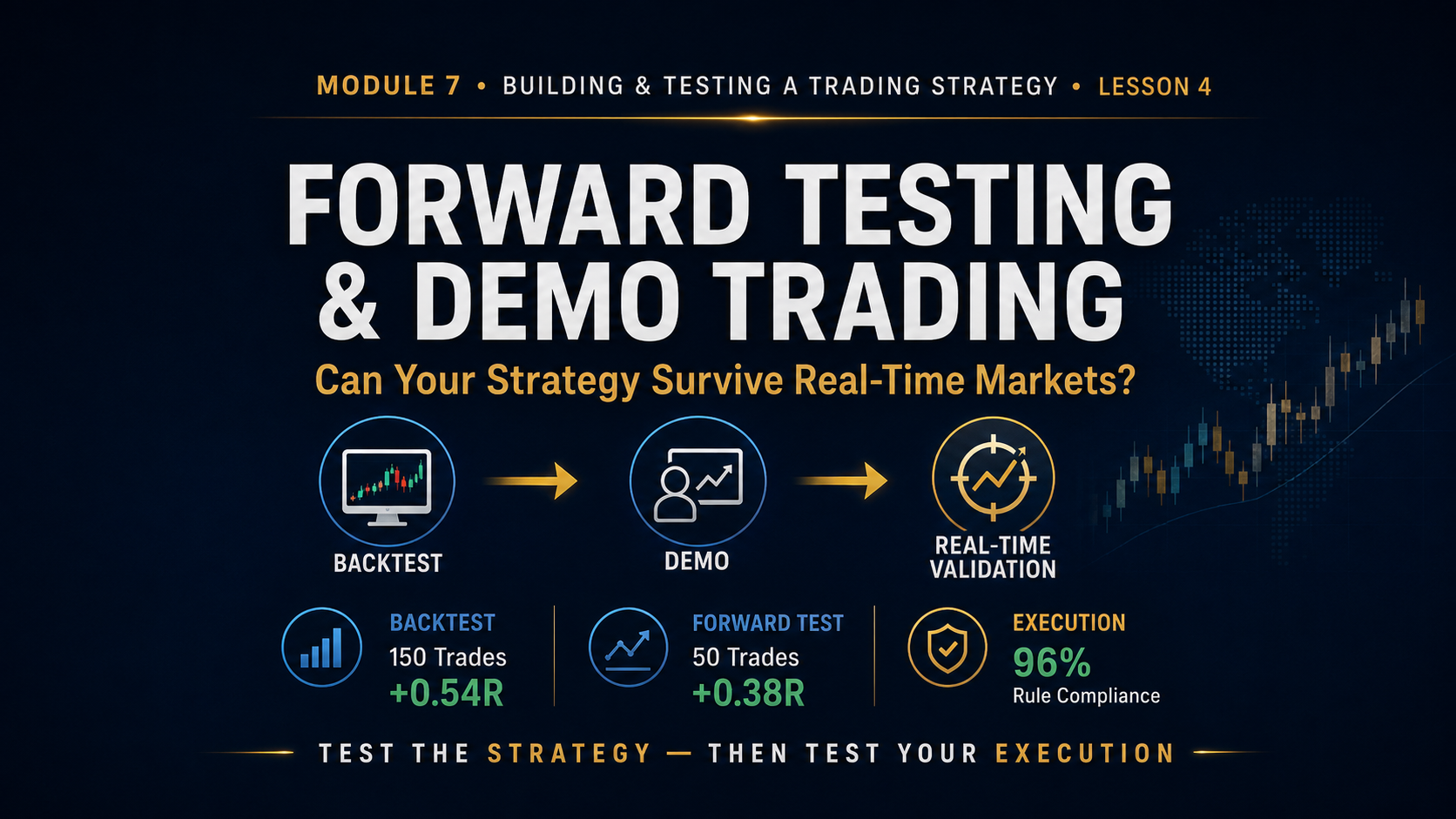
Module 7 · Building & Testing a Complete Trading Strategy · Lesson 4
Forward Testing & Demo Trading: Can Your Strategy Survive Real-Time Markets?
Learn how to test a trading strategy in real time, measure live execution quality, compare results with your backtest and uncover problems that historical charts cannot fully reveal.
Forward Testing
Demo Trading
Execution
Validation
A backtest tells you how a strategy behaved on historical data.
Forward testing asks a different question:
Can you recognize, execute and manage the same strategy correctly when the future is unknown?
Historical charts are useful, but real-time markets introduce waiting, uncertainty, spreads, missed entries, fast candles, changing conditions and emotional pressure.
Forward testing is the bridge between a promising backtest and risking real capital.
Lesson Objectives
What You’ll Learn
✓ What forward testing is
✓ Why demo trading still matters
✓ How live execution differs from backtesting
✓ What to record during forward testing
✓ How to compare live and historical results
✓ When a strategy may be ready for small live risk
What Is Forward Testing?
Forward testing means applying your finalized strategy rules to new market data as it unfolds.
Backtest → New Market Data → Real-Time Decisions → Recorded Results → Validation
The key difference is that the outcome is genuinely unknown when the decision is made.
Backtesting vs. Forward Testing
| Backtesting | Forward Testing |
|---|---|
| Historical market data | New market data |
| Can be accelerated | Must wait for setups |
| Execution may be simulated | Execution occurs in real time |
| Hindsight can contaminate decisions | Future candles are genuinely unknown |
Why Demo Trading Is Useful
Demo trading allows you to practice the complete execution process without putting live capital at risk.
Place actual orders.
Use realistic position sizes.
Practice stop-loss placement.
Practice target placement.
Observe spreads and execution.
Learn whether you can follow the strategy patiently.
Demo Trading Is Not Identical to Live Trading
Demo trading removes much of the emotional pressure associated with real financial loss.
A demo stop loss may feel insignificant.
The same stop with real money may feel very different.
Demo validates execution mechanics — not every aspect of live psychology.
Use the Exact Same Strategy Version
Forward testing should validate the strategy you already tested historically.
Strategy Version: 1.0
Entry Rules: Same
Stop Rules: Same
Target Rules: Same
Risk Rules: Same
If you change the strategy immediately after beginning forward testing, you are no longer validating the original backtest.
Forward Testing Reveals the Reality of Waiting
Historical testing can move quickly.
Real markets force you to wait.
Monday: No setup.
Tuesday: No setup.
Wednesday: Setup almost qualifies.
Thursday: Still nothing.
Patience becomes part of the strategy.
Boredom Can Expose Weak Discipline
No qualifying trade appears.
Trader wants activity.
A B-quality setup is upgraded mentally into an A-setup.
The strategy did not create the trade. Boredom did.
Forward Testing Reveals Missed Trades
Backtesting assumes you were available to see every setup.
Real life may prove otherwise.
Setup forms while you are commuting.
Setup forms during a meeting.
Setup forms while you are asleep.
Setup triggers too quickly to execute manually.
A strategy is only useful if you can realistically execute it.
Real-Time Execution Matters
A perfect historical entry may not be available in real time.
Planned entry: 1.1000
Price moves quickly.
Actual available entry: 1.1006
Entry quality and realized R:R may change.
Observe Real-Time Spread
Spreads are not always constant.
Quiet market → tighter spread
Session transition → spread may widen
High-impact news → spread may expand sharply
Illiquid periods → execution can deteriorate
Slippage Can Change Results
Slippage occurs when the actual fill differs from the expected price.
Expected entry: 1950.00
Actual fill: 1950.40
Small differences can matter when stops and targets are tight.
Test the Actual Order Method
Market Entry
Can execution happen quickly enough?
Limit Order
How often is the order actually filled?
Stop Order
How does fast movement affect the fill?
News Filters Become More Real in Forward Testing
A written news filter may seem simple in historical testing.
Setup appears at 8:22.
High-impact release is scheduled at 8:30.
Trade looks excellent.
Forward testing reveals whether you can actually respect the no-trade rule.
Forward Testing Begins Testing You Too
The strategy is not the only thing being tested.
Can you wait for confirmation?
Can you skip an almost-valid setup?
Can you accept a stop without revenge trading?
Can you avoid changing the target after price starts moving?
Can you stop when your trading window ends?
Separate Strategy Results From Execution Errors
| Trade | Strategy Valid? | Executed Correctly? | Result |
|---|---|---|---|
| 1 | Yes | Yes | +2R |
| 2 | Yes | No — entered late | +0.6R |
| 3 | No | No — FOMO | -1R |
Without this separation, you may blame the strategy for losses that were actually caused by execution.
What to Record During Forward Testing
Date and time
Instrument
Session
Setup type
Entry price
Stop price
Target price
Planned R:R
Actual R result
Spread / execution notes
Screenshot before entry
Screenshot after exit
Rule compliance
Emotional / execution notes
Build a Meaningful Forward-Test Sample
Five live demo trades are rarely enough to validate anything.
5 Trades
Too small for strong conclusions.
20–30 Trades
Useful early execution information.
50+ Trades
More useful for comparing with historical statistics.
Compare Forward Results With the Backtest
| Metric | Backtest | Forward Test |
|---|---|---|
| Win Rate | 48% | 45% |
| Avg Winner | +2.2R | +2.0R |
| Expectancy | +0.54R | +0.35R |
| Max Losing Streak | 7 | 5 |
The numbers do not need to match perfectly. The question is whether forward results remain reasonably consistent with the strategy’s historical profile.
What If Forward Results Are Much Worse?
Do not immediately conclude the strategy is broken.
Is the sample too small?
Are you missing qualifying trades?
Are entries consistently late?
Are spreads larger than modeled?
Are you breaking rules?
Has market behavior materially changed?
Was the original backtest overfit?
Measure the Execution Gap
The execution gap is the difference between what the strategy should have produced and what you actually produced.
Strategy-qualified trades: +12R
Your actual execution: +7R
Execution gap = -5R
That gap may come from missed trades, late entries, early exits, skipped winners or unnecessary trades.
Missed Winners Still Matter
Suppose your strategy has a lower win rate but large winners.
You take 4 losing trades.
Then miss the next valid +4R winner.
Missing one important winner can significantly alter the realized strategy statistics.
Consistency Matters More Than Excitement
Same Market · Same Setup · Same Risk · Same Execution
Forward testing should become boring. That is a good sign.
Do Not Change Rules Because of One Live Loss
Trade loses.
Trader adds a new filter.
Next trade loses.
Trader changes the target.
The strategy becomes impossible to validate.
Document Strategy Changes Properly
Version 1.0: Original backtested rules.
Finding: Live entries consistently suffer from poor fills.
Version 1.1: Entry method modified.
Requirement: New version must be tested separately.
Build a Forward-Testing Routine
Daily Validation Routine
1. Check economic calendar.
2. Prepare approved markets.
3. Mark strategy context.
4. Wait for exact setup.
5. Complete pre-trade checklist.
6. Place demo trade exactly as planned.
7. Record execution details.
8. Screenshot final result.
9. Review whether the strategy or execution produced the outcome.
Review Forward-Test Data Weekly
Number of qualifying setups
Number actually taken
Number missed
Rule violations
Average planned R:R
Average realized R
Spread and slippage notes
Emotional or operational problems
Track Setup Capture Rate
Setup capture rate measures how many valid opportunities you actually executed.
Capture Rate = Trades Taken ÷ Valid Setups × 100
Valid setups = 20
Trades taken = 16
Capture rate = 80%
Measure Rule Compliance
30 total trades
27 fully followed the strategy
Rule Compliance = 90%
The goal should move toward extremely high compliance before meaningful live risk is introduced.
Does the Strategy Fit Your Real Life?
Strategy requires monitoring London open.
Trader is consistently asleep during London.
A historically profitable strategy can still be a poor personal fit.
Time availability, work schedule, concentration, market access and lifestyle all matter.
Does the Strategy Fit Your Psychology?
Strategy Profile
38% win rate, 3R average winner, long losing streaks.
Trader Reaction
Stops taking valid setups after three losses.
A mathematically valid system may still require adjustments in risk or execution style to become realistically tradable.
Treat Demo Trading Seriously
Demo accounts lose value as a training tool when traders treat them like video games.
Random lot sizes
No stop loss
Ten trades at once
Reset account after losses
None of this validates the strategy you plan to trade.
Trade the demo account as if every dollar were real and every rule mattered.
When Might a Strategy Be Ready for Small Live Risk?
There is no universal checklist that guarantees readiness, but several conditions should be present.
✓ Rules are clearly documented.
✓ Historical backtest is complete.
✓ Out-of-sample validation is acceptable.
✓ Forward-test results broadly support the backtest.
✓ Rule compliance is consistently high.
✓ Execution mistakes are uncommon.
✓ Drawdown expectations are understood.
✓ Losing streak expectations are understood.
✓ You can execute the system without constantly changing it.
Small Live Risk Is Another Test — Not Graduation
Moving from demo to live introduces a major new variable: real financial emotion.
Backtest → Demo → Small Live Risk → Review → Scale Slowly
The first live stage should focus on whether execution remains stable when money is actually at risk.
Do Not Scale Because of Three Winning Trades
Live trade 1: Winner
Live trade 2: Winner
Live trade 3: Winner
Trader doubles risk.
A three-trade sample proves almost nothing.
Scale Based on Process Milestones
Minimum number of live trades completed
High rule-compliance percentage
Drawdown remains within expected range
Execution gap remains small
Risk increase follows a predefined plan
Example Strategy Validation Path
Strategy Version 1.0
Backtest: 150 trades
Backtest Expectancy: +0.54R
Forward Test: 50 trades
Forward Expectancy: +0.38R
Rule Compliance: 96%
Execution Issues: Minor
Next Stage: Small live-risk validation
Common Forward-Testing Mistakes
Changing Rules Too Quickly
Every small live difference triggers a new strategy version.
Treating Demo Like a Game
Unrealistic risk makes the test meaningless.
Ignoring Missed Trades
Availability problems are excluded from the evaluation.
Blaming the Strategy for Execution Errors
FOMO entries and early exits distort actual system performance.
Using Too Small a Sample
Five trades are treated as proof that the strategy works or fails.
Ignoring Spread and Slippage
Actual execution costs are not compared with backtest assumptions.
Scaling Too Quickly
A few winning live trades create false confidence.
Complete Forward-Testing Framework
1. Use the finalized backtested strategy version.
2. Trade only approved markets and sessions.
3. Use realistic demo position sizes.
4. Record every valid setup.
5. Record missed setups.
6. Record actual execution prices.
7. Track spread and slippage.
8. Separate strategy results from execution mistakes.
9. Measure setup capture rate.
10. Measure rule compliance.
11. Build a meaningful sample.
12. Compare forward statistics with backtest statistics.
13. Evaluate operational and psychological fit.
14. Document any rule changes as a new version.
15. Move to small live risk only after the process is stable.
Validate in Real Time
Find Out Whether You Can Actually Execute the Strategy You Tested
Financial Markets Academy offers live 1-on-1 mentorship for traders who want help building, backtesting, forward testing and refining complete strategies before exposing significant capital to live market risk.
Forward-Testing Checklist
✓ Am I using the same strategy version I backtested?
✓ Am I using realistic demo risk?
✓ Did I record every valid setup?
✓ Did I record missed trades?
✓ Did I record actual entry and exit prices?
✓ Did I track spread and slippage?
✓ Did I separate execution errors from strategy losses?
✓ What is my setup capture rate?
✓ What is my rule-compliance rate?
✓ Is the sample large enough?
✓ Are forward results reasonably consistent with the backtest?
✓ Does the strategy fit my actual schedule?
✓ Can I follow the strategy without repeatedly changing it?
Frequently Asked Questions
What is forward testing in trading?
Forward testing means applying a finalized trading strategy to new market data in real time and recording the results without knowing what the market will do next.
Is demo trading useful?
Yes. Demo trading is useful for testing execution mechanics, patience, rule-following and real-time strategy recognition without risking live capital.
How many forward-test trades do I need?
There is no universal number, but larger samples such as 30–50 or more trades generally provide more useful information than only a handful of trades.
Should forward-test results exactly match the backtest?
No. Some variation is normal. The question is whether the live sample remains broadly consistent with the historical strategy profile.
What if my demo results are worse than my backtest?
Review sample size, missed trades, execution quality, spreads, slippage, rule violations and whether the historical test may have been overly optimistic.
When should I move from demo to live trading?
Consider small live risk only after the strategy has been clearly defined, historically tested, forward tested and executed with consistently high rule compliance.
Test Yourself
Module 7 · Lesson 4 Knowledge Quiz
1. What makes forward testing different from backtesting?
A. The future market outcome is genuinely unknown
B. Forward testing guarantees profit
C. Forward testing uses no rules
D. It only applies to stocks
2. Why should the strategy rules remain unchanged during validation?
A. So the forward test evaluates the same strategy that was backtested
B. Because strategies can never change
C. Because losses are impossible
D. To increase trade frequency
3. What is setup capture rate?
A. The percentage of valid setups actually executed
B. The maximum drawdown
C. The spread
D. The average stop size
4. Why should execution errors be tracked separately?
A. So you can distinguish strategy performance from trader mistakes
B. So losses can be deleted
C. So win rate always increases
D. So stop losses are unnecessary
5. What should happen before significant live risk is used?
A. Historical testing, forward testing and stable execution
B. Three winning demo trades
C. One profitable week
D. Increasing leverage
Answer Key: 1. A · 2. A · 3. A · 4. A · 5. A
Key Takeaways
✓ Forward testing evaluates a strategy on genuinely unseen market data.
✓ Demo trading helps test real-time execution without live financial risk.
✓ Real-time waiting can reveal boredom and discipline problems.
✓ Missed trades can materially alter realized strategy performance.
✓ Spreads, slippage and actual fills should be recorded.
✓ Strategy losses and execution mistakes should be separated.
✓ Setup capture rate and rule compliance are important performance metrics.
✓ Forward results do not need to perfectly match historical results.
✓ Strategy changes should be documented as new versions.
✓ A strategy must fit your schedule and psychology as well as your statistics.
✓ Demo accounts should be traded realistically.
✓ Moving to live capital should happen gradually and with very small initial risk.
Coming Next
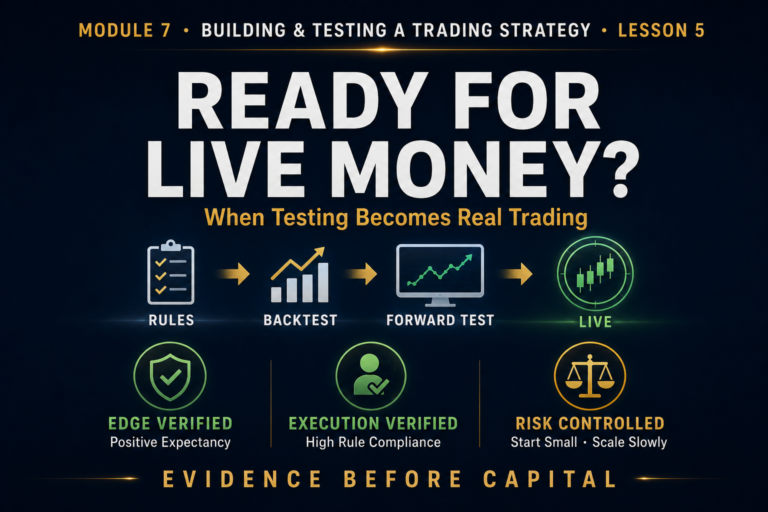
Lesson 5: When Is a Trading Strategy Ready for Live Money?
In the final lesson of Module 7, we bring the entire strategy-development process together. You’ll learn how to create a readiness checklist, set initial live risk, establish scaling rules, monitor performance drift and know when to pause, reduce risk or return to testing.
Learn How to Move From Testing to Live Trading →
Financial Markets Academy provides educational information only. Nothing in this lesson constitutes financial or investment advice or a guarantee of trading performance. Trading leveraged financial markets involves substantial risk and may not be suitable for everyone.