Toronto Trading Education · Course Pricing Guide
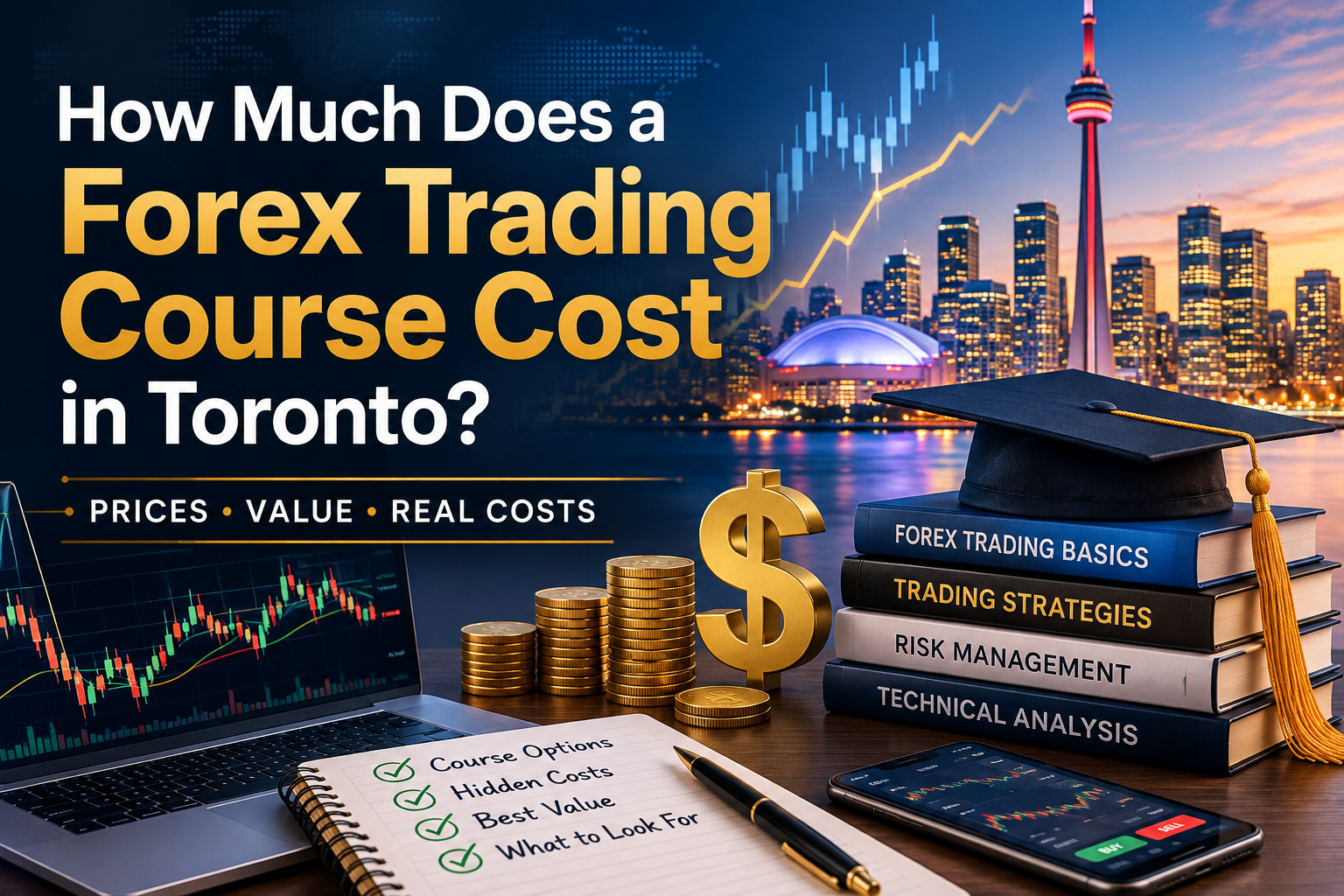
How Much Does a Forex Trading Course Cost in Toronto?
Compare the typical costs of free Forex education, recorded courses, group classes, live online programs and private one-on-one trading mentorship in Toronto.
Forex Course Cost Toronto
Trading Course Prices
Private Mentorship
Toronto
The cost of a Forex trading course in Toronto can vary dramatically.
At one end of the market, you can find completely free educational material. At the other end, private trading mentorship can cost several thousand dollars because the instructor is dedicating significant time directly to one student.
That means simply asking, “How much does a Forex course cost?” does not tell the whole story.
The real question is: what exactly are you getting for the money?
This guide explains the major pricing categories and what Toronto students should compare before deciding whether a course represents good value.
Toronto Forex Education Series
Before comparing prices, you may also want to read:
The Short Answer: Forex Course Prices Vary Widely
Depending on the learning format, Forex education can range from free to several thousand dollars.
| Training Type |
Typical Cost Level |
Personalization |
| Free Educational Content |
Free |
Very Low |
| Recorded Online Courses |
Low to Moderate |
Low |
| Live Group Courses |
Moderate to High |
Moderate |
| Private One-on-One Mentorship |
Higher |
Very High |
Two programs can have completely different prices while both being reasonable — because they may be selling completely different levels of instructor access.
1. Free Forex Trading Education
Free trading education is usually the best place for a complete beginner to start.
There is no reason to spend thousands of dollars simply to learn what a pip, candlestick, currency pair or stop loss is.
Free Education Is Useful For:
✓ Trading terminology
✓ Currency-pair basics
✓ Candlestick basics
✓ Basic technical analysis
✓ Risk-management foundations
✓ Determining whether trading actually interests you
Academy of Financial Markets provides a free online educational academy covering foundational and intermediate trading topics.
Explore the Free Trading Academy →
2. Recorded Online Forex Courses
Recorded online programs are one of the most common forms of Forex education.
Students normally receive access to a library of videos covering topics in a predefined sequence.
Advantages
Lower cost
Learn at your own pace
Replay lessons
Convenient scheduling
Limitations
Limited personal feedback
No immediate questions
Little accountability
Curriculum may be generic
Recorded courses may represent strong value when the objective is to build foundational knowledge rather than receive personal coaching.
3. Live Group Forex Courses
Live group courses usually cost more because an instructor is actively teaching rather than simply providing access to recorded content.
Live Questions: Students may be able to ask the instructor questions during class.
Market Examples: Current charts can be reviewed rather than relying only on historical screenshots.
Class Interaction: Students may learn from questions raised by others.
Accountability: Scheduled classes create more structure than fully self-paced training.
Class size is one of the biggest factors affecting value.
A “live course” with 100 students does not provide the same learning experience as a live class with 5 students.
4. Private One-on-One Forex Mentorship
Private mentorship normally represents the highest-cost form of trading education because the instructor’s time is dedicated directly to one student.
Instead of teaching a generic curriculum at the same pace for everyone, the mentor can spend more time on the areas where the student actually needs help.
Private Mentorship May Include:
✓ One-on-one chart review
✓ Personalized curriculum
✓ Review of your existing strategy
✓ Risk-management correction
✓ Trade-plan development
✓ Psychology and execution review
✓ Direct questions and feedback
Private education costs more because you’re paying for the instructor’s attention — not simply access to information.
Why Do Forex Trading Course Prices Vary So Much?
Several factors influence pricing.
Instructor Time
One-on-one time costs more than prerecorded education.
Course Length
A two-hour workshop and a multi-week mentorship are different products.
Personalization
Customizing training requires more instructor involvement.
Class Size
Smaller classes generally provide greater access.
Course Materials
Worksheets, templates, exercises and support may increase value.
Post-Course Support
Continued access or follow-up may affect the program price.
Compare the Cost Per Hour of Actual Instruction
One useful comparison is the amount of actual instructor time you receive.
Simple Course Comparison
Total Course Price ÷ Live Instructor Hours
= One useful way to compare training value
This calculation is not perfect because recorded material, resources and support also have value.
But it can reveal a major difference between a program offering dozens of prerecorded videos and one providing substantial individual instructor time.
Example: Two Courses With Very Different Value
Course A
Lower purchase price
30+ hours prerecorded
No live instructor
Generic curriculum
No trade review
Course B
Higher purchase price
Live instruction
Personal feedback
Customized areas of focus
Trade review and planning
Neither option is automatically better. The value depends on whether the student needs information or individualized guidance.
Complimentary Consultation
Before You Pay for a Trading Course, Talk to Us First
Book a free 15-minute strategy call with Academy of Financial Markets.
Tell us where you are in your trading journey, what you already know and what you are trying to improve. We can discuss whether free education, self-study or private mentorship makes the most sense for you.
Is a Cheap Forex Course a Bad Course?
Not necessarily.
A lower-priced course can provide excellent value if the objective is simply to teach foundational concepts efficiently.
Expensive does not automatically mean good, and inexpensive does not automatically mean bad.
The mistake is assuming price itself proves quality.
When Can a More Expensive Course Make Sense?
Paying more can make sense when the additional price is purchasing something you genuinely need.
✓ Direct instructor access
✓ Private one-on-one instruction
✓ Personalized strategy review
✓ Individual trade review
✓ Custom trading-plan development
✓ Accountability
✓ Continued support
If those features are not important to you, paying a premium may not make sense.
What You Should Not Be Paying a Premium For
Guaranteed Profits
No legitimate course can guarantee your future trading results.
Secret Indicators
There is no magic tool that permanently removes market uncertainty.
Lifestyle Marketing
Expensive cars and vacations do not improve the educational curriculum.
Signal Dependency
Paying someone indefinitely to tell you when to buy and sell is different from learning how to make decisions yourself.
Ask About Additional Costs Before Enrolling
The advertised course price may not always represent the complete cost.
Are there software fees?
Are data subscriptions required?
Are additional modules sold separately?
Is ongoing support an additional subscription?
Are private sessions extra?
Are course materials included?
Are there renewal or membership fees?
Compare the total expected cost — not simply the advertised entry price.
Your Time Has a Cost Too
Course price is only one part of the equation.
A disorganized course may cost less financially but require much more time to figure out what is actually important.
Financial cost: What do I pay?
Time cost: How many hours will this require?
Opportunity cost: What else could I be doing with that time?
Learning efficiency: Is this course helping me focus on what actually matters?
How Much Should a Beginner Spend?
Beginners should generally avoid assuming that spending more money will automatically accelerate their progress.
A better approach is to move through education in stages.
Beginner Education Path
Step 1: Learn basic market terminology through quality free education.
Step 2: Practice chart reading and risk calculations.
Free Academy Access
Unlock the rest of this lesson free
Sign in to continue, or create a 100% free Academy account and unlock the full member experience.
ALREADY A MEMBER?
Sign In & Continue
Access the rest of this lesson instantly.
Forgot password?

 6 min
6 min
 5 min
5 min
 11 min