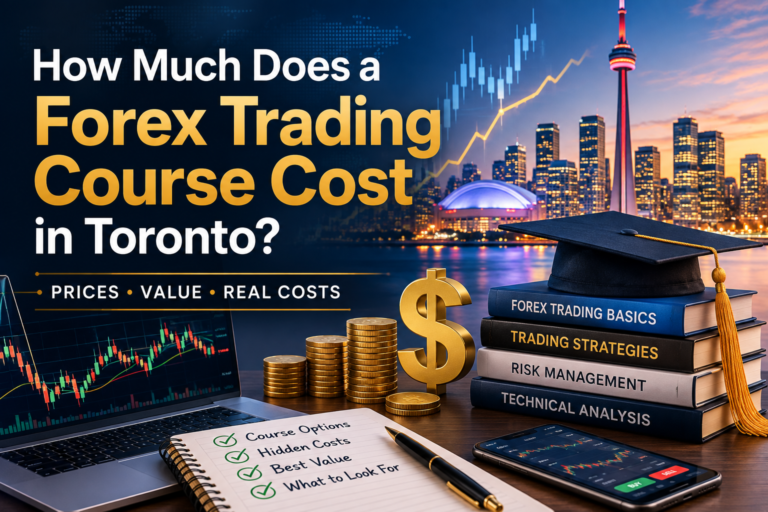

Toronto Trading Education · 2026 Guide
Forex Trading Courses in Toronto: A 2026 Guide
Compare online courses, group classes, in-person training and private mentorship while learning what quality Forex education should actually include before choosing a trading course in Toronto.
Toronto Forex Course
Trading Education
Private Mentorship
Downtown Toronto
Finding a Forex trading course in Toronto is easy. Finding one that genuinely teaches you how to understand financial markets, control risk and make independent trading decisions is much harder.
Toronto traders now have more educational choices than ever: prerecorded online courses, live Zoom programs, group classes, seminars, private trading mentors and free educational resources covering Forex, stocks, futures and other financial markets.
The challenge is figuring out which type of training actually fits your experience, goals, learning style and budget.
A good Forex course should teach you how to make better trading decisions — not simply give you more indicators to put on a chart.
This guide explains what to look for when comparing Forex trading courses in Toronto in 2026, what different programs typically offer and which questions you should ask before enrolling.
2026 Toronto Forex Course Guide
What This Guide Covers
✓ Types of Forex courses in Toronto
✓ Online vs in-person training
✓ What a quality curriculum should teach
✓ Typical course costs
✓ Questions to ask before enrolling
✓ Trading-course red flags
What Is a Forex Trading Course?
A Forex trading course teaches students how currencies are bought and sold in the foreign exchange market and how traders analyze potential opportunities while managing financial risk.
Beginner courses generally start with the mechanics of trading.
Currency Pairs: Understanding majors, minors and crosses.
Pips & Spreads: Understanding price movement and transaction costs.
Lot Sizes: Understanding trade size and exposure.
Leverage & Margin: Understanding how leveraged trading affects risk.
Stop Loss & Take Profit: Defining risk and potential exits.
Trading Platforms: Learning how to enter, modify and manage positions.
More advanced programs may include market structure, technical analysis, fundamental analysis, position sizing, trading psychology and trading-plan development.
The objective should eventually be to understand why you are entering a trade, where the idea becomes invalid, how much you are risking and how the trade fits into a repeatable process.
Types of Forex Trading Courses Available in Toronto
There is no single learning format that works best for every student.
Self-Paced Online Courses
Usually prerecorded lessons that students complete on their own schedule.
These can be useful for learning terminology and foundational concepts at a relatively low cost.
Live Online Training
Live training through Zoom or another meeting platform allows students to ask questions and share charts with an instructor.
The amount of individual interaction depends heavily on class size.
Group Trading Classes
Group programs can provide community, discussion and exposure to questions raised by other traders.
The trade-off is that the instructor must teach at a pace appropriate for the group.
Private One-on-One Mentorship
Private training provides the greatest opportunity to personalize the curriculum around the individual trader.
Sessions can focus directly on the student’s weaknesses, strategy, trade review, risk management and trading plan.
Start Learning Free
Explore the Academy of Financial Markets Online Academy
Before investing in private training, you can explore our free educational academy covering trading foundations, market structure, technical analysis, risk management, trading psychology and related financial-market topics.
Explore Free Trading Education →
What Should a Good Toronto Forex Course Teach?
A serious trading curriculum should connect multiple areas of market education rather than simply teaching individual indicators.
Market Structure
Before deciding whether to buy or sell, traders need to understand what price is actually doing.
✓ Trends
✓ Ranges
✓ Higher highs
✓ Higher lows
✓ Lower highs
✓ Lower lows
✓ Breakouts
✓ Failed breakouts
✓ Consolidation
✓ Important price zones
An entry signal viewed without broader market context can be misleading.
Risk Management
Risk management should be taught before students become heavily focused on how much money a trade might make.
Position Sizing
Match trade size to account risk.
Stop Placement
Define where the trade thesis becomes invalid.
Drawdown Control
Protect the account during losing periods.
Risk-to-Reward
Compare potential downside to potential upside.
A trader can have a strategy with a positive edge and still destroy an account through excessive leverage and poor position sizing.
You can also read our guide on
building trading discipline and following a trading plan consistently
.
Technical Analysis
Technical analysis helps traders interpret price behaviour and identify potential areas of interest.
Price Action: Candlesticks and how price reacts around important areas.
Support & Resistance: Areas where buying or selling pressure may emerge.
Moving Averages: Tools for evaluating trend and average price.
Momentum: Evaluating the strength and speed of price movement.
RSI & Stochastic: Momentum tools that may help provide market context.
Multiple Timeframes: Comparing shorter-term opportunities with broader market structure.
Indicators should support a structured trading framework rather than become a collection of unrelated buy and sell signals.
Fundamental Analysis
Forex markets are affected by global economics, monetary policy and expectations about future growth and interest rates.
✓ Interest rates
✓ Inflation
✓ Employment reports
✓ GDP
✓ Central banks
✓ Monetary policy
✓ Bond yields
✓ Commodity prices
✓ Government policy
✓ Geopolitical events
Canadian traders may find it particularly useful to understand the Canadian dollar, Bank of Canada policy, the U.S. economy and Canada’s relationship with major commodity markets.
Trading Psychology
A strategy is only useful when the trader can execute it with discipline.
Revenge Trading
Increasing activity or risk after a frustrating loss.
Fear of Missing Out
Entering because price is moving rather than because a valid setup exists.
Moving Stop Losses
Changing predefined risk because the trader does not want to accept a loss.
Overtrading
Taking marginal setups because the trader feels compelled to remain active.
How Much Do Forex Trading Courses Cost in Toronto?
Forex education ranges from completely free resources to several thousand dollars for personalized instruction.
| Training Format | General Cost Range | Personalization |
|---|---|---|
| Free Education | $0 | Low |
| Recorded Online Course | Often $100–$1,000+ | Low |
| Live Group Training | Can range from hundreds to thousands | Medium |
| Private Mentorship | Usually higher | High |
Price matters, but price alone tells you very little about the quality or value of the training.
Online vs In-Person Forex Training in Toronto
Both formats can work.
Online Training
Learn from home or while travelling.
Screen sharing makes chart analysis practical.
No commute required.
Available to students throughout Canada.
In-Person Training
Face-to-face interaction with the instructor.
Review charts side-by-side.
Useful for students who prefer classroom accountability.
Convenient for students living or working near downtown Toronto.
The best format is the one that makes you most likely to practice, ask questions and remain accountable.
Questions to Ask Before Enrolling
Who actually teaches the course?
Determine whether the instructor being advertised is the person who will actually teach you.
Is the training live or prerecorded?
Neither is automatically good or bad, but you should know exactly what you are purchasing.
How many students are in each class?
A live course with 100 students provides a very different experience from private or small-group training.
Can I ask questions about my own trades?
Personal trade review can become increasingly valuable as your knowledge develops.
Does the curriculum teach risk management?
If almost all of the marketing focuses on profits and very little discusses losses, drawdown and position sizing, investigate further.
Will I build a written trading plan?
Trading education should eventually help you develop a repeatable decision-making framework.
Complimentary Consultation
Book a Free 15-Minute Trading Strategy Call
Not sure which type of trading education is right for you?
Schedule a complimentary 15-minute call with Academy of Financial Markets to discuss your current experience, what you are trying to improve, your trading goals and whether private mentorship may be appropriate for you.
Book Your Free 15-Minute Call →
No obligation · Choose your available time online
Forex Course Red Flags to Watch For
Trading education is an area where healthy skepticism is valuable.
Guaranteed Profits
Financial markets involve uncertainty. No legitimate educator can guarantee how much money a student will make.
Unrealistic Lifestyle Marketing
Luxury cars and exotic vacations do not demonstrate curriculum quality.
Large Profit Claims With Little Risk Discussion
Returns mean very little without understanding the capital and risk involved.
Pressure to Use a Specific Broker
Understand why a broker is being recommended and whether compensation is involved.
“Secret Strategy” Claims
There is no indicator or setup that permanently removes uncertainty from financial markets.
No Discussion of Losing Trades
Losses are part of trading. Education should explain how to manage them.
How Long Does It Take to Learn Forex Trading?
There is no universal timeline.
Learning what a currency pair, pip or candlestick is may happen relatively quickly. Developing disciplined decision-making generally takes much longer.
Previous financial-market experience
Amount of deliberate practice
Quality of instruction
Risk discipline
Emotional control
Strategy complexity
Time available for study
Ability to review mistakes objectively
A course should therefore be treated as part of a longer learning process rather than a promise that someone will become profitable after a predetermined number of hours.
Should Beginners Take a Forex Course?
Structured education may be particularly useful for beginners because early habits can shape how someone approaches trading later.
Traders learning entirely through random social-media content can easily develop habits that are difficult to correct.
✕ Using excessive leverage
✕ Copying random trade signals
✕ Switching strategies constantly
✕ Trading without a stop loss
✕ Entering trades without a plan
✕ Chasing losses after a losing trade
Beginners should focus first on market mechanics, capital preservation and process. Profit comes later.
Learning Forex Trading in Downtown Toronto
Toronto has a significant advantage for people interested in financial markets: it is Canada’s largest financial centre.
The city is home to major banks, investment dealers, asset managers, pension funds, wealth-management companies, fintech businesses and other financial institutions.
Academy of Financial Markets
Location: 192 Spadina Avenue, Toronto, Ontario
Format: Private one-on-one instruction
Online Option: Live Zoom instruction
Focus: Forex, stocks, market analysis, risk management and trading-plan development
Forex Education vs Professional Financial Careers
There is an important distinction between learning to trade your own capital and working professionally for a Canadian financial institution.
Retail Trading Education
Focuses on analyzing markets, managing personal risk and developing an individual trading process.
Institutional Financial Careers
May involve formal education, regulatory requirements, professional credentials and experience depending on the specific role.
Our growing financial education library will also cover:
✓ CIRO examinations
✓ Wealth management careers
✓ Institutional trading
✓ Portfolio management
✓ Investment research
✓ Canadian financial regulation
Is Forex Trading Right for Everyone?
No.
Trading involves financial risk and requires patience, discipline and a willingness to continue learning.
Some people enjoy analyzing markets and actively managing positions. Others discover that they are better suited to long-term investing.
Some students may also discover that their interest in markets leads them toward a professional career in wealth management, portfolio management, investment analysis or institutional finance rather than active retail trading.
Choosing the Right Forex Trading Course in Toronto
The right course depends on where you are starting and what you actually need.
Complete Beginner:
Start with market fundamentals, terminology and risk management.
Self-Directed Learner:
A structured online academy may provide a strong foundation.
Trader Struggling With Execution:
Individual feedback may be more valuable than additional generic lessons.
Student Who Learns Through Discussion:
Live or in-person instruction may be more suitable.
Your Trading Process
What am I trading?
Why am I entering?
Where am I wrong?
How much am I risking?
How will I manage the position?
When should I stay out of the market?
If your trading education cannot eventually help you answer these questions consistently, your learning process probably is not finished.
Key Takeaways
✓ Toronto traders can choose from self-paced, live online, group and private training.
✓ A quality Forex course should teach risk management, not just entries.
✓ Market structure should provide context for technical signals.
✓ Fundamental analysis matters because currencies respond to economics and monetary policy.
✓ Trading psychology is part of execution.
✓ Price alone should not determine which course you choose.
✓ Online and in-person training can both be effective.
✓ Avoid programs that promise guaranteed returns.
✓ Beginners should prioritize capital preservation and process.
✓ The objective of education should be greater independence as a trader.
Frequently Asked Questions
What is the best Forex trading course in Toronto?
There is no single course that is best for every student. Compare the curriculum, instructor experience, learning format, class size, risk education, support and amount of individual instruction offered.
Can I learn Forex trading in person in Toronto?
Yes. Some educators provide classroom or private in-person instruction. Academy of Financial Markets provides private training in downtown Toronto by appointment as well as live online training.
Can beginners take a Forex trading course?
Yes. Beginners should focus first on market fundamentals, position sizing, risk management and development of a structured trading process.
How much does Forex training cost in Toronto?
Costs range from free educational resources to several thousand dollars for intensive or private training. Compare actual instructor access and hours of training rather than price alone.
How long does it take to learn Forex trading?
Basic concepts can be learned relatively quickly, but developing disciplined trading skills normally requires continued study, practice and review. There is no guaranteed timeframe for profitability.
Is online Forex training as good as in-person training?
It can be. Live screen sharing provides many of the benefits of classroom education. Some students prefer face-to-face interaction while others prefer the convenience of online training.
Do Forex courses guarantee profits?
They should not. Trading involves risk and no educational program can guarantee future trading performance.
Where can I take private Forex lessons in downtown Toronto?
Academy of Financial Markets provides private one-on-one trading mentorship from its downtown Toronto location at 192 Spadina Avenue, with sessions available by appointment.
Private Trading Mentorship Toronto
Ready to Take Your Trading Education Further?
Academy of Financial Markets provides live private one-on-one Forex and stock trading mentorship in downtown Toronto and online. Training is tailored around your current experience, objectives and areas that need improvement.
Book a Free 15-Minute Call →
View Private Mentorship
Academy of Financial Markets provides educational information only. Nothing in this article constitutes financial or investment advice, a recommendation to trade any financial instrument or a guarantee of future trading performance. Trading leveraged financial markets involves substantial risk and may not be suitable for everyone. Always consider your financial circumstances, experience and risk tolerance before trading.