What Time Does the Forex Market Open in Toronto? 2026 Trading Hours Guide
16 min lessonSep 2, 2026
Toronto Trading Education
What Time Does the Forex Market Open in Toronto? 2026 Trading Hours Guide
The forex market trades almost continuously from Sunday evening through Friday evening, but not every hour offers the same liquidity, volatility or opportunity. Here is how the global forex trading day translates into Toronto time.
One of the first questions new traders ask is simple:
What time does the forex market open in Toronto?
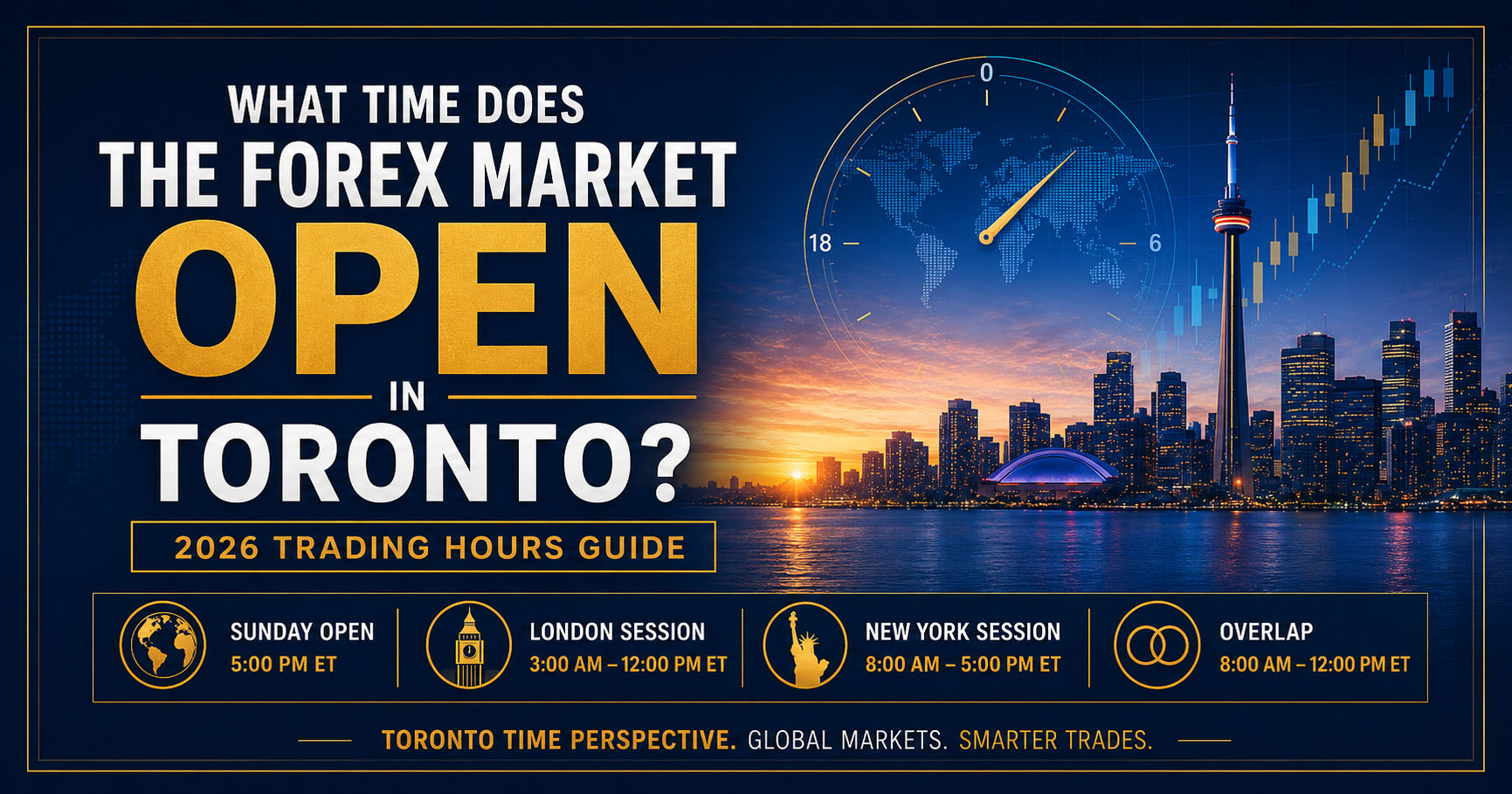
For most retail traders using Eastern Time, forex trading begins at approximately 5:00 p.m. ET on Sunday and continues around the clock until approximately 5:00 p.m. ET on Friday.
That does not mean the market behaves the same way for 24 straight hours.
Forex activity moves around the world as major financial centres begin and finish their business days. Sydney becomes active, then Tokyo, followed by London and finally New York.
For someone learning forex trading in Toronto, understanding these sessions is important because the time of day can affect liquidity, spreads, volatility and which currency pairs are most active.
This guide explains the forex market schedule from a Toronto perspective and shows why many local traders pay particular attention to the London and New York sessions.
Forex Market Hours in Toronto: Quick Answer
The global retail forex trading week generally runs:
Weekly Forex Open: Sunday at approximately 5:00 p.m. Toronto time
Weekly Forex Close: Friday at approximately 5:00 p.m. Toronto time
Between those times, currencies can normally be traded throughout the day and night.
However, individual brokers may have slightly different schedules, maintenance windows or holiday hours. Traders should always check the exact hours published by their broker or trading platform.
Why Does Forex Trade 24 Hours a Day?
Forex is different from a stock exchange.
The Toronto Stock Exchange has a defined local trading session because securities are being traded through an exchange with set opening and closing hours.
The foreign exchange market is largely an over-the-counter global market.
Trading takes place through a network of banks, financial institutions, dealers, corporations and other market participants around the world.
When one financial centre approaches the end of its business day, another is opening.
A simplified progression looks like this:
Sydney → Tokyo → London → New York → Sydney
This handoff allows forex activity to continue almost uninterrupted throughout the business week.
The weekend is the major exception. Retail forex trading generally closes late Friday afternoon Toronto time and resumes Sunday evening.
The Four Major Forex Trading Sessions
Forex traders commonly divide the trading day into four broad sessions:
Sydney
Tokyo / Asian session
London / European session
New York / North American session
These labels are useful because currency behaviour often changes as different regions become active.
A pair involving the Japanese yen may receive greater attention during Asian hours, while pairs involving the euro and British pound often become more active as European institutions enter the market.
Once New York opens, U.S. and Canadian economic data, North American institutions and U.S. dollar flows become increasingly important.
Forex Session Times in Toronto
The following table gives a practical beginner reference in Eastern Time. Exact session boundaries can shift by approximately one hour during periods when North America, Europe or Australia change daylight-saving time on different dates.
Forex Session
Approx. Toronto Time
Typical Focus
Toronto Perspective
Sydney
Around 5:00 p.m.–2:00 a.m.
AUD, NZD, early weekly positioning
Evening and overnight
Tokyo / Asia
Around 7:00 p.m.–4:00 a.m.
JPY, AUD, NZD, Asian markets
Mostly overnight
London
Around 3:00 a.m.–12:00 p.m.
EUR, GBP, USD crosses
Early morning through lunch
New York
Around 8:00 a.m.–5:00 p.m.
USD, CAD and North American flows
Normal Toronto daytime
These times should be viewed as practical reference windows rather than a promise that volatility will begin or end at a precise minute.
What Time Does the Forex Market Open on Sunday in Toronto?
For most retail traders, the forex trading week begins at approximately 5:00 p.m. Eastern Time on Sunday.
This is why a Toronto trader may see their forex platform begin updating prices Sunday evening even though Canadian banks and stock exchanges are closed.
The opening portion of the week can behave differently from a normal weekday session.
Liquidity can initially be thinner, especially when only the earliest Asia-Pacific markets are active.
If significant news occurred while the market was closed over the weekend, a currency pair can reopen at a noticeably different price from Friday’s close.
This creates what traders commonly call a weekend gap.
Beginner lesson: The fact that your platform is open Sunday evening does not mean you need to trade immediately. Market availability and trade quality are two different things.
What Time Does the Forex Market Close on Friday in Toronto?
The retail forex week generally ends at approximately 5:00 p.m. Eastern Time on Friday.
Liquidity can change as the trading week winds down.
This matters if you are considering holding a position through the weekend because there may be no opportunity to exit while the forex market is closed.
If major political, economic or geopolitical news occurs between Friday’s close and Sunday’s reopen, the market can resume at a different price.
A stop-loss order also cannot guarantee execution at the exact stop price if the market reopens beyond that level.
That is one reason weekend exposure should be a deliberate part of the trading plan rather than something that happens accidentally.
What Time Is the London Forex Session in Toronto?
The London session generally becomes active around 3:00 a.m. Toronto time, although daylight-saving differences can temporarily shift the relationship by an hour.
London is extremely important to the global foreign exchange market.
For Toronto traders, there are two practical ways to interact with London activity:
Trade the early London session before the normal North American workday begins.
Focus on the later portion of London when New York is also active.
The second option is naturally more convenient for many Toronto-based traders because it occurs during the morning.
Why does London matter?
European banks and institutions are active, and currencies such as the euro and British pound can receive substantial participation.
Commonly watched pairs include:
EUR/USD
GBP/USD
EUR/GBP
GBP/JPY
EUR/JPY
However, session timing alone should never be treated as an entry signal.
A trader still needs market structure, a defined setup and predetermined risk.
What Time Is the New York Forex Session in Toronto?
The New York forex session generally becomes active around 8:00 a.m. Eastern Time.
For Toronto traders, this is particularly convenient because Toronto and New York share the same Eastern Time framework.
There is no conversion required.
When it is 8:30 a.m. in Toronto, it is also 8:30 a.m. in New York.
This period can be especially important because many high-impact Canadian and U.S. economic announcements are released during the North American morning.
These can include:
inflation reports
employment reports
GDP data
retail sales
central-bank decisions
manufacturing and services data
This is particularly relevant to USD/CAD because the pair represents the relationship between the U.S. and Canadian currencies.
The London-New York Overlap
The most discussed forex session overlap for Toronto traders occurs when London is still active and New York has already opened.
As a practical Toronto reference, this is often roughly:
London + New York
8:00 a.m. – 12:00 p.m. ET
Approximate Toronto morning overlap
Two major financial centres are participating simultaneously during this window.
That can mean:
greater liquidity
more institutional participation
increased volatility
tighter spreads in heavily traded pairs under normal conditions
faster reactions to economic news
But there is an important distinction:
More movement does not automatically mean easier trading.
A volatile market can travel quickly in either direction. Beginners who chase candles or trade without defined stops can lose money just as quickly as the market moves.
What Is the Best Time to Trade Forex in Toronto?
There is no single best forex trading time for every trader.
The right session depends on:
the currency pair
the trading strategy
the trader’s schedule
the expected holding period
economic releases
the amount of volatility the strategy requires
That said, the Toronto morning is a logical period for many traders to study.
A trader who works with EUR/USD, GBP/USD or USD/CAD may find that approximately 8:00 a.m. through noon Eastern Time provides substantial market participation because London and New York are both active during much of that period.
This does not mean a trader should automatically enter trades between 8:00 and noon.
It simply means the environment may have sufficient activity for strategies that depend on liquidity and movement.
Our next Toronto Trading article will examine this subject separately:
Best Time to Trade Forex in Toronto: London vs New York Session.
Which Currency Pairs Are Active During Each Session?
Different currencies naturally receive more attention when their home financial regions are open.
Session
Pairs Often Watched
Reason
Sydney
AUD/USD, NZD/USD, AUD/NZD
Australia and New Zealand entering the business day
Tokyo
USD/JPY, AUD/JPY, EUR/JPY
Japanese and broader Asian participation
London
EUR/USD, GBP/USD, EUR/GBP
European financial activity
New York
EUR/USD, GBP/USD, USD/CAD, USD/JPY
U.S. and Canadian participation and economic releases
These are tendencies, not trading rules.
EUR/USD does not stop trading when London closes, and USD/JPY does not stop moving when Tokyo closes.
The objective is simply to understand where participation is likely to be concentrated.
Economic News and Toronto Forex Trading Hours
Market hours become much more useful when combined with an economic calendar.
A trader might see a technically attractive USD/CAD setup at 8:25 a.m., for example, without realizing that major Canadian or U.S. economic data is scheduled five minutes later.
That can completely change the trading environment.
Economic releases can cause:
sudden volatility
rapid spread changes
slippage
false breaks of technical levels
sharp moves followed by reversals
For this reason, our educational framework emphasizes knowing the day’s scheduled events before executing a technical setup.
New traders should develop the habit of asking:
What important economic events are scheduled before, during and immediately after the time I plan to trade?
How Daylight Saving Time Affects Forex Hours in Toronto
Toronto changes between Eastern Standard Time and Eastern Daylight Time.
New York follows the same North American change, so the relationship between Toronto and New York remains straightforward.
The complication comes from other countries changing their clocks on different dates.
The United Kingdom, United States, Canada and Australia do not always enter or leave daylight saving time during the same week.
That can temporarily shift the apparent Toronto-time opening of London or Sydney by approximately one hour.
This is why traders should not blindly memorize one permanent set of global session times.
Check the current session schedule and your broker’s clock, especially around March, October and November.
Sample Forex Trading Schedules for Toronto Beginners
Free Academy Access
Unlock the rest of this lesson free
Sign in to continue, or create a 100% free Academy account and unlock the full member experience.
When you are ready, take the 30-question Financial Markets Assessment. Score 70% or higher to instantly earn your verified Certificate of Completion. You can retake it free as many times as needed.

 16 min
 14 min