
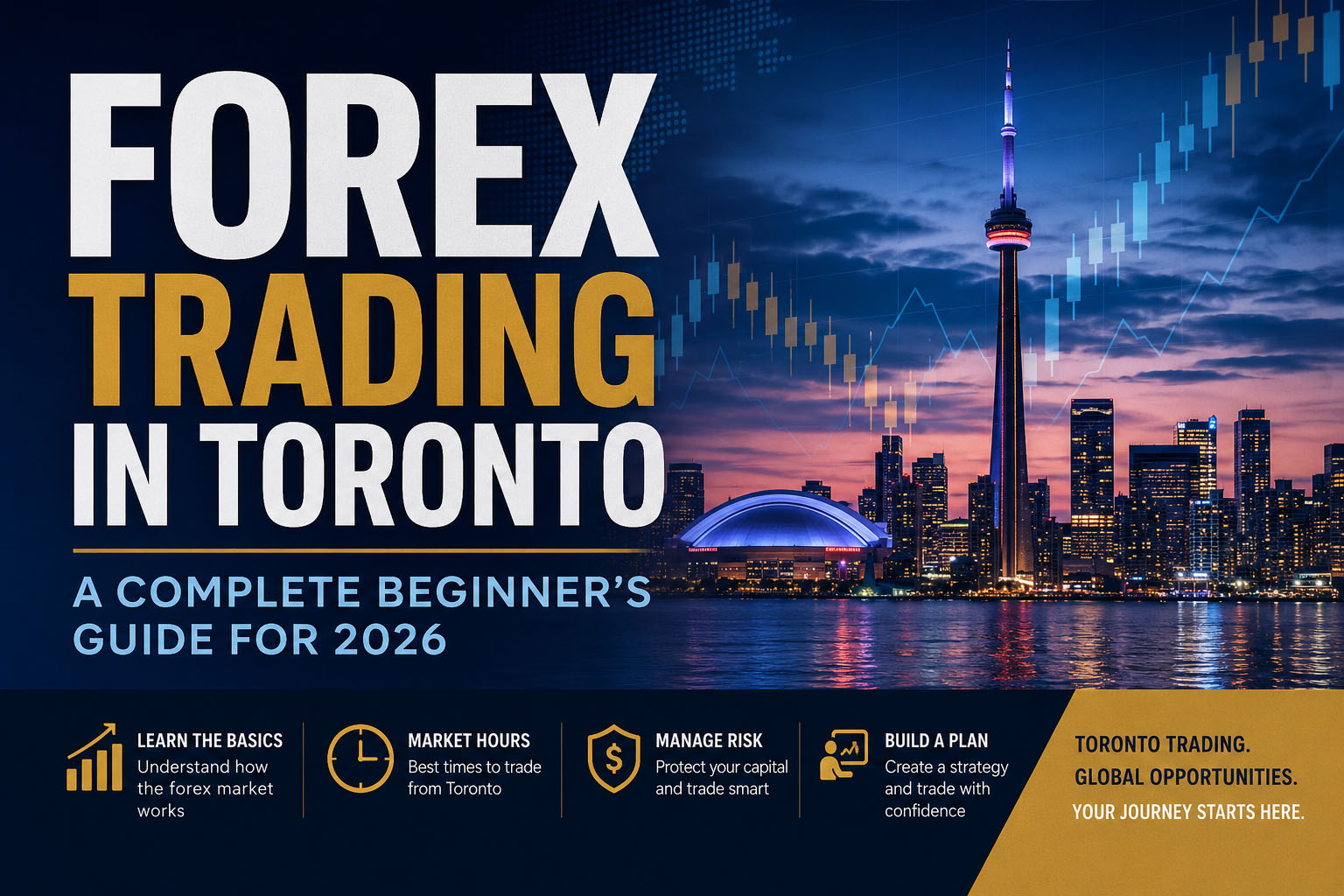
Forex Trading in Toronto: A Complete Beginner’s Guide for 2026
Learn how the foreign exchange market works, when Toronto traders can access the most active sessions, how USD/CAD fits into the Canadian trading landscape, what beginners should understand about risk and regulation, and how to build a structured path from learning the basics to developing a complete trading plan.
If you are searching for forex trading in Toronto, the first thing to understand is that learning to trade currencies is not simply a matter of downloading a platform, watching a few chart videos and placing trades.
Forex is one of the largest and most actively traded financial markets in the world. Banks, corporations, investment firms, hedge funds, asset managers, governments and individual traders all participate for different reasons. The Bank for International Settlements reported that global over-the-counter foreign exchange turnover averaged approximately US$9.6 trillion per day in April 2025.
That scale creates tremendous liquidity, but it does not make trading easy.
For beginners in Toronto, a better starting point is understanding how the market operates, what actually moves currencies, how risk is controlled and how a trading strategy is developed and tested before meaningful capital is placed at risk.
This guide provides a practical roadmap.
What Is Forex Trading?
Forex, short for foreign exchange, is the market in which one currency is exchanged for another.
Currencies therefore trade in pairs.
Common examples include:
- EUR/USD — euro versus U.S. dollar
- GBP/USD — British pound versus U.S. dollar
- USD/JPY — U.S. dollar versus Japanese yen
- USD/CAD — U.S. dollar versus Canadian dollar
- AUD/USD — Australian dollar versus U.S. dollar
If EUR/USD rises, the euro is strengthening relative to the U.S. dollar. If USD/CAD falls, the U.S. dollar is weakening relative to the Canadian dollar, all else being equal.
Unlike stocks listed on a single exchange, much of the global foreign exchange market operates over the counter through a decentralized network of banks, dealers, institutions and electronic trading venues.
Why Toronto Is a Practical Location for Forex Traders
Toronto has one geographical advantage that beginners sometimes overlook: its time zone.
Toronto operates on Eastern Time, placing local traders directly inside the North American trading day.
That means traders do not necessarily have to stay awake overnight to participate during periods when North American institutions, major economic releases and U.S. markets are active.
Toronto traders can follow Canadian and U.S. developments during normal morning hours, including important releases involving inflation, employment, central-bank policy and economic growth.
Toronto is also Canada’s largest financial centre, making subjects such as interest rates, monetary policy, the Canadian dollar and financial markets particularly relevant to anyone studying trading locally.
Forex Market Hours in Toronto
The foreign exchange market does not have one universal opening bell comparable with the Toronto Stock Exchange or New York Stock Exchange.
Instead, activity moves between major financial centres around the world as their business days begin and end.
The four sessions traders commonly discuss are:
| Session | General Character | Why Toronto Traders Care |
|---|---|---|
| Sydney | Opening portion of the global week | Primarily overnight from a Toronto perspective |
| Tokyo / Asia | Active in JPY, AUD and regional flows | Occurs largely overnight in Toronto |
| London | Major global FX participation | Early Toronto morning overlaps with European activity |
| New York | North American institutional activity and U.S./Canadian data | Falls directly within Toronto’s daytime schedule |
One of the most important periods for many Toronto forex traders is the portion of the morning when London and New York activity overlap.
Liquidity can be deeper and market activity can increase during this period, particularly in heavily traded pairs involving the U.S. dollar, euro, pound and Canadian dollar.
However, greater activity does not automatically create better trades. Volatility can increase both opportunity and risk.
We will explore this subject in much greater depth in our dedicated Toronto forex market-hours guides.
Currency Pairs Toronto Traders Should Understand
A beginner does not need to monitor dozens of currency pairs.
Learning a smaller group can make it easier to understand how each currency responds to economic data, monetary policy and market sentiment.
EUR/USD
EUR/USD combines the euro and U.S. dollar. It is one of the most actively traded currency pairs globally and is heavily influenced by the U.S. Federal Reserve, European Central Bank, inflation, employment and economic growth.
GBP/USD
GBP/USD pairs the British pound with the U.S. dollar. It can experience significant movement during London and New York trading hours.
USD/JPY
USD/JPY can be especially sensitive to interest-rate expectations involving the Federal Reserve and Bank of Japan.
USD/CAD
For Canadians, USD/CAD deserves special attention because it directly expresses the exchange rate between Canada’s currency and that of its largest trading partner.
Why USD/CAD Matters to Canadian Traders
A trader learning forex in Toronto should become familiar with the Canadian dollar even if USD/CAD does not ultimately become their primary trading pair.
USD/CAD can respond to differences between Canadian and U.S. economic conditions, interest-rate expectations and central-bank policy.
Important influences can include:
- Bank of Canada interest-rate decisions
- Federal Reserve decisions
- Canadian inflation
- U.S. inflation
- Canadian employment data
- U.S. employment data
- economic growth expectations
- commodity-market developments
- global risk sentiment
The Bank of Canada publishes exchange-rate information and extensive economic data that Canadian traders can use as primary-source material when studying the Canadian dollar.
A good trader therefore learns to combine what is happening on the chart with an understanding of why demand for CAD or USD may be changing.
What Actually Moves Forex Prices?
This is where trading education needs to go beyond memorizing candlestick patterns.
Currencies move because market participants constantly reassess the relative outlook for economies, interest rates, inflation, capital flows and risk.
1. Interest Rates
Central-bank policy can materially affect currencies because interest-rate expectations influence the relative attractiveness of holding assets denominated in different currencies.
2. Inflation
Inflation data matter partly because they can change expectations about future central-bank decisions.
3. Employment
Employment reports can affect expectations for economic growth, inflation and monetary policy.
4. Economic Growth
Stronger or weaker growth can influence expectations about corporate activity, capital flows and central-bank policy.
5. Geopolitical Risk
Wars, trade conflicts, elections, energy shocks and unexpected political developments can rapidly alter investor positioning.
6. Market Expectations
A critical concept for beginners is that markets react not only to what happened, but to how the actual result compares with what traders had already expected.
Technical Analysis vs Fundamental Analysis
New traders often ask which is better.
They answer different questions.
Technical analysis asks:
- What is price doing?
- Is the market trending or ranging?
- Where are buyers or sellers responding?
- Where are important highs and lows?
- Is momentum increasing or fading?
- Where can risk be defined?
Our free Market Structure module introduces how traders organize price movement before attempting to predict it.
The Price Action & Entries module then explores candlestick behaviour, rejection, momentum and confirmation.
Fundamental analysis asks:
- What is happening in the economy?
- What is the central bank likely to do?
- How are interest-rate expectations changing?
- Is the economic outlook improving or deteriorating?
- What event risk could change market expectations?
Many traders eventually develop a framework that incorporates both.
Technical analysis can help identify structure and execution. Fundamental analysis can help explain the broader environment in which that structure is developing.
Risk Management for Forex Beginners
If there is one subject beginners should learn before focusing on profit, it is risk.
A trader can have a reasonable market idea and still lose money because the position is too large, the stop is poorly placed or too many correlated positions are open simultaneously.
Risk management generally involves answering questions such as:
- How much of the account can be lost on one trade?
- Where does the original trading idea become invalid?
- How large should the position be?
- How much total exposure is already open?
- What is the expected reward relative to the risk?
- When should trading stop for the day?
Beginners can continue with the Academy’s Foundations & Risk module before progressing into more advanced strategy material.
Our Trade & Risk Management module goes deeper into managing positions after entry.
Understanding Leverage Before You Use It
Leverage allows a trader to control a market position larger than the cash committed as margin.
That sounds attractive because gains are magnified.
The other half of the sentence matters more: losses are magnified too.
Beginners sometimes focus on how much leverage a broker offers instead of asking how much leverage their trading plan actually requires.
Those are very different questions.
Professional risk management starts with the amount you are prepared to lose if the trade is wrong and works backward to determine position size.
It should not begin with the largest position your trading account will allow.
Forex Trading and Regulation in Canada
Canadian traders should pay close attention to who they are dealing with before depositing money with any financial firm.
The Canadian Investment Regulatory Organization, commonly known as CIRO, oversees investment dealers and their representatives across Canada. Investors can use regulatory resources to research firms and understand whether the dealer they are considering is appropriately regulated.
Ontario traders should also understand that financial products, dealer registration and investor protection operate within a Canadian regulatory framework rather than assuming that every online trading company advertising to Canadians is automatically authorized to do business here.
Before opening an account, verify the firm’s regulatory status directly through official Canadian regulatory resources.
Choosing a Forex Broker or Trading Platform
Beginners often choose brokers based almost entirely on leverage or spreads.
Those matter, but they are not the complete picture.
A better comparison includes:
- regulatory status
- customer-fund arrangements
- available markets
- trading costs
- spreads and commissions
- execution model
- deposit and withdrawal procedures
- platform reliability
- order types
- account reporting
- customer support
A broker is infrastructure. It is not a trading strategy.
Changing brokers will not fix poor risk management, emotional decision-making or an untested system.
How to Learn Forex Trading in Toronto
There are several ways to learn trading, and they are not mutually exclusive.
Self-Study
Books, primary economic sources, chart practice and high-quality educational material can provide a strong foundation.
The biggest difficulty is usually knowing what to study, in what order and which information to ignore.
Structured Online Education
A structured curriculum can solve part of that problem by organizing subjects into a logical progression.
Academy of Financial Markets currently provides a free curriculum divided into eight learning modules:
Unlock the rest of this lesson free
Sign in to continue, or create a 100% free Academy account and unlock the full member experience.
Sign In & Continue
Access the rest of this lesson instantly.
Free — save your progress across every lesson.
Keep learning
Related lessons
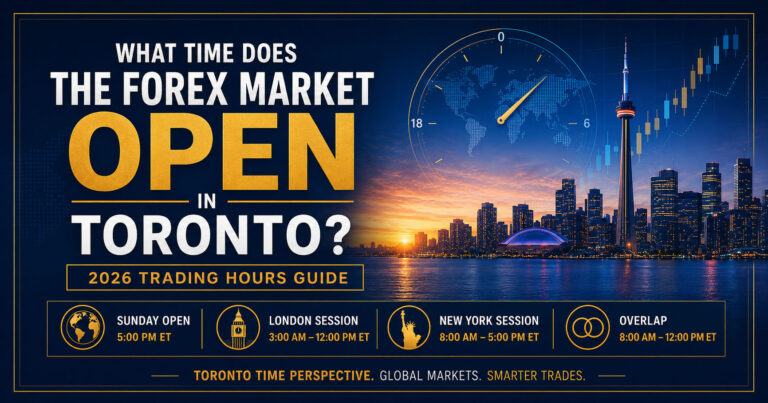 16 min
What Time Does the Forex Market Open in Toronto? 2026 Trading Hours Guide
Toronto Trading Education What Time Does the Forex Market Open in Toronto? 2026 Trading Hours Guide…
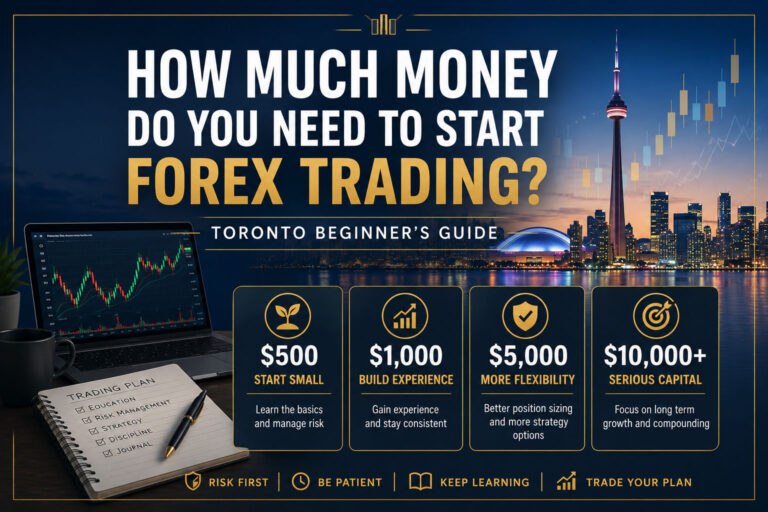 14 min
How Much Money Do You Need to Start Forex Trading in Toronto?
Toronto Trading Education How Much Money Do You Need to Start Forex Trading in Toronto? A…
Test Your Knowledge
Take the Final Exam. Earn the Certificate.
When you are ready, take the 30-question Financial Markets Assessment. Score 70% or higher to instantly earn your verified Certificate of Completion. You can retake it free as many times as needed.
Take the Exam →Certificate of Completion
This certificate is proudly presented toPass the 30-question Financial Markets Assessment with a score of 70% or higher.
Ready to go deeper?
Apply this live,
one-on-one.
The reading is free. The breakthroughs come from doing it with a veteran mentor coaching you step-by-step
Reserve a seat →