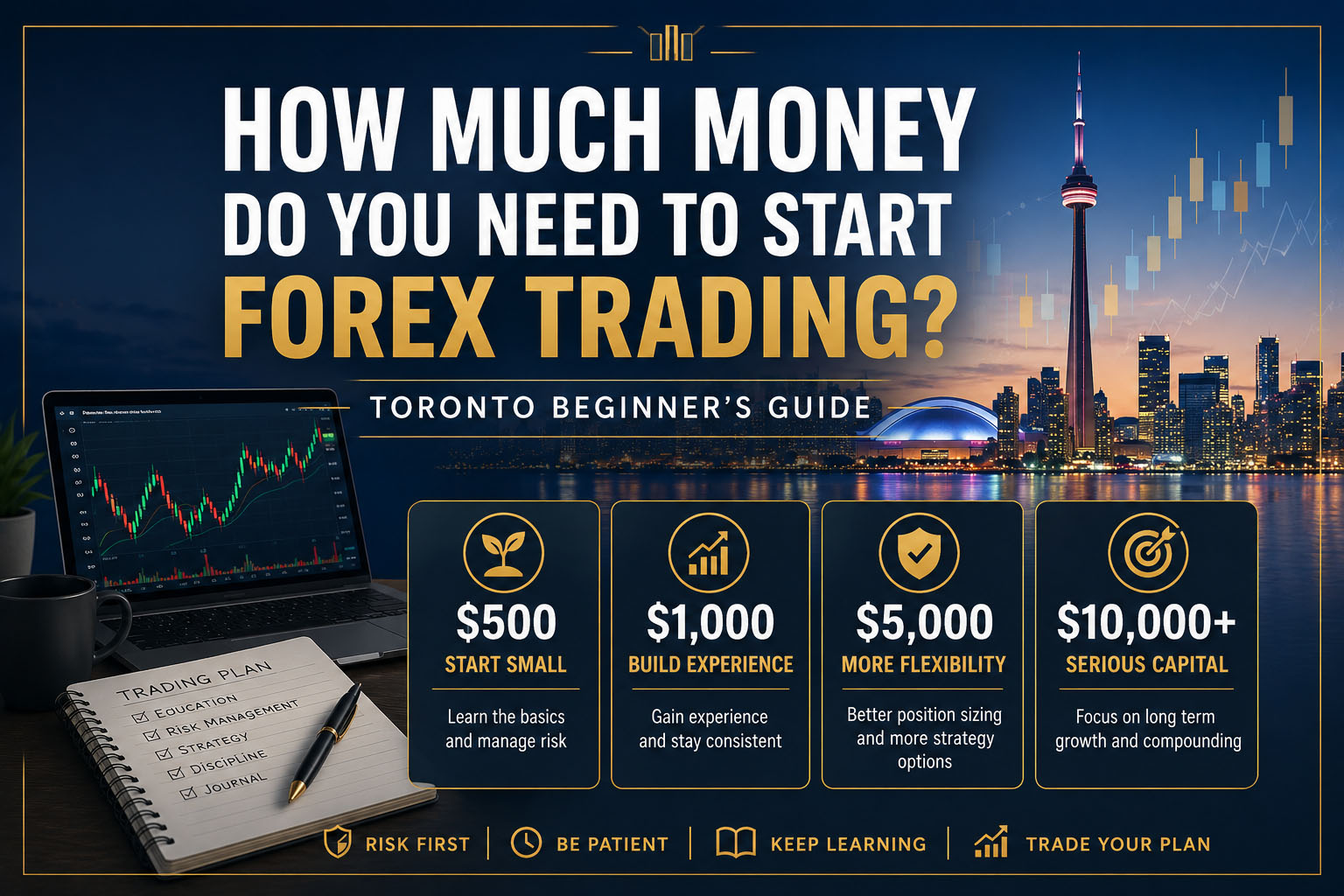
How Much Money Do You Need to Start Forex Trading in Toronto?
14 min lessonSep 2, 2026
Toronto Trading Education
How Much Money Do You Need to Start Forex Trading in Toronto?
A broker’s minimum deposit tells you how little money you can put into an account. It does not tell you how much capital you need to trade responsibly. For beginners, account size should be considered together with position sizing, leverage, drawdown and risk per trade.
One of the most common questions from people interested in forex trading in Toronto is:
How much money do I actually need to start?
The frustrating answer is that there is no single number that is correct for everyone.
Some trading accounts can technically be opened with a few hundred dollars or even less. That does not mean a very small account provides enough room to trade a sensible strategy with appropriate position sizing.
There is a major difference between:
the minimum amount a broker allows you to deposit,
the amount required to open a particular position, and
the amount of capital that allows you to manage risk responsibly.
Those three numbers should not be confused.
If you are completely new to currencies, start with our cornerstone guide to
Forex Trading in Toronto
before putting significant money at risk.
How Much Money Do You Need to Start Forex Trading?
You can technically begin learning forex with almost no trading capital at all.
A demo account allows you to learn the platform, practice order placement and test a strategy using simulated funds.
When moving into live trading, however, the relevant question becomes:
Can this account size support my strategy while keeping the dollar amount at risk sufficiently small?
For one beginner, that might mean $1,000.
For another, $5,000.
For someone whose strategy requires wider stops, several simultaneous positions or larger minimum contract sizes, more capital may be appropriate.
The strategy should determine the required capital.
The capital should not determine how recklessly the strategy is traded.
Minimum Deposit Is Not the Same as Adequate Trading Capital
Broker marketing can create confusion here.
Suppose a broker allows someone to open an account with $100.
That tells you the broker accepts a $100 account.
It does not establish that $100 is enough money to trade your strategy responsibly.
Imagine your strategy requires a stop that produces a $20 loss at the smallest practical position size available to you.
On a $100 account, that would represent:
20% of the entire account.
That is an enormous amount of risk on one idea.
The problem is not necessarily the setup.
The problem is that the account is too small relative to the required position size and stop distance.
What Different Forex Account Sizes Actually Mean
Account size should be viewed in relation to risk.
Account
0.5% Risk
1% Risk
2% Risk
$500
$2.50
$5
$10
$1,000
$5
$10
$20
$5,000
$25
$50
$100
$10,000
$50
$100
$200
This table is educational, not a recommendation that traders should risk a particular percentage.
Its purpose is to demonstrate something important:
Percentage risk translates into real dollars.
A trader should understand both before clicking Buy or Sell.
How Much Should a Beginner Risk Per Trade?
There is no percentage that is automatically appropriate for every trader.
Risk depends on:
strategy characteristics
historical drawdown
win rate
average reward-to-risk
trade frequency
number of correlated positions
account objectives
personal risk tolerance
Many educational examples discuss figures such as 1% per trade because percentage-based risk makes it easy to understand how losses scale with account size.
But a professional risk framework should go further.
You should ask:
What happens after five consecutive losses?
What happens after ten?
How much drawdown has the strategy historically experienced?
Are several open trades effectively expressing the same market idea?
Would a normal losing streak materially affect my decision-making?
Our Foundations & Risk module is designed to establish these concepts before students progress into entry strategies.
Position Size Matters More Than the Deposit
The number sitting in the account balance does not control risk by itself.
Position size does.
Consider two traders who both have $10,000 accounts.
Trader A risks $50 on a trade.
Trader B risks $1,000.
Their account balances are identical.
Their risk profiles are completely different.
A trading plan should therefore determine position size from:
account capital
maximum acceptable dollar risk
distance between entry and stop
the value of the instrument’s price movement
This is why experienced traders generally think in terms of risk first and lot size second.
How Leverage Changes the Equation
Leverage is one reason people underestimate how much capital they need.
Leverage allows a trader to control a market exposure larger than the cash being committed as margin.
That can make a small account appear powerful.
But purchasing power and risk capacity are not the same thing.
Leverage does not turn a $500 account into a $50,000 account. It gives the trader the ability to take larger market exposure. The underlying account still has only $500 available to absorb losses.
The critical question is therefore not:
How large a position will my broker allow?
It is:
How large a position can my risk plan justify?
Can You Start Forex Trading With $500?
Yes, depending on the broker, contract sizes and strategy.
But a $500 account should be understood for what it is:
a small account.
If a trader risks 1% of $500, that represents $5.
That may restrict the types of trades that can be taken while maintaining appropriate risk.
This is not necessarily a problem.
A small account can be useful for transitioning from simulated trading to the psychological experience of having actual money at risk.
The mistake is expecting a $500 account to immediately produce meaningful monthly income.
Is $1,000 Enough to Start Trading Forex?
A $1,000 account provides more flexibility than $500, but the same principles apply.
At 1% risk, a full losing trade represents $10.
At 0.5%, it represents $5.
Whether that account is sufficient depends partly on whether your broker and instrument allow position sizes small enough to keep risk within your plan.
A $1,000 account can be entirely appropriate for learning execution.
It should not automatically be treated as an income-generating account.
What Does a $5,000 Forex Account Change?
A $5,000 account gives the trader more room to express percentage-based risk without dollar amounts becoming excessively small.
For example:
0.5% = $25
1% = $50
2% = $100
Again, none of those figures is automatically the correct risk amount.
But the larger account provides more flexibility around stop distance and position size while still allowing the trader to keep percentage risk controlled.
What About a $10,000 Forex Account?
At $10,000, percentage-based position sizing becomes easier to visualize:
0.5% = $50
1% = $100
2% = $200
The important point is that having more capital does not create an obligation to risk more aggressively.
A $10,000 trader who uses disciplined sizing may actually expose less capital per trade than someone trading a $1,000 account recklessly.
Account size and trading skill are separate things.
Can a Small Forex Account Produce a Full-Time Income?
This is where beginners need realistic expectations.
Suppose someone wants to withdraw $4,000 every month from trading.
Trying to generate that income from a $5,000 account would require extraordinarily aggressive returns relative to the capital base.
The trader would likely need to take substantial risk.
That dramatically increases the possibility of large drawdowns or losing the account entirely.
Beginners should separate two goals:
Learning to trade consistently.
Generating meaningful income from trading capital.
The first must come before the second.
Trying to force income out of an account that is too small is one of the fastest ways to destroy good risk management.
Think in Percentages Before Dollars
When people see a profitable trade posted online, they often focus on the dollar amount.
A $2,000 profit looks impressive.
But without knowing the account size and amount risked, the number is almost meaningless.
A $2,000 return on a $1 million account is very different from a $2,000 return produced by risking half of a $5,000 account.
Serious performance analysis asks:
What percentage was gained?
How much was risked?
What was the maximum drawdown?
How repeatable was the process?
How long did the result take?
This is a healthier way to evaluate trading performance.
Why Beginners Should Start With Demo Trading
One of the cheapest trading lessons is also one of the most valuable:
You do not need live money to learn how the mechanics work.
A demo account can be used to practice:
placing orders
setting stop losses
setting take-profit orders
calculating position size
reading charts
testing entry rules
following a defined trading session
maintaining a journal
Demo trading has limitations because simulated money does not produce the same emotions as real money.
But that is not an argument for skipping it.
If someone cannot follow a strategy with simulated funds, adding financial pressure is unlikely to improve the process.
Trading Costs Beginners Often Forget
Your starting capital is not the only financial consideration.
Forex trading can involve:
Spreads
The difference between bid and ask prices.
Free Academy Access
Unlock the rest of this lesson free
Sign in to continue, or create a 100% free Academy account and unlock the full member experience.
When you are ready, take the 30-question Financial Markets Assessment. Score 70% or higher to instantly earn your verified Certificate of Completion. You can retake it free as many times as needed.

 16 min
 16 min