Module 6 · Trading Psychology, Discipline & Emotional Control · Lesson 5
Building Trading Discipline: How to Follow Your Plan Consistently
Learn how to turn discipline into a repeatable system using checklists, routines, risk limits, journaling, accountability and hard trading rules that remain consistent through fear, greed, losing streaks and winning streaks.
Trading Discipline
Checklists
Risk Limits
Journaling
Discipline is often misunderstood.
Traders sometimes imagine disciplined people as having extraordinary self-control — people who simply never feel fear, greed, frustration or excitement.
That is not the goal.
A disciplined trader can feel all of those emotions and still follow the plan.
Discipline becomes more reliable when good decisions are built into the trading system instead of depending on willpower in the moment.
This lesson brings everything from Module 6 together into one practical operating framework.
Lesson Objectives
What You’ll Learn
✓ What trading discipline actually means
✓ How to remove unnecessary decisions
✓ How to use checklists effectively
✓ How to create hard risk boundaries
✓ How journaling builds accountability
✓ How to score process instead of emotion
What Is Trading Discipline?
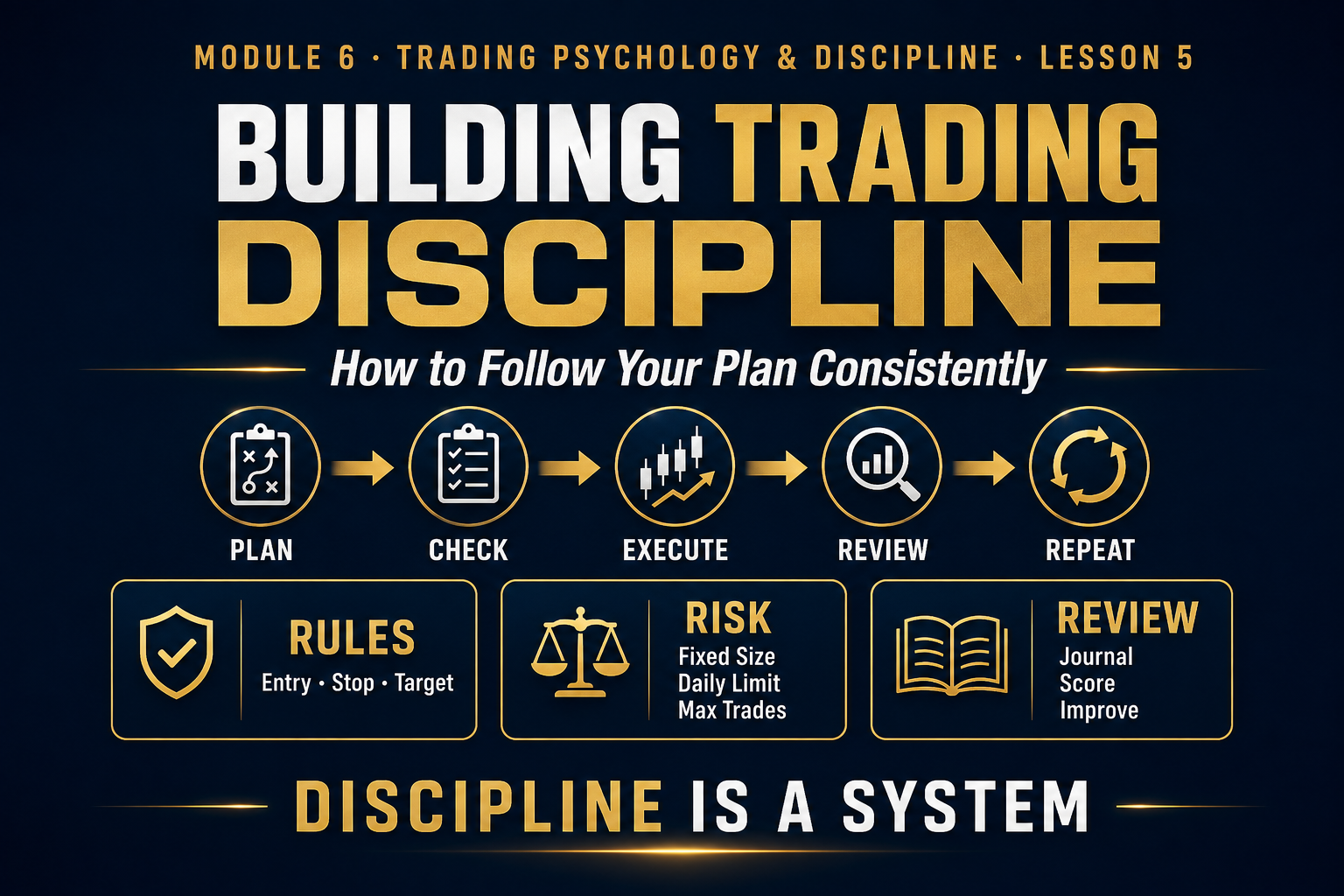
Trading discipline is the ability to follow a predefined process even when emotions or short-term outcomes encourage you to do something else.
Plan → Rules → Execution → Review → Repeat
Discipline is less about perfection and more about repeatability.
Discipline Is Not Motivation
Motivation changes from day to day.
Motivation
“I feel focused today, so I’ll follow the plan.”
Discipline
“I follow the plan whether I feel focused or not.”
Do Not Build Your Trading System Around Willpower
Willpower becomes weaker when you are tired, angry, excited or under financial pressure.
Trader knows not to exceed daily loss limit.
After two losses, frustration increases.
Rule becomes negotiable.
A rule that relies only on emotion-resistant willpower is fragile.
Build Discipline Into the System
✓ Define a fixed trading window.
✓ Define a maximum daily loss.
✓ Define maximum trades per session.
✓ Predetermine risk per trade.
✓ Use a written setup checklist.
✓ Use a mandatory pause after losses.
✓ Use a review process after the session.
✓ Track every rule violation.
Make Decisions Before Emotion Arrives
Many of the most important trading decisions should already be made before the trade exists.
Before Session: Define maximum risk.
Before Entry: Define stop and target.
Before Loss: Define what happens after a stop-out.
Before Winning Streak: Define whether risk ever increases.
Calm decisions should govern emotional moments — not the other way around.
The Pre-Trade Checklist
A checklist creates friction between impulse and execution.
✓ Is the market inside my allowed session?
✓ Is high-impact news approaching?
✓ Is higher-timeframe context clear?
✓ Is price at a meaningful location?
✓ Has my actual trigger occurred?
✓ Is the stop based on invalidation?
✓ Is target space sufficient?
✓ Is risk within plan?
✓ Am I emotionally neutral enough to execute?
Make the Checklist Binary
Avoid vague checklist questions that can be emotionally negotiated.
Weak:
“Does this setup look pretty good?”
Strong:
“Did the required candle close above resistance? Yes or No.”
If the strategy requires every condition, “almost” is still No.
Your Trading Plan Should Remove Ambiguity
| Decision | Predefined Rule |
|---|---|
| Risk per trade | Fixed percentage / formula |
| Entry | Specific technical trigger |
| Stop | Technical invalidation |
| Target | Structure / R-multiple rule |
| After loss | Pause / reset protocol |
| Session stop | Time, loss or trade-count limit |
Risk Rules Are Discipline Rules
Risk management is not separate from psychology.
Excessive risk makes disciplined behavior harder.
Normal risk: 0.5%–1%
Trader remains relatively calm.
Risk increased dramatically.
Every small market movement now feels emotionally important.
Create Hard Boundaries
Maximum Risk Per Trade
Maximum Daily Loss
Maximum Number of Trades
Maximum Simultaneous Exposure
Maximum Drawdown Before Review
Hard boundaries are valuable precisely because emotions will eventually ask you to break them.
Build a Loss Reset Routine
After a Stop Loss
1. Accept the outcome.
2. Screenshot the completed trade.
3. Record the result in R.
4. Step away for the predefined pause.
5. Review whether rules were followed.
6. Return only for a new qualifying setup.
Build a Win Reset Routine Too
Excitement after a winner can damage discipline just like frustration after a loss.
Record the trade.
Return to normal risk.
Do not lower setup standards.
Do not extend the session automatically.
Treat the next trade as completely independent.
A Trading Window Protects Discipline
The longer you stare at charts, the more opportunities your brain will invent.
Example
“I trade only between 8:30 a.m. and 11:00 a.m. New York time. After 11:00, no new entries.”
When the window ends, discipline means closing the platform — not searching for an exception.
Boredom Is a Psychological Trading Risk
Not all impulsive trades come from fear or greed.
No setup for two hours.
Trader becomes restless.
A mediocre setup appears.
Boredom lowers standards.
A Day With No Trade Can Be a Perfectly Executed Trading Day.
Journaling Creates Accountability
A journal turns vague impressions into evidence.
Setup type
Entry reason
Risk amount
Stop and target
R result
Rule compliance
Emotional state
Screenshot before and after
Track Rule Violations Separately From Losses
A losing trade is not automatically a mistake.
| Trade | Result | Rules Followed? | Evaluation |
|---|---|---|---|
| A | -1R | Yes | Good Execution |
| B | +2R | No | Poor Execution |
Score Your Discipline
If you only score money, money becomes the only thing that feels important.
Preparation: 0–10
Patience: 0–10
Setup Selection: 0–10
Risk Discipline: 0–10
Execution: 0–10
Emotional Control: 0–10
Set Process Goals
Outcome Goal
“I need to make $1,000 this week.”
Process Goal
“I will execute the next 10 qualified trades with zero risk-rule violations.”
Process goals are measurable without requiring the market to produce a specific outcome.
Fix One Discipline Problem at a Time
Trying to fix ten weaknesses simultaneously usually produces vague improvement.
If your biggest problem is revenge trading, make “zero revenge trades” the primary behavioral objective until it becomes consistent.
Accountability Can Improve Discipline
It becomes easier to rationalize broken rules when nobody else ever sees them.
Share weekly trade review with a mentor.
Track rule violations visibly.
Review screenshots regularly.
Use a trading partner for process accountability.
Keep written statistics on discipline, not just profits.
Design Your Environment for Better Decisions
Remove unnecessary charts.
Turn off distracting social media.
Keep the economic calendar visible.
Keep your checklist beside the platform.
Use predetermined risk calculators.
Close the platform after the trading window.
Protect Yourself From Outside Noise
You can have a perfect plan and abandon it because someone online posts the opposite bias.
Your analysis: bullish.
Social-media trader says bearish.
You hesitate and alter the setup.
Another person’s opinion enters your process without being part of the strategy.
Your Physical State Affects Discipline
Decision quality can decline when you are exhausted, distracted or emotionally stressed outside trading.
Poor sleep
High stress
Illness
Major personal distraction
Emotional agitation
A professional plan can include conditions where reduced risk or no trading is appropriate.
What Happens When You Break a Rule?
Discipline does not require pretending mistakes never happen.
1. Identify the violation immediately.
2. Do not hide it because the trade won.
3. Record what triggered the behavior.
4. Apply any predefined consequence.
5. Design a barrier against repeating it.
Possible Rule-Break Consequences
Trading session ends immediately.
Next session begins at reduced size.
Mandatory written review required.
Violation must be added to weekly review.
Build an Identity Around Execution
Instead of defining yourself as a trader who “wins a lot,” define success around the process.
“I am a trader who follows my risk and execution rules.”
That identity remains useful whether the current trade wins or loses.
Consistency Is Built Through Repetition
Skip one FOMO trade.
Accept one clean stop.
Stop one session at the daily limit.
Keep risk normal after one big win.
Repeat disciplined decisions until they become normal behavior.
Do Not Chase Perfect Discipline
The objective is not to become emotionless or never make another mistake.
The objective is to make rule-following increasingly consistent and rule-breaking increasingly rare, visible and correctable.
The 20-Trade Discipline Challenge
Instead of trying to “make money” on the next twenty trades, focus entirely on process.
Same risk every trade.
No entries outside your setup.
No revenge trades.
No moving stops emotionally.
No chasing missed trades.
No trading outside the session window.
Journal every result honestly.
At the end, grade the twenty trades on execution quality — not simply on P&L.
Your Complete Trading Discipline System
1. Begin with a written trading plan.
2. Define your trading session.
3. Define exact setup requirements.
4. Use a pre-trade checklist.
5. Keep risk predetermined.
6. Set hard daily loss and trade limits.
7. Use post-loss and post-win reset routines.
8. Stop when the trading window ends.
9. Journal every trade.
10. Track rule violations.
11. Score execution quality.
12. Review weekly patterns.
13. Improve one behavioral weakness at a time.
Build Real Trading Discipline
Turn Good Trading Decisions Into a Repeatable System
Financial Markets Academy offers live 1-on-1 mentorship for traders who want help building a complete trading process around setup selection, risk limits, execution discipline, journaling and emotional control in live market conditions.
Daily Discipline Checklist
✓ Did I prepare before the session?
✓ Did I trade only inside my defined window?
✓ Did every trade pass my checklist?
✓ Was risk correct on every trade?
✓ Did I respect my stop-loss rules?
✓ Did I avoid FOMO?
✓ Did I avoid revenge trading?
✓ Did I maintain discipline after wins?
✓ Did I stop at my daily limit?
✓ Did I journal every trade?
✓ Did I record any rule violations honestly?
✓ What one behavior should I improve tomorrow?
Frequently Asked Questions
What does trading discipline mean?
Trading discipline means consistently following a predefined trading process even when fear, greed, frustration or recent results create pressure to break the rules.
How can I improve trading discipline?
Use written rules, binary checklists, consistent risk, defined trading windows, daily loss limits, journaling and structured review.
Why do traders break their plans?
Fear, greed, revenge trading, overconfidence, boredom and excessive risk can all create emotional pressure that makes rules feel negotiable.
Does a checklist really help?
A clear checklist can create a pause between impulse and execution and make it harder to rationalize trades that do not meet the strategy.
Should I journal winning trades too?
Yes. Winning trades can still contain rule violations, and reviewing them helps prevent profitable mistakes from becoming repeated habits.
How long does it take to become disciplined?
There is no fixed timeline. Discipline develops through repeated rule-following, objective review and correcting recurring behavioral patterns over many trading sessions.
Test Yourself
Module 6 · Lesson 5 Knowledge Quiz
1. What makes discipline more reliable?
A. Building rules and systems before emotional moments occur
B. Depending entirely on willpower
C. Increasing risk after wins
D. Trading more often
2. Why should checklist questions be specific?
A. They reduce emotional interpretation
B. They guarantee winners
C. They eliminate market risk
D. They increase leverage
3. What is a hard daily loss limit designed to do?
A. Stop further trading once a predefined loss is reached
B. Guarantee recovery
C. Increase position size
D. Predict reversals
4. Can a profitable trade still be poorly executed?
A. Yes
B. No
C. Only during news
D. Only on forex
5. What should a trader improve first?
A. One important repeatable behavioral weakness at a time
B. Everything simultaneously
C. Only profit targets
D. Maximum leverage
Answer Key: 1. A · 2. A · 3. A · 4. A · 5. A
Key Takeaways
✓ Discipline means following the process despite emotion.
✓ Motivation is temporary; systems are repeatable.
✓ Important decisions should be made before the trade.
✓ Binary checklists reduce emotional negotiation.
✓ Risk limits protect both capital and psychology.
✓ Losses and wins both require reset routines.
✓ Trading windows reduce boredom and overtrading.
✓ Journaling creates accountability.
✓ Rule violations should be tracked separately from trade outcomes.
✓ Process goals are more controllable than profit goals.
✓ Discipline improves through repeated correct behavior.
✓ The goal is not perfection — it is consistent professional execution.
Module 6 Complete
Trading Psychology, Discipline & Emotional Control — Complete
You now understand the major psychological forces that can interfere with execution and the practical rules that can keep those emotions from controlling your trading.
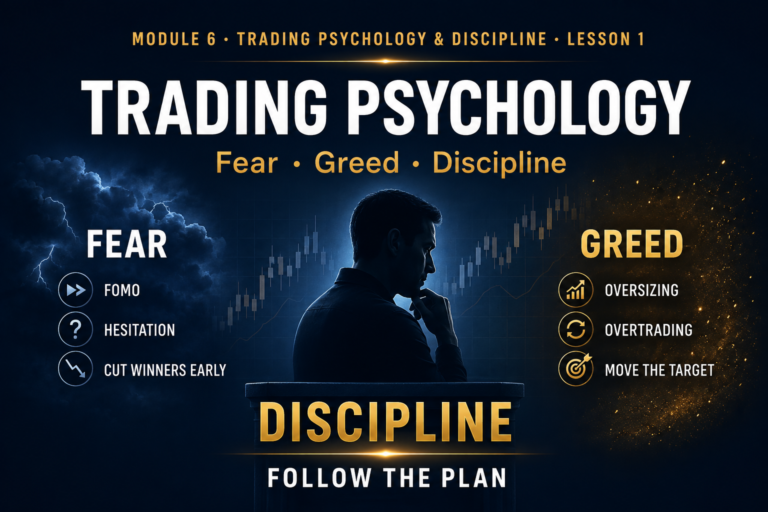
Lesson 1: Fear, greed, FOMO and emotional trading
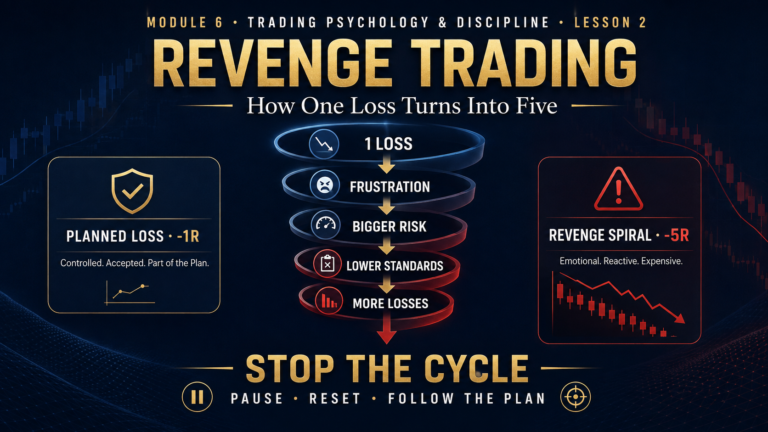
Lesson 2: Revenge trading and post-loss control
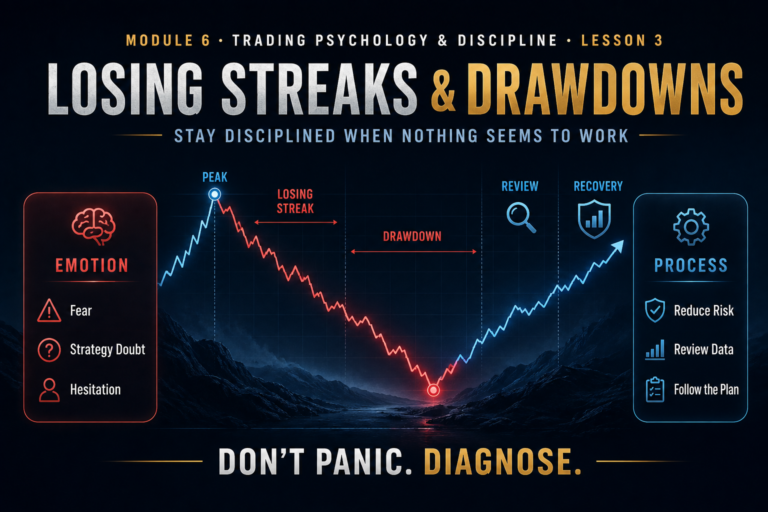
Lesson 3: Losing streaks, variance and drawdowns
Lesson 4: Overconfidence and winning-streak psychology
Lesson 5: Building a complete trading discipline system
Next Module
Module 7: Building & Testing a Complete Trading Strategy
Now that you understand market structure, entries, trade management, timing and psychology, Module 7 will bring those pieces together into a rule-based trading strategy — including setup definitions, backtesting, forward testing, performance statistics and knowing when a strategy is ready for live capital.
Continue to Module 7 →
Financial Markets Academy provides educational information only. Nothing in this lesson constitutes financial or investment advice or a guarantee of trading performance. Trading leveraged financial markets involves substantial risk and may not be suitable for everyone.