Module 6 · Trading Psychology, Discipline & Emotional Control · Lesson 1
Trading Psychology: Fear, Greed & Why Traders Break Their Own Rules
Learn how fear, greed, loss aversion, overconfidence and emotional decision-making can override a good trading plan — and how professional traders build systems that make discipline easier to maintain.
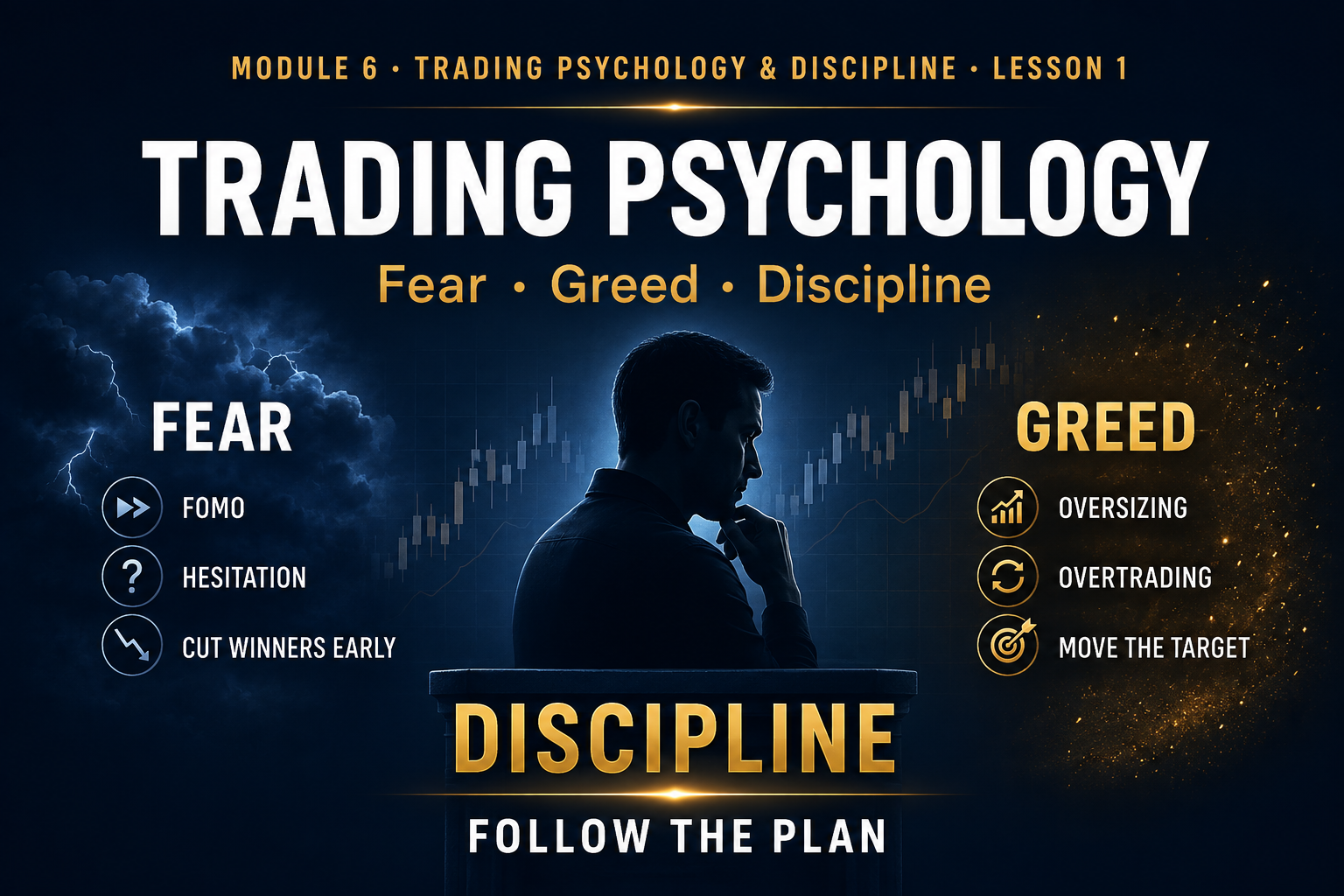
Trading Psychology
Fear
Greed
Discipline
Most traders do not lose discipline because they forgot what a stop loss is.
They lose discipline because the moment money becomes involved, the decision feels different.
A trader may know that a setup requires confirmation — then enter early because they are afraid of missing the move.
They may know that a stop should never be widened — then move it because accepting the loss feels painful.
They may know that the target is 2R — then extend it to 4R because the trade is winning and greed takes over.
Trading psychology is not about eliminating emotion. It is about preventing emotion from controlling execution.
The market will always create uncertainty. Your job is to build a process strong enough that uncertainty does not constantly rewrite your rules.
Lesson Objectives
What You’ll Learn
✓ Why emotion increases when money is at risk
✓ How fear damages execution
✓ How greed changes good trade management
✓ What loss aversion does to decision-making
✓ How overconfidence develops after winners
✓ How rules reduce emotional decisions
What Is Trading Psychology?
Trading psychology refers to the emotional and behavioral factors that influence how a trader interprets information and makes decisions.
Two traders can look at the same chart, use the same strategy and still produce very different results because one follows the plan while the other reacts emotionally.
Strategy + Risk Management + Execution + Psychology = Trading Process
Psychology does not replace technical skill. It determines whether you can consistently apply that skill.
Knowing the Rule Is Different From Following the Rule
| Trader Knows |
Emotion Says |
Bad Decision |
| Wait for confirmation |
“You’ll miss it.” |
Enter early |
| Respect stop loss |
“Give it more room.” |
Widen stop |
| Risk 1% |
“This one looks guaranteed.” |
Oversize position |
| Stop after daily loss limit |
“One trade will get it back.” |
Revenge trade |
Fear in Trading
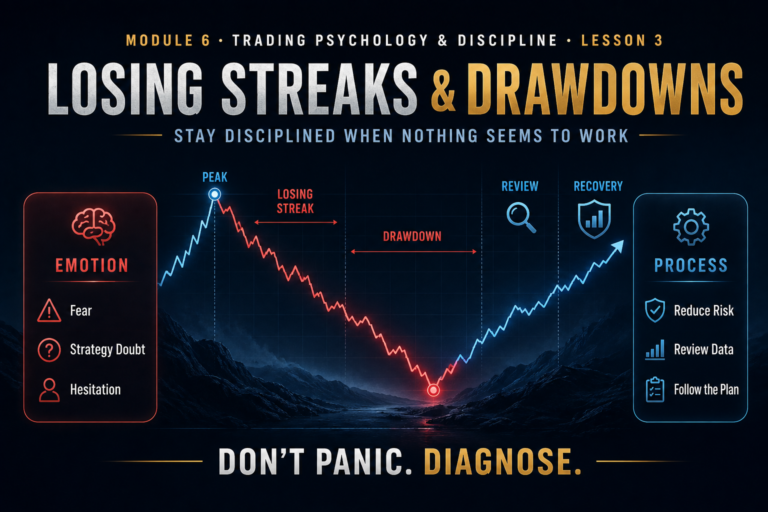
Fear usually appears when the trader focuses more on what could be lost than on executing the process.
• Fear of losing money
• Fear of being wrong
• Fear of missing the move
• Fear of giving back profit
• Fear of taking the next trade after a loss
Fear of Missing Out — FOMO
FOMO is one of the most common forms of trading fear.
Price starts moving.
Trader has not received confirmation.
Move becomes larger.
Trader feels left behind.
Emotion converts observation into an impulsive entry.
The trader is no longer evaluating whether the entry is good. They are trying to eliminate the discomfort of watching price move without them.
FOMO Entry Example
Ideal entry: 1.1000
Planned stop: 1.0975
Target: 1.1050
Trader waits too long, then chases at: 1.1035
The market idea may be right, but the new trade mathematics are poor.
Fear of Taking a Loss
Traders often know exactly where their stop belongs until price approaches it.
Original stop: 1.0950
Price falls toward stop.
Trader moves stop to 1.0920.
Price keeps falling.
Fear of a small planned loss creates a larger unplanned loss.
A stop loss is part of the strategy, not evidence that the strategy failed.
Fear Can Also Make You Close Winners Too Early
Once a trade becomes profitable, the trader may become afraid that the profit will disappear.
Planned target: 2R
Trade reaches: 0.4R
Trader closes immediately.
Fear changes the strategy’s average winner.
Greed in Trading
Greed often appears when the trader begins treating possibility as entitlement.
“This trade can make more.”
“I’ll increase the lot size.”
“Why stop at 2R?”
“I’m on a winning streak.”
“I should take another trade even though my session is over.”
Greed Can Move a Good Target
Planned target: 2R
Price reaches 1.8R.
Trader moves target to 5R.
Price reverses.
A planned winner becomes a breakeven trade or loss.
Greed Often Appears as Oversizing
A trader sees an unusually attractive setup and decides the normal risk rule does not apply.
Normal Risk: 1%
Emotion: “This setup cannot lose.”
Actual Risk: 4%
Problem: One ordinary loss now causes four times the planned damage.
Confidence in a setup does not change the uncertainty of the market.
Loss Aversion: Why Losing Feels So Powerful
Traders frequently experience the pain of losing more intensely than the satisfaction of an equivalent gain.
This can create irrational behavior designed to avoid realizing a loss.
Losing Trade
Trader gives the position “more time” and allows loss to grow.
Winning Trade
Trader closes quickly because they are afraid the profit will disappear.
Undisciplined traders often allow losers more freedom than winners.
Hope Is Not a Trade Management Strategy
Hope becomes dangerous when the market has invalidated the setup but the trader refuses to accept the information.
Support breaks.
Bearish structure confirms.
Stop should execute.
Trader removes stop.
Analysis has ended. Hope has taken over.
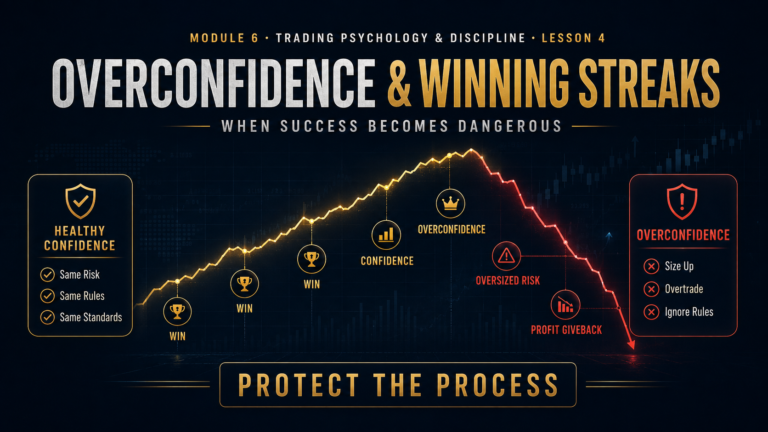
Overconfidence After Winning
Losing trades can damage discipline, but winning trades can do the same thing.
Trade 1 wins.
Trade 2 wins.
Trade 3 wins.
Trader begins feeling unusually skilled.
Risk increases and standards fall.
“I’m Hot Today” Thinking
A winning streak does not make the next individual trade certain.
Previous three trades: Wins
Next setup: Still probabilistic
Correct Action: Use the same risk process.
Recency Bias
Recency bias occurs when the most recent outcomes receive too much influence over the next decision.
After Several Losses
“My strategy stopped working. I should skip the next setup.”
After Several Wins
“Everything is working. I can increase risk.”
A tested process should not be completely redefined because of a tiny sample of recent trades.
The Need to Be Right
Some traders connect a losing trade with personal failure.
Instead of saying, “This trade lost,” they internally experience, “I was wrong.”
Your job is not to be right on every trade. Your job is to execute a process with positive expectancy across many trades.
Trading Is a Probability Business
A valid setup can lose.
An invalid setup can occasionally win.
| Outcome |
Process |
Evaluation |
| Loss |
All rules followed |
Good trade |
| Win |
Rules ignored, risk oversized |
Poor trade |
Outcome Bias
Outcome bias means judging a decision solely by whether it made or lost money.
Trader ignores stop.
Trade moves deep into drawdown.
Market eventually reverses.
Trade closes for profit.
Profit can accidentally reward dangerous behavior.
That is why the process must be reviewed separately from the financial result.
Focus on What You Can Control
You Control
Setup selection
Entry discipline
Risk amount
Stop placement
Whether rules are followed
You Do Not Control
Next candle
Unexpected headlines
Whether one trade wins
Other participants
Short-term randomness
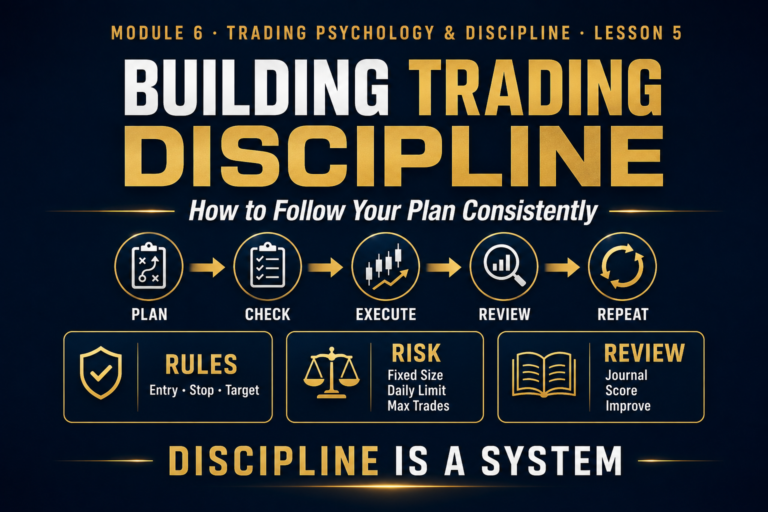
Rules Reduce Emotional Decision-Making
Good rules turn vague emotional moments into predefined decisions.
Fear: “Should I enter now?”
Rule: Enter only after candle close and structure confirmation.
Greed: “Should I risk more?”
Rule: Risk stays fixed regardless of setup confidence.
Loss Aversion: “Should I move my stop?”
Rule: Stop can only move according to predefined management conditions.
Make Discipline Easier Through Environment
Discipline should not depend entirely on willpower.
✓ Use predefined position-size calculations.
✓ Set stop and target immediately when appropriate.
✓ Use daily loss limits.
✓ Remove instruments outside your watchlist.
✓ Stop watching charts after the trading window.
✓ Use checklists before every entry.
Position Size Changes Psychology
A trade that feels emotionally overwhelming may simply be too large.
At 0.5% risk: trader follows plan calmly.
At 5% risk: trader watches every tick.
Same setup.
Different emotional load.
Risk should be small enough that you can still think clearly when the trade moves against you.
Make Important Decisions Before the Trade
The best time to decide how much to risk is before you are excited.
The best time to decide where the stop belongs is before you are afraid.
The best time to decide where to take profit is before greed appears.
Plan in a Calm State → Execute in an Emotional Environment

 12 min
 12 min
 11 min