Module 6 · Trading Psychology, Discipline & Emotional Control · Lesson 2
Revenge Trading: How One Loss Turns Into Five
Learn why traders chase losses, increase risk, lower setup standards and spiral into overtrading — and how to build hard rules that stop one normal losing trade from destroying an entire session.
Revenge Trading
Overtrading
Daily Loss Limits
Emotional Control
The first loss is often not the problem.
The problem is what happens next.
A trader takes a completely valid setup. The stop is hit. The loss is small, controlled and well within the trading plan.
Then frustration appears.
The trader wants the money back immediately. They enter again too quickly. The second setup is weaker. The position is larger. The stop is worse. Another loss follows.
Revenge trading is what happens when recovering the previous loss becomes more important than following the next valid setup.
One controlled loss can become five uncontrolled decisions because the trader stops trading the market and starts trading their emotions.
Lesson Objectives
What You’ll Learn
✓ What revenge trading actually is
✓ Why losses create urgency
✓ How risk escalates after frustration
✓ Why setup standards collapse
✓ How to use hard daily stop rules
✓ How to reset after a loss
What Is Revenge Trading?
Revenge trading is emotionally motivated trading after a loss, usually with the goal of recovering the money quickly.
The key difference is motivation.
Normal Next Trade
A completely new setup appears and independently meets all strategy criteria.
Revenge Trade
Trader enters because they feel compelled to recover the previous loss.
The First Loss Is Often Completely Normal
Setup: A-quality.
Risk: 1%.
Stop: Correct.
Execution: According to plan.
Outcome: -1R.
Nothing necessarily went wrong.
A planned loss is a normal business expense of a probabilistic trading process.
The Emotional Brain Interprets the Loss Differently
Instead of seeing -1R as one expected outcome in a larger series, the trader may experience it as something that must be corrected immediately.
“I shouldn’t have lost that.”
“The market took my money.”
“I know where price is going now.”
“I’ll make it back on the next trade.”
The goal quietly changes from executing well to recovering money.
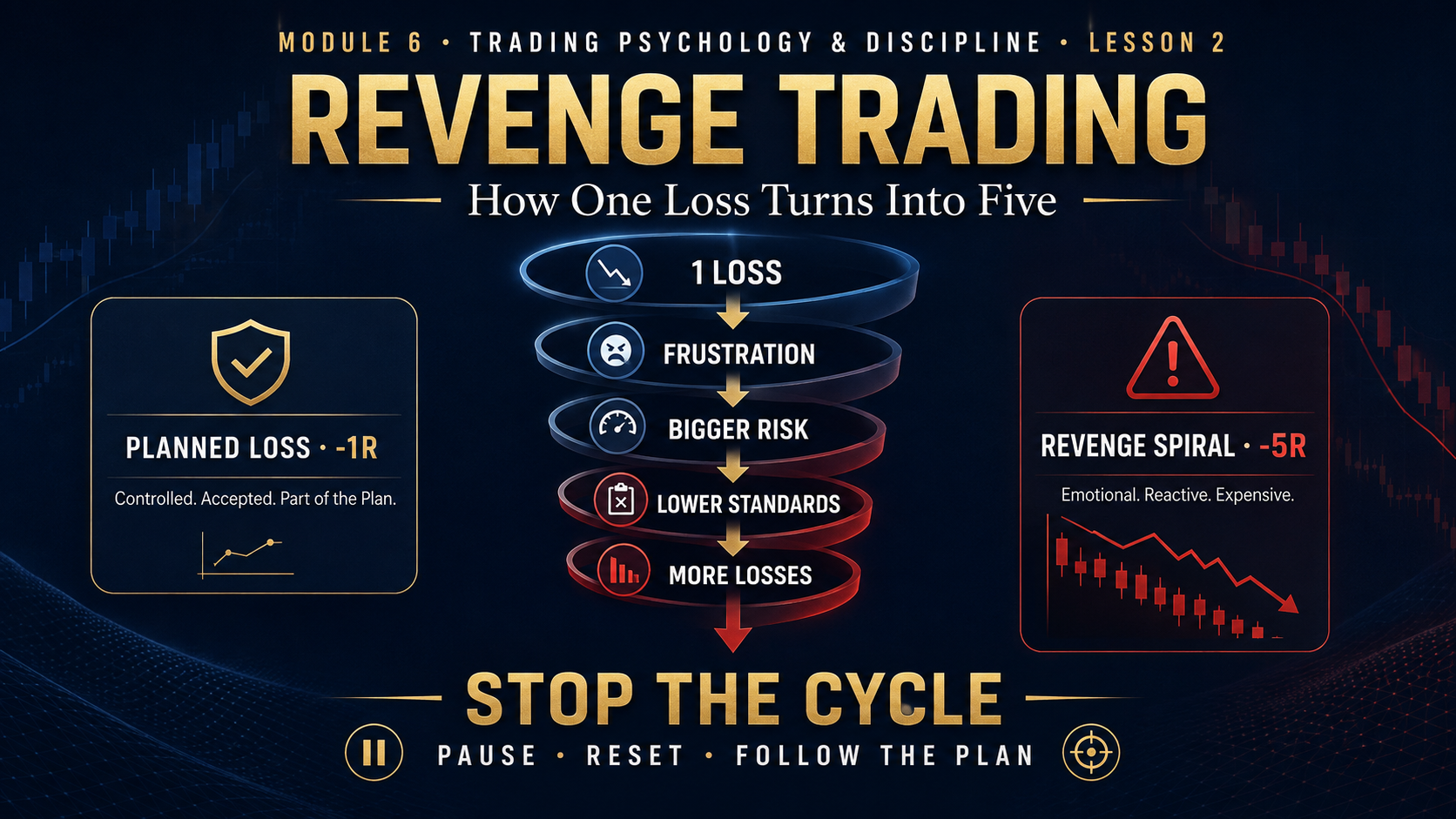
How One Loss Turns Into Five
Planned Loss
↓
Frustration
↓
Urgency to Recover
↓
Lower Setup Standards
↓
Larger Risk
↓
More Losses
Revenge Trading Creates Artificial Urgency
After losing, traders often feel they need to act before the market moves away.
The account does not require the loss to be recovered today. The trader’s emotions do.
Setup Standards Begin to Collapse
The second trade often would not have been taken if the first trade had never happened.
| Before Loss |
After Loss |
| Wait for candle close |
Enter before close |
| Require key level |
Enter in middle of range |
| Require 2R target space |
Accept 0.8R |
| Risk 1% |
Risk 2–3% |
The Dangerous Logic of Increasing Risk
Revenge traders often increase position size because they want the next winner to recover the previous loss faster.
Trade 1: risk 1R → loses 1R
Trade 2: risk 2R → loses 2R
Trade 3: risk 3R → loses 3R
Three losses = -6R instead of -3R.
Increasing risk after a loss makes the next decision more emotionally difficult, not less.
Larger Losses Require Larger Recoveries
Drawdown and recovery are not symmetrical.
| Account Loss |
Approx. Gain Needed to Recover |
| -5% |
+5.3% |
| -10% |
+11.1% |
| -20% |
+25% |
| -50% |
+100% |
The deeper revenge trading pushes the account into drawdown, the harder recovery becomes.
Revenge Trading Often Becomes Overtrading
The trader starts seeing setups everywhere because they are searching for a reason to trade.
Trade 1: valid setup.
Trade 2: questionable setup.
Trade 3: random breakout.
Trade 4: impulsive reversal.
Quantity replaces quality.
Re-Entering the Same Market Immediately
A common revenge pattern is repeatedly trading the same instrument after being stopped out.
Long stopped.
Immediately go short.
Short stopped.
Immediately go long again.
Trader is reacting to every movement instead of waiting for a complete setup.
Direction-Flipping Is Often an Emotional Warning
Changing bias is not inherently wrong. Markets change.
But repeatedly flipping long-short-long within minutes after losses can signal emotional instability rather than legitimate analysis.
A valid reversal requires new evidence. A revenge reversal only requires frustration.
Revenge Trading Can Feel Personal
Traders sometimes behave as if the market took something from them.
“The market stopped me out on purpose.”
“It always reverses after my stop.”
“I’m getting this money back.”
The trader starts fighting the market instead of analyzing it.
The market does not know who you are, where your stop is, or how much you lost.
The Dangerous Goal of “Getting Back to Breakeven”
After a losing start, traders may create a new objective:
“I cannot stop until I’m back to zero.”
That objective has nothing to do with the market’s available opportunities.
If no high-quality setup exists, the desire to reach breakeven creates trades that should never have happened.
A Red Day Can Be a Successful Day
One valid trade taken.
Trade loses -1R.
No second setup appears.
Trader stops.
Financially negative. Operationally excellent.
Protecting the process is more important than forcing a green number at the end of every session.
Use a Mandatory Pause After a Loss
A short interruption can separate the previous outcome from the next decision.
Trade Stops Out
↓
Step Away
↓
Record the Trade
↓
Reassess Only When Calm
Example rule:
After any full stop loss, no new trade may be entered for at least 15 minutes and until a completely new setup forms.
Review the Loss Before Taking Another Trade
Was the setup valid?
Was the risk correct?
Was the stop correctly placed?
Did I break any rule?
Was there unexpected news?
Am I emotionally calm?
Would I take the next setup if the previous trade had never existed?
Daily Loss Limits Are Anti-Revenge Tools
A daily loss limit removes the option to keep escalating when decision quality deteriorates.
Example
Maximum daily loss: -2R. Once reached, trading ends regardless of how attractive the next setup appears.
A daily loss limit that can be ignored after you hit it is not a limit.
Maximum Trade Counts Can Help Too
Some traders also limit the number of trades allowed in one session.
Maximum 2 or 3 trades per session.
Every trade must meet full setup criteria.
This creates friction against rapid-fire emotional entries.
Consider a Two-Loss Stop Rule
Some traders deliberately end the session after two consecutive full losses.
The reasoning is not that a third trade cannot win.
The objective is to protect decision quality.
After repeated losses, frustration, fatigue and urgency may be increasing even if the trader does not fully recognize it.
Remove Decisions When Possible
Good systems reduce the number of choices available during emotional moments.
✓ Predetermine lot size.
✓ Use stop loss immediately where appropriate.
✓ Define daily maximum loss.
✓ Define maximum number of trades.
✓ End platform access when limits are reached.
✓ Keep a written post-loss reset checklist.
Learn Your Personal Revenge-Trading Warning Signs
“I need one more trade.”
Increasing lot size without a rule.
Entering immediately after being stopped.
Switching direction repeatedly.
Skipping the checklist.
Feeling angry at the market.
Watching the dollar loss instead of the chart.
Trying to finish the day exactly at breakeven.
Physical Signals Can Warn You Too
Emotional escalation can have physical signs.
• Faster breathing
• Tension
• Constant clicking between charts
• Inability to sit still
Free Academy Access
Unlock the rest of this lesson free
Sign in to continue, or create a 100% free Academy account and unlock the full member experience.
ALREADY A MEMBER?
Sign In & Continue
Access the rest of this lesson instantly.
Forgot password?

 12 min
 13 min
 12 min