Module 8 · Prop Firms & Funded Trading · Lesson 5
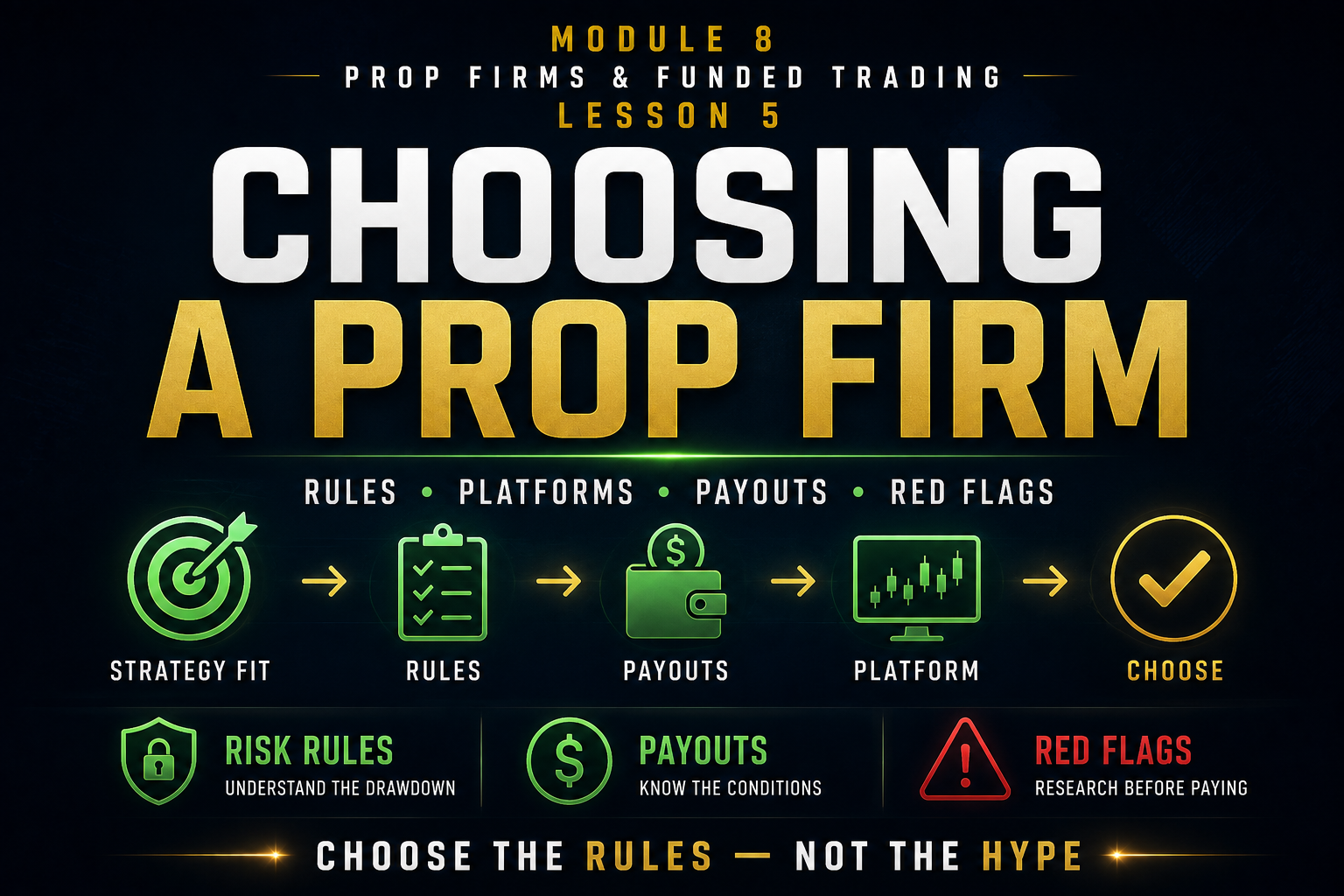
Choosing a Prop Firm: Rules, Platforms, Payouts & Red Flags
Learn how to evaluate prop firms beyond headline account size and challenge price by comparing drawdown models, payout rules, consistency requirements, platforms, restrictions, support and business transparency.
Prop Firm Comparison
Payout Rules
Trading Platforms
Red Flags
A prop firm can look attractive because of a large advertised account size, a low challenge fee or a generous profit split.
But those numbers do not tell you whether the program is actually compatible with your trading strategy.
A cheaper challenge with poor rules can be more expensive than a higher-priced program that gives your strategy enough room to operate.
The best prop firm is not necessarily the cheapest one or the one advertising the largest account. It is the one whose rules fit your strategy and whose operating model you understand.
Choosing a prop firm is a risk-management decision before it is a purchasing decision.
Lesson Objectives
What You’ll Learn
✓ How to compare prop firm rules
✓ How to evaluate drawdown models
✓ How to compare payout conditions
✓ Why platform compatibility matters
✓ How to identify operational red flags
✓ How to build a firm-comparison scorecard
Start With Strategy Compatibility
Before comparing prices, ask whether the program allows your strategy to operate normally.
Trading Session: Does the account allow when you trade?
Holding Time: Are overnight or weekend positions allowed?
News: Can positions be opened or held around major events?
Platform: Is your preferred platform available?
Automation: Are EAs, trade copiers or other tools permitted?
A great deal is not a great deal if the rules force you to trade differently from the strategy you tested.
Do Not Choose a Prop Firm Based on Price Alone
Firm A
Challenge fee: $250
Tight trailing drawdown
Strict consistency rules
Platform incompatible with your normal execution
Firm B
Challenge fee: $400
More suitable drawdown structure
Rules fit your strategy
Preferred platform supported
The lower entry price does not automatically represent better value.
Calculate the Real Cost of the Program
The challenge fee may be only one part of the total cost.
Initial challenge fee
Activation fee, if applicable
Reset or retry costs
Platform or data fees
Withdrawal or processing charges
Potential recurring fees
Advertised evaluation: $199
Activation after passing: $150
Platform/data fee: $39
Effective cost before first payout: $388
Compare the Drawdown Model First
Drawdown often has more impact on account survivability than the advertised account size.
| Feature |
Firm A |
Firm B |
| Account |
$100K |
$100K |
| Max Drawdown |
$5K |
$10K |
| Type |
Trailing |
Static |
| Practical Flexibility |
Lower |
Higher in this example |
Compare the Daily Loss Rule Carefully
A 5% daily limit sounds generous until you discover that floating equity, prior-day profit or another calculation changes the actual threshold.
Is it based on balance?
Is it based on equity?
Does unrealized P&L count?
When does the limit reset?
Does previous profit change the calculation?
Compare Profit Targets in Context
A lower target can be attractive, but only when considered alongside drawdown and other restrictions.
Firm A:
Target = 6%
Drawdown = 4%
Firm B:
Target = 8%
Drawdown = 10%
A lower target does not automatically mean the easier program.
Think About Target-to-Drawdown Pressure
Profit Target ÷ Available Drawdown = One Useful Comparison
It is not the only metric, but it can help reveal how much profit must be produced relative to the account’s loss allowance.
Compare Payout Rules Before You Compare Profit Splits
A 90% profit split sounds better than an 80% split, but only if the payout itself is realistically obtainable.
Firm A
90% split
Longer payout wait
Strict consistency conditions
Limited first withdrawal
Firm B
80% split
Simpler eligibility
Clear payout schedule
Rules better fit the strategy
A smaller percentage of a payout you can consistently reach may be more valuable than a larger percentage attached to rules that repeatedly block withdrawals.
Payout Questions to Ask
When can the first payout be requested?
How frequently can later payouts be requested?
Is there a minimum withdrawal?
Is there a maximum payout?
Is profit consistency required?
Are there minimum profitable days?
How does withdrawal affect drawdown?
What conditions can cause a payout request to be rejected?
Platform Compatibility Matters More Than Traders Think
Your execution may change materially when you move to an unfamiliar trading platform.
Order-entry workflow
Stop-loss placement
Position-sizing tools
Charting quality
Mobile access
EA or automation support
Trade-copying compatibility
Test the Platform Before Risking the Challenge
If a demo or trial environment exists, use it to understand order entry, stop placement and platform behavior before the evaluation starts.
Verify That Your Markets Are Actually Available
You trade NASDAQ.
Firm offers US indices.
But the exact contract, symbol specification or trading hours differ from what you tested.
Verify contract size, tick value, spread, commission and trading hours instead of assuming the instrument behaves identically.
Compare Spreads, Commissions & Execution Costs
A strategy with a small average target can be affected significantly by higher transaction costs.
Strategy Average Winner: +1.2R
Higher Spread & Commission: reduces realized return
Result: Tested expectancy may not transfer perfectly.
Check News Restrictions
If your strategy depends on trading around economic releases, even a small restriction can make the program unsuitable.
Can you open a trade before news?
Can you hold through news?
Can you close during the restricted window?
Which events are restricted?
Do rules differ between challenge and funded stages?
Check Overnight and Weekend Rules
Your swing strategy often holds positions for three days.
Program requires Friday closure.
The strategy and account are structurally mismatched.
Check Automation, EA & Copy-Trading Rules
Traders using automated tools should pay particular attention to the terms.
Are expert advisors permitted?
Are third-party bots permitted?
Are trade copiers allowed?
Can your own accounts copy each other?
Are account-management services allowed?
Are certain high-frequency or arbitrage methods prohibited?
One prohibited strategy clause can matter more than every marketing feature on the pricing page.
Evaluate Customer Support Before You Need It
Support quality becomes especially important when money, rule interpretation or payout eligibility is involved.
Are support channels clearly listed?
Are responses specific or generic?
Can rule questions be answered before purchase?
Are payout questions handled transparently?
Is there a written record through email or ticketing?
Get Important Rule Clarifications in Writing
If a rule is unclear and materially affects your strategy, ask support before purchasing and keep the written response.
Read the Terms — Not Just the FAQ
Marketing pages summarize the program. Formal terms often contain additional restrictions and definitions.
Account termination conditions
Payout review rights
Prohibited trading definitions
Identity and geographic restrictions
Refund conditions
Program-change rights
Prop Firm Red Flags
Rules Are Difficult to Find
Important account conditions should not require detective work.
Marketing Contradicts the Terms
Promotional claims and formal rules should be consistent.
Payout Requirements Are Vague
Traders should understand how eligibility works before paying.
Frequent Major Rule Changes Without Clear Communication
Program stability matters when trading plans depend on exact restrictions.
Support Cannot Explain Important Rules
If support cannot clarify the program before purchase, that deserves attention.
Extreme Promotional Claims
Be cautious when marketing focuses more on unrealistic wealth expectations than on rules, risk and process.
Pressure to Purchase Immediately
A temporary discount should not replace due diligence.
Use Reviews Carefully
Reviews can reveal recurring issues, but they should not be treated as perfect evidence.
Useful Review Pattern
Many unrelated traders describe the same clearly documented operational issue.
Less Useful Review
“They failed my account” without explaining the rule, trade history or circumstances.
Look for patterns involving:
Payout processing
Unexpected rule interpretations
Platform outages
Support quality
Account closures
Changes to program terms
Always Verify Current Information
Prop firm rules can change. A YouTube review, comparison article or social-media post from six months ago may no longer describe the current program.
Use official current rules as the primary source before purchasing or trading.
Consider Business Stability
A funded account is only useful while the program continues operating and honoring its obligations.
How long has the company operated?
Are company details available?
Are the terms clearly published?
Is communication consistent?
Are significant business changes explained?
Does the business model appear dependent on unusually aggressive promotional promises?
Discounts Should Be the Last Comparison
RULES → STRATEGY FIT → PAYOUTS → PLATFORM → BUSINESS → PRICE
Reverse that order and traders often buy the cheapest challenge before discovering whether they can trade it properly.
Build a Prop Firm Comparison Scorecard
| Category |
Weight |
Firm Score |
| Strategy Compatibility |
25% |
__/10 |
| Drawdown Rules |
20% |
__/10 |
| Payout Rules |
20% |
__/10 |
| Platform & Execution |
15% |
__/10 |
| Transparency & Support |
10% |
__/10 |
| Price & Fees |
10% |
__/10 |
The exact weighting can be changed, but notice that price is intentionally not the most important factor.
Example Firm Comparison
| Feature |
Firm A |
Firm B |
Firm C |
| Challenge Price |
Low |
Medium |
High |
| Drawdown |
Tight trailing |
Static |
EOD trailing |
| Payouts |
High split / strict rules |
Lower split / simple rules |
Moderate |
| Platform |
Unfamiliar |
Preferred |
Acceptable |
| Strategy Fit |
Poor |
Strong |
Moderate |
Firm B may be the better choice even if it is neither the cheapest nor the most generous on paper.

 13 min
 13 min
 13 min