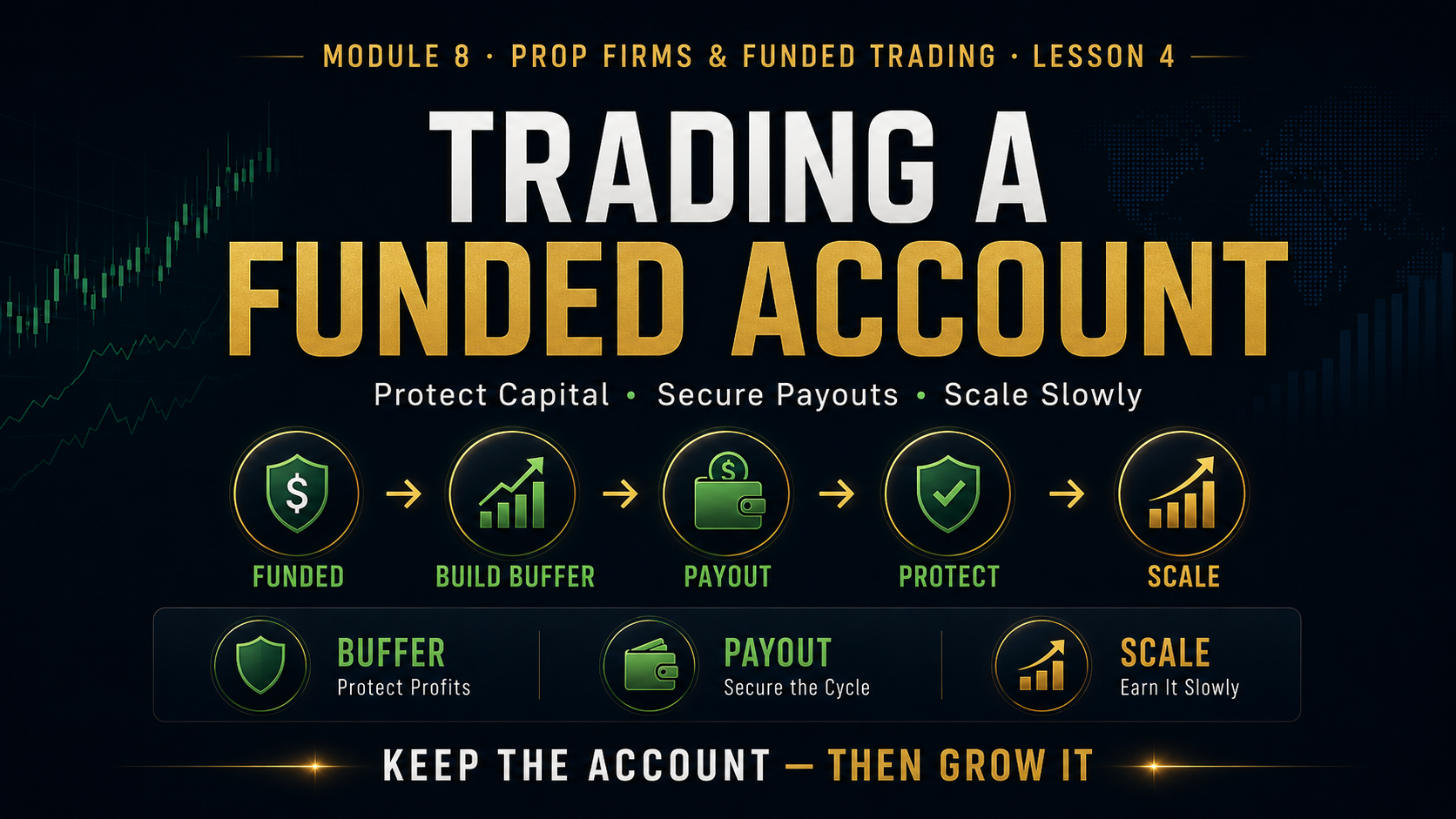
Module 8 · Prop Firms & Funded Trading · Lesson 4
Trading a Funded Account: Protecting Capital, Payouts & Scaling
Learn how to trade a funded account with a capital-preservation mindset, protect your first payout, manage profit buffers, avoid giving back gains and scale risk only after consistency has been proven.
Funded Account
Payout Protection
Profit Buffer
Scaling
Passing a prop challenge feels like the hard part.
For many traders, it is actually the beginning of the harder test.
Once the funded account arrives, excitement increases. The trader may feel pressure to make the first payout quickly, prove the account was deserved or increase risk because the evaluation is finally over.
The goal of a funded account is not to prove how much you can make. It is to prove how long you can keep access to the opportunity.
Funded trading should usually become more controlled after passing — not more aggressive.
Lesson Objectives
What You’ll Learn
✓ Why funded trading requires a different mindset
✓ How to protect your first payout
✓ How to build and manage a profit buffer
✓ How to avoid giving profits back
✓ When to reduce or pause risk
✓ How to scale only after proving consistency
Passing the Challenge Does Not Change the Market
The market does not become easier because the word “funded” appears on the account.
Your strategy still has losing trades. Losing streaks still occur. News still creates volatility. Spreads still widen. Emotional mistakes still exist.
Same Strategy · Same Variance · More Reason to Protect the Account
The Mindset Shift: From Passing to Preserving
Challenge Mindset
“I need to reach the target.”
Funded Mindset
“I need to preserve the account while letting profits accumulate.”
The First Payout Should Be a Major Milestone
A trader who passes an evaluation but never completes a payout has not yet completed the full funded-account cycle.
PASS → STAY FUNDED → BUILD PROFIT → QUALIFY → RECEIVE PAYOUT
The first objective after funding should often be to navigate the account safely enough to complete that cycle.
Do Not Rush the First Payout
Funded on Monday.
Trader wants payout immediately.
Position size increases.
Setup quality drops.
Account fails before payout eligibility.
The first payout is valuable because it proves the entire process can survive — not because it must happen as fast as possible.
Build a Profit Buffer
A profit buffer is the amount of profit sitting between the account’s current value and a critical loss threshold.
Simplified Example
Starting Balance: $100,000
Current Balance: $104,000
Profit: +$4,000
Result: More breathing room under some account structures
The exact benefit depends on the firm’s drawdown model, but in many structures, accumulated profit can create additional room for normal strategy variance.
A Profit Buffer Is Not “Free Money”
Account is up +4%.
Trader thinks: “I can risk the profit.”
Risk jumps dramatically.
Buffer disappears.
This is the funded-account version of the house-money effect.
Profit should increase account resilience before it increases your confidence.
Profit Giveback Is One of the Biggest Funded-Account Risks
Account progress: +5%
Trader becomes aggressive.
Account falls back to +1%.
Most of the buffer has disappeared.
The danger is not merely losing profit. The trader may also move much closer to the account’s drawdown threshold.
Protect More Aggressively as a Payout Gets Closer
If payout eligibility is approaching, there is often less reason to increase exposure.
High-Risk Approach
Increase size to maximize the first payout.
Capital-Preservation Approach
Keep risk stable or reduce it and protect eligibility.
Example First-Payout Protection Rule
“Once the account reaches the minimum payout objective, risk is reduced by 50% until payout eligibility is confirmed.”
This is an educational example, not a universal recommendation.
Know the Exact Payout Rules
A profitable account does not always mean every dollar is immediately withdrawable.
Minimum trading days
Minimum payout period
Consistency requirements
Maximum payout amount
Minimum retained balance or buffer
Profit split
Account-status requirements
Never assume that because the platform shows profit, the full amount is currently eligible for withdrawal.
Should You Withdraw Everything?
The answer depends heavily on the program’s drawdown structure and payout rules.
Withdraw Maximum
Realizes more profit immediately but may leave less account buffer under some models.
Leave a Buffer
May provide more room for normal drawdown depending on how the account rules work.
The correct decision cannot be made without understanding exactly what happens to the drawdown threshold after a payout.
Understand What Happens to Drawdown After a Payout
Before payout:
Balance = $106,000
Payout requested = $5,000
After payout:
Balance = $101,000
Depending on the account structure, the available drawdown after withdrawal may be very different from what it was before the payout.
Always Recalculate the Account After a Withdrawal
New balance
New drawdown threshold
New usable buffer
New appropriate position size
Payout Consistency Matters
If a program uses consistency rules, one huge winning day may delay or complicate payout eligibility.
Total profit: $6,000
Best day: $3,000
Best day = 50% of total profit.
If the firm requires a lower concentration, the trader may need additional profitable trading days before requesting a payout.
Do Not “Fix” Consistency With Reckless Trading
Trader needs more total profit for consistency.
Begins forcing extra trades.
Drawdown increases.
Payout becomes even less likely.
If more profit is required, allow the normal strategy to produce it over time.
Funded Risk Should Usually Feel Boring
SAME SETUPS · SAME RISK · SAME PROCESS
If funded trading suddenly feels far more exciting than your testing or challenge phase, risk may be increasing for the wrong reason.
Do Not Double Risk Because You Are Funded
Challenge risk: 0.5%
Funded account arrives.
Trader moves immediately to 1.5%.
Strategy variance has not changed — but account pressure has tripled.
Plan for Losing Streaks Before the First Payout
Suppose the strategy historically experienced six consecutive losses.
| Risk Per Trade |
6 Losses |
| 0.25% |
Approx. -1.5% |
| 0.50% |
Approx. -3% |
| 1.00% |
Approx. -6% |
Ask whether that loss sequence would still leave enough room to preserve the funded account.
Have a Funded-Account Drawdown Mode
When the account enters drawdown, the objective should shift toward stabilization.
Drawdown Protocol
1. Reduce attention on payout goals.
2. Review whether trades followed the strategy.
3. Reduce risk if the written plan requires it.
4. Trade only the strongest setups.
5. Rebuild buffer gradually.
Never Try to Recover a Funded Drawdown in One Trade
Account drawdown: -3%
Trader risks 3% to recover.
If the trade loses, the account may be placed under severe pressure or fail.
Recover drawdown with the same edge that built the account — not with a bigger bet.
Think in Terms of Payout Cycles, Not One Big Score
A funded account may be more valuable as a repeatable income opportunity than as a vehicle for one unusually large withdrawal.
PAYOUT 1 → PROTECT → PAYOUT 2 → PROTECT → PAYOUT 3
Repeated smaller payouts can demonstrate much more durable execution than one large payout followed by account failure.
Recover Your Costs Before Chasing Size
One useful business-minded milestone is reaching a point where previous challenge and account costs have been recovered through payouts.
Challenge and related costs: $500
First payout received: $1,500
Net before taxes or other expenses: $1,000 above initial cost
Once the initial cost has been recovered, there is even less reason to become reckless trying to prove something with the account.
What Does Scaling Mean?
Scaling can refer to increasing position risk, receiving access to larger funded allocations or adding additional accounts.
Increasing risk per trade
Moving to a larger account size
Using a firm’s formal scaling plan
Operating multiple approved accounts where permitted
Scale Only After the Account Proves Stability
Scaling should be earned by evidence.
✓ Multiple payouts completed
✓ Rule compliance remains high
✓ Drawdown remains within expectations
✓ Strategy expectancy remains positive
✓ No repeated emotional rule violations
✓ Increased scale still fits the account rules
A Winning Streak Is Not a Scaling Plan
Five winners in a row.
Trader doubles size.
Normal losing streak begins.
Account gives back weeks of progress.
Scaling after a hot streak is often just overconfidence disguised as strategy.
Scale in Steps, Not Jumps
Educational Example
Stage 1: Initial conservative risk
Stage 2: Complete multiple payout cycles
Stage 3: Small predetermined increase
Stage 4: Observe new drawdown behavior
Stage 5: Increase again only if stability remains
Multiple Accounts Can Multiply Risk Too
Traders sometimes focus on the total funded allocation while forgetting that the same trade can create exposure across every account.
Account A risk: $500
Account B risk: $500
Account C risk: $500
Combined exposure to one idea: $1,500
Always evaluate total exposure, and follow each firm’s rules regarding copying, account coordination and automation.
Keep a Personal Daily Stop After Funding
The daily stop that protected you during the challenge should not disappear after funding.
Firm Daily Maximum: Emergency boundary
Personal Daily Stop: Normal operating boundary
Have a Rule for Strong Green Days Too
Morning profit: +2.5R
Trader keeps trading because confidence is high.
Afternoon result: -3R
Day finishes negative.
Funded traders need rules for protecting wins as well as containing losses.
Build a Payout Plan Before Profit Arrives
When is payout eligibility reached?
What consistency conditions apply?
Free Academy Access
Unlock the rest of this lesson free
Sign in to continue, or create a 100% free Academy account and unlock the full member experience.
ALREADY A MEMBER?
Sign In & Continue
Access the rest of this lesson instantly.
Forgot password?

 13 min
 13 min
 13 min