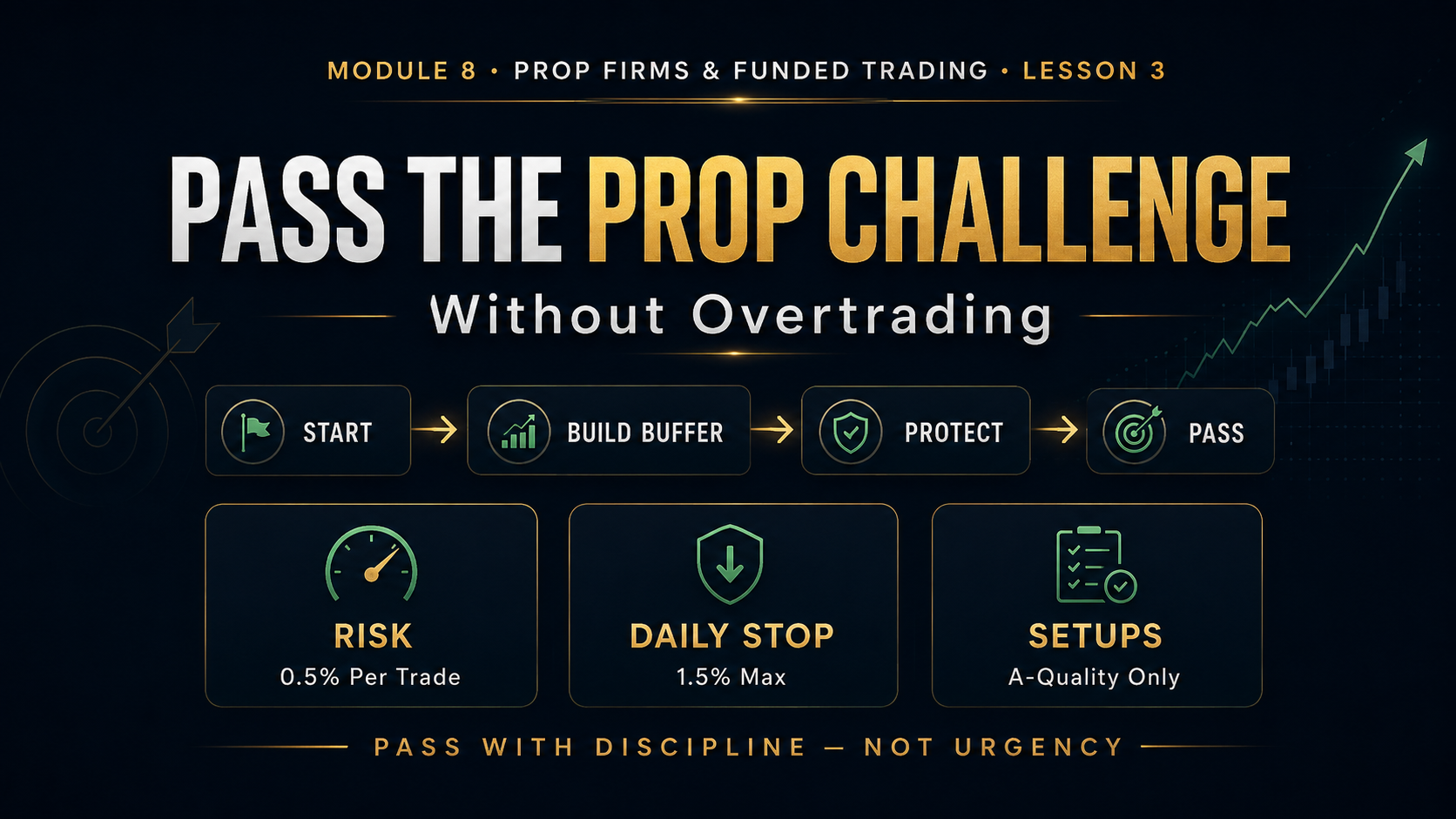
Module 8 · Prop Firms & Funded Trading · Lesson 3
How to Pass a Prop Firm Challenge Without Overtrading
Learn how to build a realistic prop challenge plan using controlled risk, daily loss limits, quality setups, conservative pacing and clear rules that help you reach the target without gambling the account.
Challenge Plan
Risk Per Trade
Daily Stop
Overtrading Control
Most traders do not fail prop challenges because the target is mathematically impossible.
They fail because the presence of a target changes their behavior.
A trader who normally waits patiently for a setup suddenly feels pressure to make money every day.
A trader who normally risks conservatively starts increasing size because the account is “almost passed.”
The challenge should not change your strategy. Your strategy should determine how you approach the challenge.
The goal is not to trade more. The goal is to create enough high-quality opportunities for your tested edge to reach the objective without violating the account.
Lesson Objectives
What You’ll Learn
✓ How to set risk per trade
✓ How to build a daily stop
✓ How to avoid target obsession
✓ How to handle losing streaks
✓ How to protect progress near the target
✓ How to avoid overtrading and revenge trading
The First Goal Is Survival
A prop challenge usually has two objectives:
Objective 1: Reach the profit target.
Objective 2: Never violate the risk rules.
Objective 2 must come first, because once the account is violated, Objective 1 no longer matters.
Stop Turning the Profit Target Into a Daily Quota
Challenge target: 8%
Trader decides to pass in 8 days.
New mental target: 1% every day.
The market does not care about that schedule.
A challenge target is a destination — not a requirement to manufacture profit every day.
Some Challenge Days Should Have No Trades
If your strategy does not produce a valid setup, staying flat protects the account.
NO SETUP = NO TRADE
A zero-trade day is often more valuable than forcing a mediocre setup and losing drawdown unnecessarily.
Start With Your Strategy Statistics
Your challenge plan should be based on how your actual strategy behaves.
Historical win rate
Average winner
Average loser
Expectancy
Maximum losing streak
Maximum historical drawdown
Average trade frequency
Make Sure the Strategy Fits the Challenge
Strategy max historical drawdown: -12R
Planned risk per trade: 1%
Approximate equivalent drawdown: -12%
If the challenge allows only 10% total drawdown, that sizing may be too aggressive.
Adjust risk to fit the account rules — do not assume the account can survive the same sizing you would use elsewhere.
Choose Risk Per Trade Before the Challenge Starts
Risk should not change because of emotion, recent results or distance from the target.
| Risk Per Trade |
6 Consecutive Losses |
| 0.25% |
Approx. -1.5% |
| 0.50% |
Approx. -3% |
| 1.00% |
Approx. -6% |
| 2.00% |
Approx. -12% |
Lower risk gives a strategy more room to experience normal variance without threatening the account.
Do Not Size Positions Based on the Remaining Target
Target remaining: 2%
Trader thinks: “If I risk 2%, one winner can finish it.”
That is not risk management. That is target-driven sizing.
Risk should be determined by the trading plan — not by how badly you want to pass.
Build a Personal Daily Stop
The firm’s daily drawdown is an account failure threshold. Your own trading should usually stop earlier.
Educational Example
Firm Daily Limit: 5%
Risk Per Trade: 0.5%
Personal Daily Stop: 1.5%
Maximum Full Losses: 3
Example only. Appropriate risk limits vary by trader and program.
Why a Trade-Count Limit Helps
After several losses, your next decision may be influenced more by frustration than by strategy quality.
Trade 1: -1R
Trade 2: -1R
Trade 3: -1R
Trader thinks: “I need one more trade to get it back.”
A predefined stop rule removes that decision.
Expect Losing Streaks Before They Happen
Losing streaks do not disappear because you bought a prop challenge.
Historical max losing streak: 7
Current challenge losing streak: 4
Interpretation: Still potentially inside normal strategy variance.
If you expect losses mathematically, you are less likely to treat them emotionally.
Consider a Drawdown Risk-Reduction Rule
Some traders choose to reduce risk as account drawdown increases.
| Challenge Status |
Example Risk Rule |
| 0% to -2% drawdown |
Normal planned risk |
| -2% to -4% |
Reduced risk |
| Beyond personal review threshold |
Pause and review |
Never Increase Risk Because You Are Losing
Loss 1: 0.5% risk
Loss 2: 1% risk
Loss 3: 2% risk
Loss 4: 4% risk
Risk escalation can turn a normal losing sequence into a challenge failure.
What Overtrading Looks Like During a Challenge
Taking setups outside your normal session
Trading lower-quality setups
Entering immediately after a loss
Adding more symbols to find activity
Switching timeframes to justify entries
Trading during news you normally avoid
Continuing after the planned session ends
More Trading Does Not Mean Faster Progress
Trader A
25 trades in one week
Many B/C setups
-3.5%
Trader B
6 qualified trades
Only A setups
+2.5%
Activity and progress are not the same thing.
Reduce Trade Frequency Before You Reduce Setup Quality
A challenge should make you more selective, not less.
Example A-Setup Requirements
✓ Higher-timeframe alignment
✓ Approved market location
✓ Exact confirmation trigger
✓ Acceptable risk-to-reward
✓ Inside approved trading session
✓ No rule conflict with economic news
Break the Challenge Into Process Milestones
Instead of obsessing over the final target, focus on smaller process states.
Stage 1: Protect starting balance.
Stage 2: Build first positive buffer.
Stage 3: Maintain normal risk and execution.
Stage 4: Protect progress near the finish line.
The First Objective Can Simply Be Staying Above Breakeven
Traders often put themselves under pressure from the very first day.
The first week does not need to produce the target. It needs to preserve enough account flexibility for the strategy to continue operating.
Build a Profit Buffer Before Thinking About Speed
Starting balance: $100,000
Current balance: $103,000
Challenge progress: +3%
That 3% is valuable because it creates psychological and financial breathing room.
Protect Progress After a Strong Day
Morning: +2R
Trader feels confident.
Afternoon: takes three unnecessary trades.
Day finishes: -0.5R.
A profitable day does not create an obligation to keep trading.
Consider a Profit-Protection Rule
Example process rule:
“Once the session reaches +2R, no additional trade is allowed unless a predefined A+ setup occurs.”
The Finish-Line Trap
The closer traders get to the target, the more likely they are to change behavior.
Profit target: +8%
Current account: +7.4%
Remaining: +0.6%
Trader starts thinking about passing instead of trading.
Reduce Urgency Near the Finish Line
When only a small amount remains, there is usually less need to expose large risk.
Finish-Line Gambling
Double risk to finish today.
Finish-Line Discipline
Maintain or reduce exposure and wait for a qualified setup.
THE CLOSER YOU ARE, THE LESS YOU NEED TO FORCE.
Do Not Change Your Trade Management to Pass Faster
Normal strategy target: 2R
Trader needs only 0.7% to pass.
Trader begins closing trades randomly or moving stops based on account progress.
The account target should not interfere with the logic of the individual trade.
What to Do When the Challenge Enters Drawdown
Drawdown is when traders are most tempted to abandon the plan.
Drawdown Response
1. Stop thinking about the profit target.
2. Compare the drawdown with historical strategy behavior.
3. Review rule compliance.
4. Reduce risk if the plan requires it.
5. Take only your best setups.
6. Recover through process, not urgency.
Do Not Try to Recover Everything in One Trade
Current challenge drawdown: -3%
Trader risks 3% on next trade to “get back to breakeven.”
One additional loss may put the account under extreme pressure.
Recovery should be a sequence of normal trades, not one oversized rescue attempt.
A Controlled Red Day Can Be a Good Challenge Day
Two valid setups.
Both lose at planned risk.
Daily stop reached.
Trader stops.
Rules followed perfectly.
That day may be more professional than a profitable day created through rule violations.
A Green Day Can Still Be Poor Trading
Trader ignores setup criteria.
Risks too much.
Trade happens to win +3%.
The result rewarded bad behavior.
Think About Consistency Before You Pass
If the program includes consistency requirements, oversized winning days can create problems later.
Day 1: +4%
Day 2: +0.5%
Day 3: +0.4%
Day 4: +0.3%
One large day may represent an excessive share of total profit depending on the program.
THE BEST CHALLENGE PACE IS THE ONE YOUR STRATEGY CAN REPEAT.
Build a Daily Challenge Routine
Before Session: Check current account balance and drawdown.
Before Session: Check high-impact economic news.
Before Session: Mark valid strategy locations.
Before Trade: Calculate position size.
Before Trade: Check remaining daily loss room.
After Trade: Update current daily P&L.
After Loss: Apply reset routine.
Session End: Journal results and close the platform.
Track Process Instead of “Days Until I Pass”
Daily Challenge Scorecard
Rule Compliance
100%
A-Setups Taken
2
FOMO Trades
0
Daily Risk Used
1.0%
Result
+0.5R
Status
Plan Followed

 13 min
 13 min
 13 min