Break of Structure & Change of Character: How Market Direction Begins to Shift
Learn how to recognize Break of Structure (BOS), Change of Character (CHoCH), failed trends, continuation signals and the early signs that buyers or sellers may be losing control.
A trend is not permanent.
At some point, the sequence of higher highs and higher lows in an uptrend can begin to fail. The same is true for lower highs and lower lows in a downtrend.
When an important structural level is broken, the market is giving you new information.
The goal of this lesson is to teach you how to separate continuation from potential reversal and how to read structure logically instead of reacting to every breakout candle.
What You’ll Learn
What Is a Break of Structure?
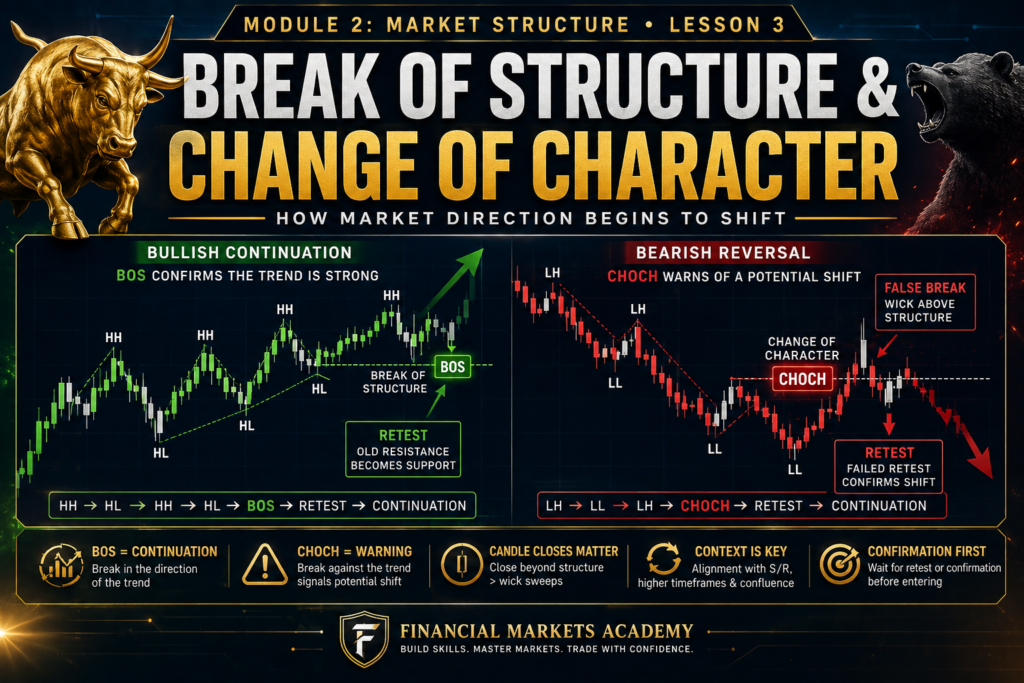
A Break of Structure, often shortened to BOS, occurs when price breaks beyond an important structural high or low.
In a bullish trend, a break above the previous swing high can confirm continuation.
In a bearish trend, a break below the previous swing low can confirm continuation.
Bullish Break of Structure
In bullish structure, price is making higher highs and higher lows.
That break tells you buyers have successfully pushed beyond the previous area where sellers stopped the market.
It does not mean you should chase the breakout. It means the bullish structure remains valid.
Bearish Break of Structure
In bearish structure, price is making lower highs and lower lows.
This confirms that sellers remain strong enough to break a previous support point and extend the downtrend.
What Is a Change of Character?
A Change of Character, often shortened to CHoCH, is a structural break that goes against the existing trend.
It can be an early sign that the current trend is weakening or that control may be shifting.
CHoCH Does Not Automatically Mean Reversal
This point is extremely important.
A Change of Character is a warning — not a guaranteed reversal.
Price may break minor structure, pull back deeply, and then resume the original trend.
Continuation Break vs. Reversal Warning
Continuation
Price breaks structure in the direction of the existing trend.
Potential Shift
Price breaks structure against the existing trend.
Bullish to Bearish Change of Character
Imagine a market has been producing:
Then price fails to make another convincing higher high and drops through the previous higher low.
Sellers have now done something they were previously unable to do: break an important bullish support point.
Bearish to Bullish Change of Character
Now imagine a bearish market producing:
Then buyers break above the previous important lower high.
Buyers have now broken a level that sellers previously defended successfully.
Major Structure vs. Minor Structure Matters
Not all structural breaks carry the same importance.
Short-Term Noise
A small intraday swing breaks while the broader structure remains intact.
Structural Shift
A major swing high or low that defines the broader trend is broken.
Always ask which structural level actually matters to the timeframe you are trading.
Why Candle Closes Matter
A wick through a structural level is not necessarily a valid break.
Price may briefly trade beyond a high or low, trigger stops, and then immediately return.
Wick moves beyond structure but candle closes back inside.
Candle body closes beyond structure and price shows follow-through.
Be Careful With Liquidity Sweeps
Previous highs and lows often attract stop orders.
Price can move through those levels briefly, trigger stops and then reverse.
What Is a False Break of Structure?
A false break occurs when price appears to break an important structural point but fails to continue.
Why Retests Can Be Useful
After a structural break, price often pulls back toward the broken level.
That retest can help show whether the market accepts the new structure.
Retests are not mandatory, but they can provide cleaner context than chasing the original breakout.
Break, Retest, Continuation
This sequence can help traders avoid emotional entries directly into an extended breakout candle.
Combine Structure Breaks With Support & Resistance
Structure becomes more powerful when it aligns with meaningful price zones.
Bullish Example
That is far more meaningful than buying simply because one green candle appeared.
Failed Continuation Can Be Important
Sometimes the first warning is not the break itself.
It is the market’s failure to continue.
The combination of failed continuation plus structural break can be more meaningful than either event alone.
Break of Structure Across Timeframes
A break that looks dramatic on a five-minute chart may be insignificant on the four-hour chart.
| Timeframe | Structure | Interpretation |
|---|---|---|
| 4 Hour | Bullish | Major trend intact |
| 1 Hour | Neutral / Pullback | Temporary weakness |
| 5 Minute | Bearish BOS | Could simply be short-term correction |
Do Not Chase Every Structure Break
By the time a strong breakout candle closes, price may already be extended.
Entering late can create poor risk-to-reward.
Enter after a huge breakout candle with a wide stop and nearby target.
Wait for pullback, retest or valid confirmation where risk can be clearly defined.
A Structure Break Is Context — Not the Entire Trade
Even a clean BOS or CHoCH does not remove the need for trade planning.
Before Entering, Still Ask:
Practical Example: Bearish Structure Turning Bullish
Imagine EUR/USD has been moving lower.
Practical Example: Bullish Structure Turning Bearish
Common BOS & CHoCH Mistakes
Minor noise should not be confused with meaningful market structure.
It is a warning that conditions may be changing, not certainty.
A wick through structure may simply be a sweep.
Short-term bearish structure can exist inside a major bullish trend.
Late entries can destroy risk-to-reward even when direction is correct.
Structural breaks are stronger when they make sense within the larger price context.
BOS & CHoCH Analysis Framework
Learn When Market Structure Is Continuing — and When It May Be Changing
Financial Markets Academy offers live 1-on-1 mentorship for traders who want help identifying meaningful structure breaks, recognizing failed trends, reading retests and combining price action with disciplined risk management.
Reserve Your Seat →Structure Break Checklist
Frequently Asked Questions
What is a Break of Structure in trading?
A Break of Structure occurs when price breaks an important swing high or low. It often confirms continuation when the break occurs in the direction of the existing trend.
What does CHoCH mean in trading?
CHoCH stands for Change of Character. It describes a structural break against the existing trend and can be an early warning that market control is changing.
Does CHoCH guarantee a reversal?
No. It signals a possible change in behavior, but price may still resume the original trend. Context and confirmation are necessary.
Does a wick count as a Break of Structure?
Not always. Many traders prefer to see a meaningful candle close beyond the level because a wick can simply represent a temporary sweep or failed breakout.
What is the difference between BOS and CHoCH?
BOS usually describes a structural break in the direction of the prevailing trend, while CHoCH describes a break against the existing trend that may warn of a potential shift.
Should I enter immediately after a structure break?
Not necessarily. Breakout entries can be extended. A pullback, retest or other confirmation may provide clearer invalidation and better risk-to-reward.
Module 2 · Lesson 3 Knowledge Quiz
B. Possible continuation
C. Broker manipulation
D. No structure
B. Change of Chart
C. Candle High Confirmation
D. Chart Holding Order
B. No
C. Only on daily charts
D. Only on Forex
B. Wicks never matter
C. Candles do not matter
D. They determine leverage
B. A random indicator
C. Maximum lot size
D. Entering immediately
Key Takeaways
Lesson 4: Liquidity, Stop Hunts & False Breakouts
Now that you understand structure breaks, the next lesson explores why price frequently moves beyond obvious highs and lows before reversing — and why traders get trapped around breakout levels.