Module 5 · Trading Sessions, Timing & Market Conditions · Lesson 5
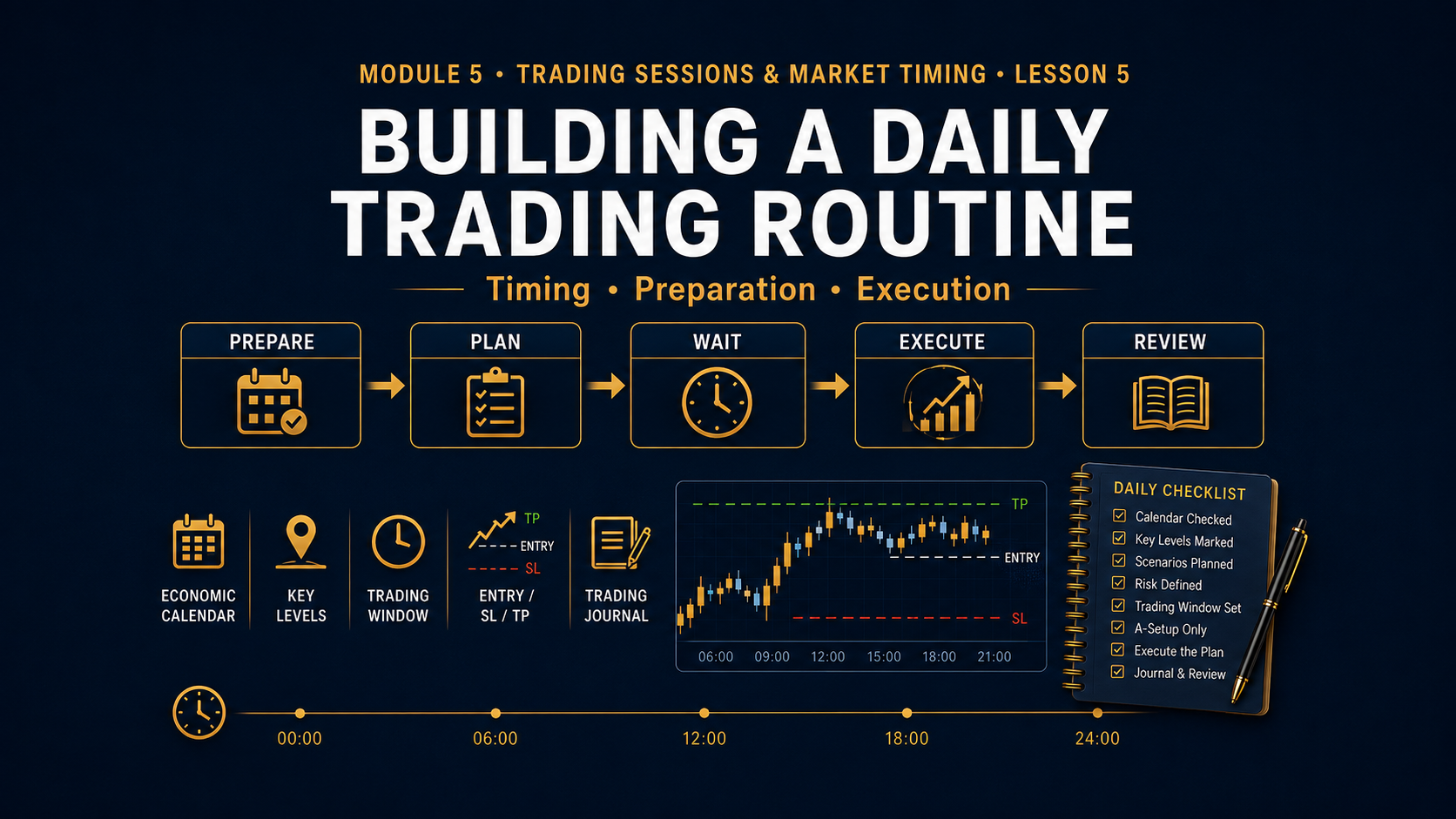
Building a Daily Trading Routine: Timing, Preparation & Execution
Learn how to build a repeatable daily trading routine that combines market preparation, economic-calendar checks, trading sessions, setup selection, execution, risk control and post-session review.
Pre-Market Prep
Trading Window
Execution
Review
Most trading mistakes do not begin with the entry.
They begin before the trader even opens the chart.
No preparation. No economic-calendar check. No defined session. No idea which levels matter. No maximum risk. No rule for when to stop.
Then the market opens, price starts moving, and every decision becomes reactive.
A strong trading routine reduces the number of decisions you need to make while money is on the line.
The goal of a daily routine is not to predict the market before the day begins. It is to arrive prepared for the scenarios the market may present.
Lesson Objectives
What You’ll Learn
✓ How to prepare before the session
✓ How to mark key levels in advance
✓ How to plan around economic news
✓ How to define a trading window
✓ How to stop overtrading
✓ How to review the session afterward
Why a Daily Trading Routine Matters
A routine creates consistency around the trading process.
You cannot control whether the next trade wins, but you can control whether you prepared properly, followed your risk rules and traded only during your defined conditions.
Prepare → Wait → Execute → Manage → Stop → Review
The routine should be repeated whether yesterday was profitable or unprofitable.
Preparation Begins Before Your Trading Window
If your trading session begins at the London or New York open, preparation should happen beforehand.
✓ Open charts before your trading window.
✓ Review higher-timeframe structure.
✓ Check the economic calendar.
✓ Mark important highs and lows.
✓ Define likely scenarios.
✓ Know exactly when you are allowed to start trading.
Step 1: Check the Economic Calendar
Before drawing a single setup, know whether major scheduled events are likely to affect your markets.
Event: What is being released?
Time: When will it occur?
Currency / Market: Which instruments may be affected?
Impact: Does your strategy require a no-trade window?
This immediately tells you whether parts of the session are restricted.
Mark News Directly Into the Day
8:30 — High-impact U.S. release
No-trade window: 8:15–8:45
9:30 — U.S. cash-market open
Trading plan now reflects the day’s actual timing risk.
Step 2: Establish Higher-Timeframe Context
Before dropping into the entry timeframe, understand the larger chart.
• Is the market trending or ranging?
• Are higher highs and higher lows forming?
• Are lower highs and lower lows forming?
• Is price near major support?
• Is price near major resistance?
• Is price already extended?
Lower-timeframe entries should live inside a higher-timeframe story.
Step 3: Mark the Levels That Matter
Avoid drawing dozens of lines.
Mark only the levels that could meaningfully affect the trading session.
Previous Day High
Previous Day Low
Asian High
Asian Low
Major Support
Major Resistance
For New York, London highs and lows may also become important intraday references.
Step 4: Build Scenarios — Not Predictions
Preparation should not sound like:
“EUR/USD is definitely going up today.”
A better approach is conditional.
If Asian low is swept at higher-timeframe support…
And if bullish structure returns…
Then I will evaluate a long setup.
Think in “If → Then” Statements
IF: London sweeps resistance and rejects…
THEN: Wait for bearish CHoCH.
IF: Resistance breaks and holds…
THEN: Look for bullish continuation on retest.
Scenarios keep you flexible without making you directionless.
Step 5: Decide What You Are Trading
Opening twenty charts usually creates more distraction, not more opportunity.
Choose a defined watchlist.
Know which session each instrument trades best in.
Remove markets that do not fit today’s conditions.
Focus your attention instead of constantly scanning everything.
Example New York Watchlist
EUR/USD
GBP/USD
XAU/USD
S&P 500
Nasdaq
Step 6: Define the Trading Window
Your trading session should have a beginning and an end.
Example
“I look for setups only during the first two hours of my New York trading window.”
When the window ends, the search for new trades ends too.
Why an End Time Matters
No setup appears during your main window.
You keep watching for four more hours.
Boredom increases.
Standards drop.
Eventually you trade because you waited all day — not because the setup is good.
Step 7: Define Daily Risk Before the First Trade
Decide in advance how much risk the day is allowed to contain.
Risk Per Trade: Predefined percentage or amount.
Maximum Daily Loss: Hard stopping point.
Maximum Trades: Optional overtrading control.
Maximum Exposure: Total simultaneous risk allowed.
Risk rules should not become more aggressive because the first trade lost.
Step 8: Define What an A-Quality Setup Looks Like
The routine should remind you what qualifies before the market starts moving quickly.
✓ Higher-timeframe context
✓ Meaningful location
✓ Session timing
✓ Liquidity event or clean breakout
✓ Confirmation candle
✓ BOS / CHoCH if required
✓ Logical invalidation
✓ Realistic target
✓ Minimum risk-to-reward
Step 9: Wait
Preparation is finished.
Now comes the part that many traders struggle with most.
Your Job
Do Nothing Until the Market Meets Your Conditions.
Do Not Invent a Setup Because the Session Is Quiet
You expected volatility.
Market stays quiet.
No liquidity sweep appears.
No breakout confirms.
No trade is the correct result.
Step 10: Execute the Setup Exactly as Planned
When the setup finally appears, execution should become mechanical.
1. Confirm setup conditions.
2. Define exact entry.
3. Define stop / invalidation.
4. Define target.
5. Confirm risk-to-reward.
6. Calculate position size.
7. Execute.
Take a Screenshot Before Entry
A simple screenshot preserves what you actually saw before the outcome became known.
Capture structure.
Capture entry.
Capture stop.
Capture target.
Capture the reason for entering.
This prevents hindsight from rewriting the setup later.
Step 11: Follow the Management Plan
Once the trade is open, return to the rules from Module 4.
• Is the trade set-and-forget?
• When can the stop move to breakeven?
• Are partial profits allowed?
• Does the stop trail behind structure?
• What market behavior permits an early exit?
Watching Every Tick Can Create Problems
If the strategy does not require continuous management, staring at floating profit and loss can increase emotional interference.
The chart should trigger management decisions — not the discomfort of watching money fluctuate.
Step 12: Handle a Losing Trade Correctly
A stop loss is not permission to abandon the routine.
Trade loses.
Pause.
Record the trade.
Check whether the setup was valid.
Do not immediately manufacture a recovery trade.
Build Protection Against Revenge Trading
Possible rule: mandatory pause after a loss.
Possible rule: maximum two losses per session.
Possible rule: session ends after daily loss limit.
Possible rule: next trade must still meet full A-setup criteria.
A Winning Trade Can Create Overconfidence Too
Emotional trading does not only happen after losses.
First trade wins 2R.
Trader feels invincible.
Second setup is mediocre.
Position size increases anyway.
Winning can create rule-breaking just as easily as losing.
Know When the Trading Day Is Finished
The trading day should end because a rule says it ends — not because you are emotionally exhausted.
Session Can End When
✓ Trading window expires
✓ Daily loss limit is reached
✓ Maximum number of trades is reached
✓ Market conditions deteriorate
✓ Your planned setup opportunity has passed
Be Careful With Mandatory Daily Profit Targets
A goal such as “I must make $500 today” can create pressure to trade when no setup exists.
The market controls opportunity. Your routine controls whether you participate.
Step 13: Post-Session Review
Once your trading window ends, the work shifts from execution to review.
✓ What setups appeared?
✓ Which trades were taken?
✓ Were all rules followed?
✓ Was risk correct?
✓ Were entries late or early?
✓ Were stops logical?
✓ Were targets realistic?
✓ Did emotion interfere?
✓ What should be repeated or corrected tomorrow?
Build a Simple Trading Journal
| Field |
What to Record |
| Date / Session |
When the trade occurred |
| Instrument |
Market traded |
| Setup |
Exact setup classification |
| Risk |
Amount / percentage risked |
| Result |
Final R-multiple |
| Rule Compliance |
Did you follow the plan? |
| Lesson |
What should be learned from the trade? |
Score the Routine — Not Just the P&L
A disciplined losing day can be more valuable than a reckless winning day.
Professional Day
Calendar checked, setups filtered, risk respected, rules followed — even if result is negative.
Free Academy Access
Unlock the rest of this lesson free
Sign in to continue, or create a 100% free Academy account and unlock the full member experience.
ALREADY A MEMBER?
Sign In & Continue
Access the rest of this lesson instantly.
Forgot password?

 11 min
 12 min
 11 min