Module 5 · Trading Sessions, Timing & Market Conditions · Lesson 2
London Session Trading: Volatility, Breakouts & High-Quality Setups
Learn how the London open changes market behavior, how to read Asian-range sweeps, distinguish false breakouts from genuine expansion, and identify higher-quality London session trade setups.
London Open
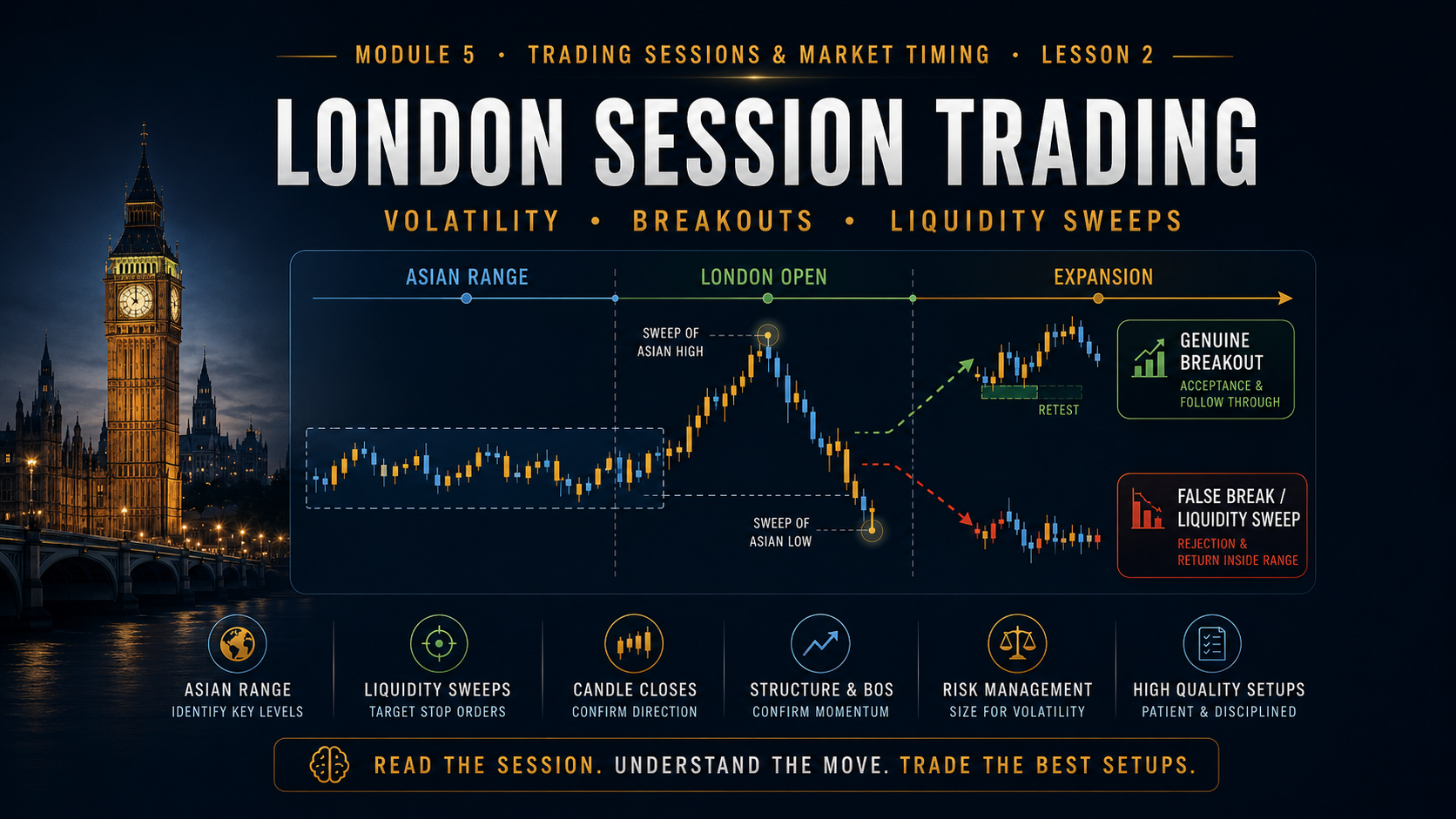
Asian Range
Liquidity Sweeps
Breakout Confirmation
The London session is where many quiet overnight charts suddenly wake up.
Liquidity increases, candle ranges expand, important overnight highs and lows come under pressure, and moves that looked impossible during Asia can develop quickly.
This makes London attractive — but also dangerous.
The London open creates opportunity because participation increases. It creates risk for exactly the same reason.
The goal is not to trade every London breakout. The goal is to understand what price is doing when European liquidity enters and wait for the best structural opportunity.
Lesson Objectives
What You’ll Learn
✓ Why London changes volatility
✓ How to mark the Asian range
✓ How Asian liquidity gets swept
✓ Genuine vs false London breakouts
✓ How to use structure for confirmation
✓ When London setups are low quality
Why the London Session Matters
London is one of the world’s most important financial centers.
When London opens, participation from European banks, funds, institutions and other market participants increases significantly.
Typical Transition
Overnight Consolidation → European Liquidity → Expansion
That expansion is often what intraday traders are waiting for.
Start With the Asian Range
Before London opens, identify the most important overnight boundaries.
Asian High: Highest meaningful overnight price.
Asian Low: Lowest meaningful overnight price.
Asian Range: The area between those two boundaries.
These levels often become obvious reference points when London enters.
Why Asian Highs and Lows Matter
Obvious overnight highs and lows can contain clustered stop orders and breakout entries.
Above Asian High: Buy stops, breakout orders, short stops.
Below Asian Low: Sell stops, breakout orders, long stops.
London: May attack one or both sides as participation increases.
The London Liquidity Sweep
A liquidity sweep occurs when price trades beyond an obvious high or low but fails to maintain acceptance beyond it.
Asian high: 1.0850
London trades to: 1.0862
Breakout buyers enter.
Price closes back below 1.0850.
The break failed to hold.
That failure can become important evidence, especially when it occurs at higher-timeframe resistance.
Bearish Setup After an Asian-High Sweep
Example Sequence
1. Higher timeframe is bearish.
2. Asia forms a tight range.
3. London trades above the Asian high.
4. Price rejects higher levels.
5. Bearish engulfing candle forms.
6. Minor bullish structure breaks.
7. Trader evaluates a short setup.
Bullish Setup After an Asian-Low Sweep
Higher timeframe bullish.
London trades below Asian low.
Price sweeps sell-side liquidity.
Bullish rejection candle closes back above range.
Bullish structure returns.
Potential long setup develops.
The sweep itself is not the trade. The reaction and confirmation after the sweep are what matter.
Genuine London Breakouts
London does not always reverse overnight levels.
Sometimes increased liquidity creates genuine expansion through the Asian range.
Price approaches Asian high.
Large bullish candle closes above it.
Next candles maintain higher prices.
Pullback holds above the old range.
Price is showing acceptance above the breakout.
Rejection vs. Acceptance
Rejection
Price trades beyond the level but closes back inside and fails to hold the breakout.
Acceptance
Price closes beyond the level, remains there and begins building new structure outside the old range.
Candle Closes Matter at the London Open
London volatility can produce fast wicks through important levels.
An unfinished candle may look like a perfect breakout and become a complete rejection by the close.
During Candle: Price 15 pips above resistance.
At Close: Price back beneath resistance.
Lesson: Wick beyond level ≠ confirmed breakout.
Break-and-Retest London Setups
A clean breakout followed by a retest can provide a more controlled setup than chasing the first expansion candle.
Example
Asian High Break → Strong Close → Pullback → Retest Holds → Bullish Confirmation
This approach sacrifices the earliest possible entry in exchange for additional evidence.
Do Not Chase the First Big London Candle
One of the easiest London mistakes is entering after a huge expansion candle simply because the market finally started moving.
Breakout begins near: 1.1000
Trader hesitates.
Price explodes to: 1.1040
Trader enters late.
Reward has already been consumed while stop distance remains large.
London Volatility Requires Different Risk Awareness
Wider candle ranges can make tight stops more vulnerable.
They can also create larger stop distances, which means position size must adjust accordingly.
Higher volatility does not justify higher account risk.
A wider technical stop should normally mean a smaller position if account risk remains constant.
What Makes a Higher-Quality London Setup?
✓ Clear higher-timeframe structure
✓ Meaningful Asian/session level
✓ Liquidity sweep or genuine breakout
✓ Strong candle close
✓ Momentum or displacement
✓ BOS / CHoCH confirmation
✓ Logical stop placement
✓ Clean target space
✓ Acceptable risk-to-reward
London A-Quality Setup Example
A-Quality Bearish Setup
Higher Timeframe: Bearish trend.
Location: Asian high aligns with resistance.
London: Price sweeps above Asian high.
Reaction: Strong bearish rejection.
Confirmation: CHoCH lower.
Entry: Retest of broken minor structure.
Stop: Above sweep high.
Target: Asian low / opposing liquidity.
What Makes a Weak London Setup?
✕ No clear higher-timeframe direction
✕ Price in middle of the Asian range
✕ No meaningful liquidity event
✕ Tiny overlapping candles
✕ Entering after a huge extended candle
✕ Major opposing level immediately ahead
✕ Poor risk-to-reward
What if the Asian Range Is Already Very Wide?
An unusually large overnight range can change the London opportunity.
If price has already traveled significantly before London opens, there may be less room for clean expansion.
Do not assume every London session must break out dramatically. Context still matters.
Very Tight Asian Ranges Can Create Strong Expansion
When overnight volatility becomes unusually compressed, London can sometimes provide a strong release of that compression.
Asia forms a narrow 20-pip range.
Price compresses near resistance.
London enters with strong bullish displacement.
Contraction transitions into expansion.
Higher-Timeframe Structure Comes Before Session Bias
Never assume London must sweep one side simply because the session opened.
The broader chart should still guide your bias.
4H: Bullish trend.
1H: Pullback into support.
Asian: Range forms above support.
London: Sweep below Asian low may be more interesting than blindly selling the break.
The First London Move Does Not Always Win
Traders sometimes assume the first strong move after London opens establishes the day’s direction.
It can.
But it can also be a liquidity grab.
Never confuse speed with confirmation.
London Can Sweep Both Sides
On particularly volatile mornings, price can attack both the Asian high and low before choosing a sustained direction.
Asian high swept.
Price reverses through range.
Free Academy Access
Unlock the rest of this lesson free
Sign in to continue, or create a 100% free Academy account and unlock the full member experience.
ALREADY A MEMBER?
Sign In & Continue
Access the rest of this lesson instantly.
Forgot password?

 11 min
 11 min
 13 min