Module 5 · Trading Sessions, Timing & Market Conditions · Lesson 4
Economic News & High-Impact Events: When Not to Trade
Learn how major economic releases, central-bank decisions, inflation data and employment reports can change spreads, slippage, volatility and execution — and how to build a clear no-trade filter around high-impact events.
Economic Calendar
High-Impact News
Slippage
No-Trade Rules
Some of the worst trading decisions begin with a chart that looks perfect.
Structure is clean. Price is sitting at support. Confirmation appears. Risk-to-reward looks excellent.
Then a major economic release hits thirty seconds later and the entire market changes.
A technical setup does not exist in isolation. Scheduled economic events can temporarily overwhelm normal price-action behavior.
Knowing when not to trade is one of the most valuable timing skills a trader can develop.
Lesson Objectives
What You’ll Learn
✓ What high-impact news is
✓ Why volatility spikes around releases
✓ How spreads and slippage can change
✓ Why the first move can be misleading
✓ How to create no-trade windows
✓ When post-news trading may become safer
What Is High-Impact Economic News?
High-impact news refers to scheduled economic events that can materially change expectations about growth, inflation, interest rates, employment or monetary policy.
Common High-Impact Events
• Central-bank interest-rate decisions
• Inflation reports
• Employment reports
• GDP releases
• Retail-sales data
• Major central-bank speeches
• Other market-moving macroeconomic releases
Why Does Price Move So Fast Around News?
Markets are continuously pricing expectations about the future.
When a major data release differs from what participants expected, traders and institutions can rapidly reprice assets.
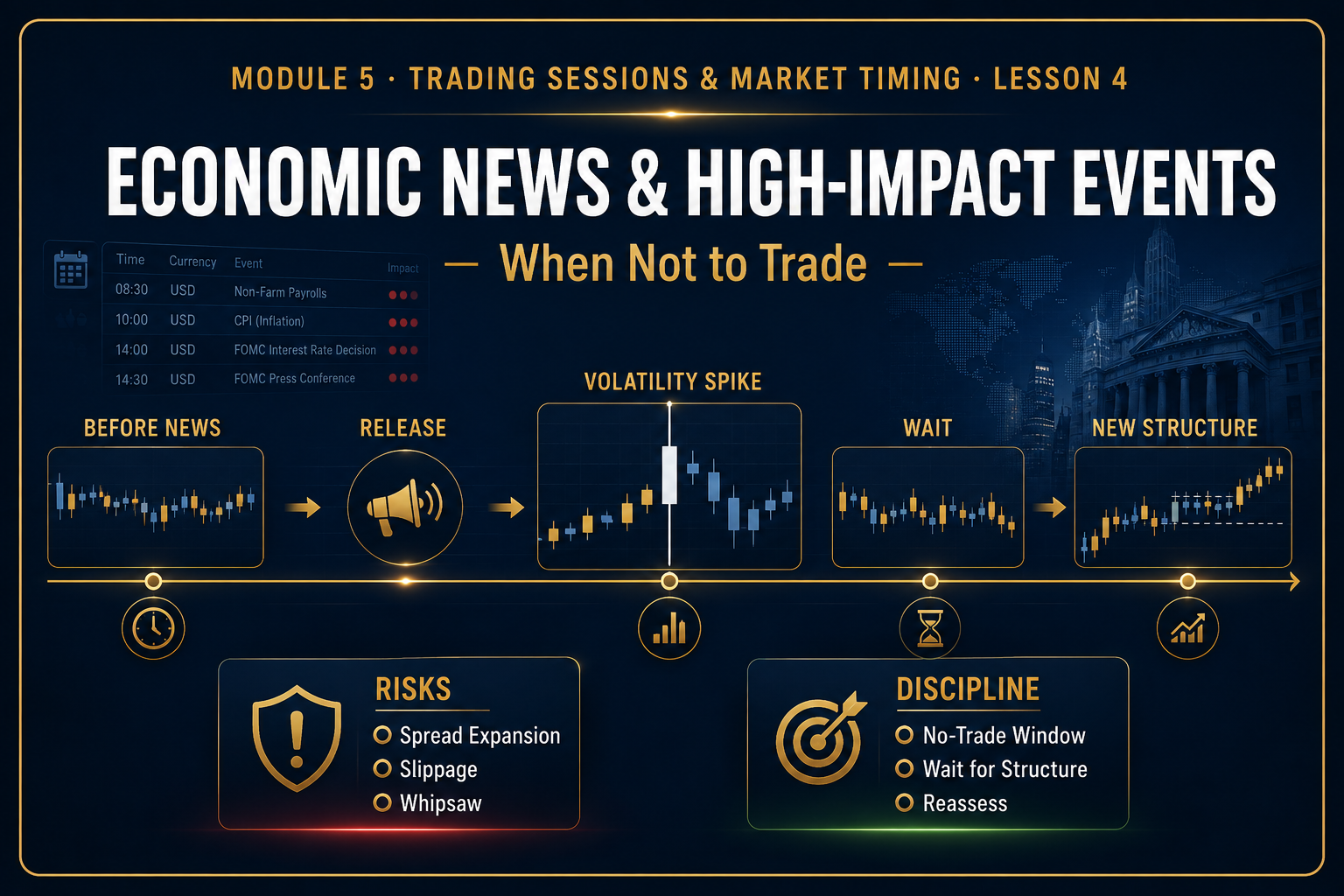
Expectation → New Information → Repricing → Volatility
Forecast vs. Actual
Markets often react not simply to whether a number looks good or bad, but to how the actual result compares with expectations.
Forecast: What economists or markets broadly expected.
Actual: The released number.
Previous: Prior reported value, which may sometimes be revised.
A seemingly “good” number can still produce a negative market reaction if participants expected something even stronger.
Spreads Can Widen Around Major Releases
During normal conditions, the distance between bid and ask may be relatively stable.
Around major economic announcements, liquidity conditions can change rapidly and spreads can widen.
Normal spread: 1 pip
News spread: temporarily much wider
Entry and exit costs can change exactly when volatility is highest.
Slippage Can Increase Too
Fast-moving markets may execute orders at prices different from the level you expected.
Requested Exit: 1.1000
Actual Fill: 1.0988
Reason: Price moved rapidly through available liquidity.
This is why a stop loss reduces risk but cannot guarantee an exact execution price during extreme conditions.
News Candles Can Create Extreme Wicks
A high-impact release can push price sharply in one direction and then immediately reverse.
Release hits.
Price spikes above resistance.
Breakout traders buy.
Price collapses back below the level.
A huge wick remains.
The First Move Is Not Always the Real Move
Initial algorithms, fast traders and order imbalances can create a violent first reaction.
Once the market has more time to process the details, direction can change completely.
The fastest candle is not necessarily the most trustworthy candle.
What Is a News Whipsaw?
A whipsaw occurs when price rapidly moves one way and then aggressively reverses.
Spike Higher → Reverse Lower → Spike Higher Again
This environment can trigger both buy and sell orders before a stable direction appears.
Tight Stops Become Especially Vulnerable
A stop that makes sense during normal conditions may sit inside a single news candle during high volatility.
Normal 5-minute range: 10 pips
News 5-minute range: 60 pips
Normal stop logic may no longer behave normally.
Widening the Stop Is Not Automatically the Solution
Some traders respond to news volatility by simply using an enormous stop.
That can create equally serious problems.
If market conditions no longer fit your tested strategy, avoiding the trade can be better than redesigning the risk plan in real time.
Build a No-Trade Window
One simple method is to define a period around major releases when new positions are not allowed.
Example Rule
“No new trades from 15 minutes before until 15 minutes after a high-impact release affecting my instrument.”
The exact timing should match the trader’s tested strategy. The important part is that the rule exists before the event arrives.
Not Every Economic Event Needs the Same Filter
Economic calendars commonly categorize events by expected market impact.
Lower Impact
Often limited market reaction, although surprises can still matter.
Medium Impact
Can increase volatility depending on context.
High Impact
Greater potential for rapid repricing and unstable execution.
The Event Must Be Relevant to the Market You Trade
A high-impact event affecting one currency or economy may matter much more to certain instruments than others.
USD news: Especially relevant to USD pairs, gold and many U.S.-linked markets.
GBP news: Particularly relevant to GBP instruments.
EUR news: Particularly relevant to euro-related markets.
Central-bank events: Can influence broad market expectations and cross-asset behavior.
Central-Bank Decisions Can Be Different From Normal Data Releases
Interest-rate decisions and central-bank communication can produce multiple waves of volatility.
Stage 1: Policy decision released.
Stage 2: Statement is analyzed.
Stage 3: Press conference or remarks may follow.
Result: Volatility can persist much longer than one initial candle.
Speeches Can Create Unscheduled-Looking Volatility
A scheduled speech may not create immediate volatility at its start.
A market-moving comment can appear several minutes later.
If your calendar shows a major policy speech, understand that the risk window may be broader than one exact timestamp.
What If You Are Already in a Trade?
This should be answered by the trading plan before the event.
Possible rule: close before major news.
Possible rule: reduce exposure.
Possible rule: hold only if stop and position size already account for event risk.
Possible rule: make no adjustment at all.
There is no universal answer, but there should be a predefined answer.
Do Not Panic-Manage Seconds Before the Release
News in two minutes.
Trader suddenly widens stop.
Then doubles target.
Then closes half.
The trade plan is being rewritten under pressure.
When Can Trading Become Safer After News?
Some traders wait for the initial volatility to pass and then reassess the market from scratch.
Initial spike finishes.
Spreads begin normalizing.
Price forms clearer structure.
New support or resistance develops.
Technical analysis becomes more usable again.
Post-News Break-and-Retest Setup
Example
News Spike → Structure Forms → Breakout → Pullback → Retest → Confirmation
The advantage is that the trader is responding to the market after the information is known rather than gambling on the release itself.
Trading the News Is a Different Strategy
Some traders deliberately specialize in news events.
That requires different assumptions about execution, volatility, spreads and risk.
If your strategy was designed for normal price action, do not suddenly turn it into a news-trading strategy because a major release is approaching.
Fundamentals Can Explain Why a Technical Level Breaks
Technical and fundamental information do not have to be treated as enemies.
A major surprise can provide the catalyst that pushes price through a technical level that traders were already watching.
Technical resistance exists.
Major economic surprise occurs.
Price breaks resistance with strong displacement.
New information becomes the catalyst for the technical breakout.
Do Not Assume You Know the Market Reaction
Even if you correctly predict the economic number, you can still incorrectly predict how markets respond.
Predicting the data and predicting the market reaction are two different problems.
Check the Economic Calendar Before the Trading Session
The calendar should be part of preparation, not something you discover after entering.

 12 min
 13 min
 11 min