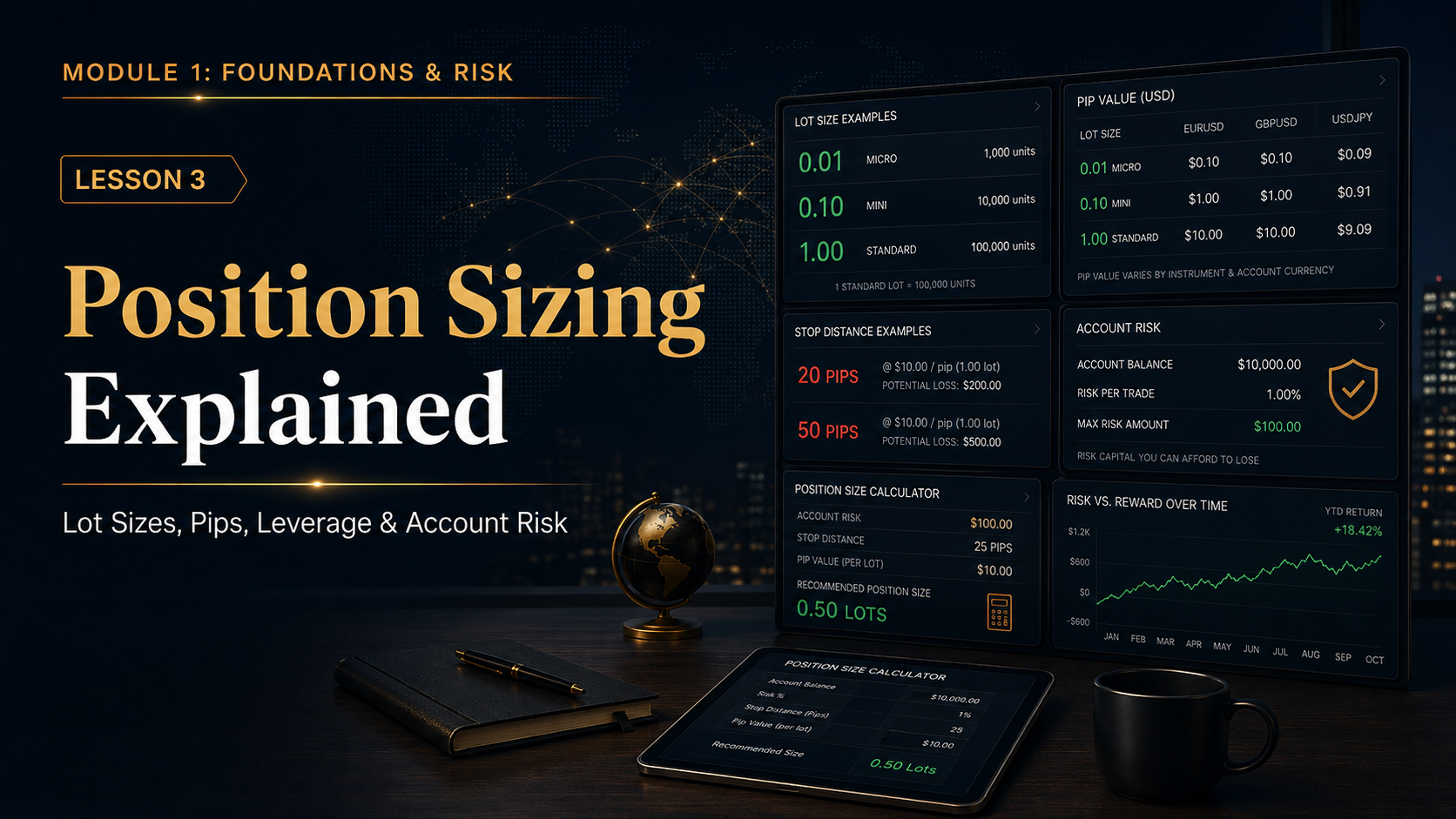
Position Sizing Explained: Lot Sizes, Pips, Leverage & Account Risk
Learn how to calculate the correct trade size, understand Forex lot sizes and pip values, control leverage, and keep your dollar risk consistent from one setup to the next.
You can have the right market direction, a good entry and a perfectly reasonable stop loss — and still take far too much risk.
The reason is simple:
Position sizing is the bridge between your trading idea and the amount of money you are actually putting at risk.
In the previous lesson, you learned why risk must be controlled. Now we are going to turn that principle into an actual trade size.
What You’ll Learn
What Is Position Sizing?
Position sizing determines how much of an instrument you buy or sell.
In Forex, this is commonly expressed in lots.
Your position size directly affects how much money is gained or lost for every pip the market moves.
Position sizing is not about asking how large a trade your broker allows. It is about selecting the size that keeps your financial risk within your plan.
Understanding Forex Lot Sizes
Forex positions are generally measured using standardized lot sizes.
| Lot Type | Lot Size | Approx. Units | Common Use |
|---|---|---|---|
| Standard Lot | 1.00 | 100,000 units | Larger exposure |
| Mini Lot | 0.10 | 10,000 units | Moderate exposure |
| Micro Lot | 0.01 | 1,000 units | Fine risk control |
What Is Pip Value?
A pip measures price movement, but the amount of money each pip is worth depends on your position size and the currency pair being traded.
For many major Forex pairs quoted in U.S. dollars, approximate pip values are often close to the following:
| Position Size | Approx. Pip Value | 10-Pip Move |
|---|---|---|
| 0.01 Lot | About $0.10 | About $1 |
| 0.10 Lot | About $1 | About $10 |
| 1.00 Lot | About $10 | About $100 |
Pip value can vary depending on the instrument, account currency and market price. Do not assume every pair has exactly the same pip value.
A Simple Pip Value Example
Imagine you buy EUR/USD using a 0.10 lot position.
If the market moves approximately 20 pips against you instead, the same position would produce an approximate $20 loss before considering spread, commission or execution differences.
The Position Sizing Equation
The core idea behind risk-based position sizing is straightforward.
In Forex, this is commonly calculated using your:
How much capital you have.
How much you are willing to lose.
How far your stop is from entry.
Dollar value of each pip at a given size.
Position Size Example: $10,000 Account
Suppose your account balance is $10,000 and you decide to risk 1% on a trade.
You need a position where a 20-pip move against you equals approximately $100.
If the instrument is worth approximately $10 per pip at 1.00 lot, then approximately $5 per pip corresponds to roughly:
The exact calculation can vary by instrument, broker specifications and account currency, but the process remains the same.
Wider Stop = Smaller Position
This relationship is essential.
20-Pip Stop
50-Pip Stop
Tighter Stops Do Not Automatically Mean Lower Risk
This is where many traders get confused.
A 10-pip stop is not automatically safer than a 50-pip stop.
If you increase the position size to compensate for the tighter stop, your total dollar risk may be exactly the same.
| Stop Distance | Approx. Position | Dollar Risk |
|---|---|---|
| 10 pips | 1.00 lot | $100 |
| 20 pips | 0.50 lot | $100 |
| 50 pips | 0.20 lot | $100 |
Different stop distances. Different trade sizes. Approximately the same planned account risk.
The Wrong Way to Choose a Lot Size
Beginners often choose position size based on how much money they want to make.
That process begins with the desired profit and forces the risk around it.
Stop Placement Comes Before Lot Size
The market should determine where the setup becomes invalid.
Your position size should then adapt to that stop distance.
Where Does Leverage Fit In?
Leverage determines how much market exposure your broker allows relative to the capital in your account.
Examples might include:
Higher leverage allows a trader to control more exposure with less margin.
But that does not mean the trader should use all of the exposure available.
Leverage vs. Margin
Margin is the amount of account equity your broker sets aside to support an open leveraged position.
Higher leverage generally means less margin is required to control the same position.
That can make it easier to open larger trades — which is exactly why discipline matters.
Position Sizing Across Multiple Trades
Calculating one position correctly does not automatically mean your total account exposure is safe.
Imagine you open four positions, each risking 1%.
If all four positions lose, total planned account exposure could approach 4%.
If those trades are correlated, they may effectively behave like one oversized market idea.
Why Correlation Matters
Some markets frequently respond to the same underlying forces.
For example, several U.S. dollar currency pairs may move strongly at the same time after major U.S. economic data.
Possible Correlated Exposure
Four separate symbols do not automatically equal four independent ideas.
Position Sizing Is Different Across Markets
The concept of risk-based sizing remains consistent, but the way position size is expressed varies by market.
| Market | Common Sizing Method | Movement Measurement |
|---|---|---|
| Forex | Lots | Pips |
| Stocks | Shares | Dollar / percentage move |
| Indices | Contracts / lots | Points |
| Gold | Lots / contracts | Price / points |
Never assume a 1.00 lot position has the same dollar behavior across completely different instruments.
Why Gold Requires Extra Attention
XAU/USD is popular because it can make significant moves in relatively short periods.
That volatility also means poorly sized positions can produce large account swings very quickly.
Instrument specifications, contract sizes and point values differ. Calculate the financial risk specifically for the instrument you are trading.
Use Your Broker’s Contract Specifications
Position-size examples are useful for understanding the concept, but your trading platform and broker specifications are the final reference for actual contract values.
Before trading an unfamiliar symbol, confirm:
What If the Exact Position Size Is Not Available?
Suppose your calculation gives you a position size of:
Your broker may only allow increments such as 0.01.
You might therefore choose 0.34 lots rather than rounding upward to 0.35 if your priority is remaining slightly below the maximum risk.
Position Size Controls Psychology Too
Position sizing is not only mathematics.
It directly affects your emotional experience while the trade is open.
Complete Trade Example
Imagine a trader identifies a valid EUR/USD buy setup.
The trader has now transformed a chart setup into a measurable, controlled account risk.
Common Position-Sizing Mistakes
Different stop distances create different dollar risk.
Profit goals should never override acceptable account risk.
Gold, indices and Forex pairs can have very different contract values.
Being allowed to open a large trade does not mean the risk is sensible.
Several individually reasonable trades can combine into excessive total risk.
When the exact size is unavailable, rounding slightly down is often the more conservative choice.
The Professional Position-Sizing Process
Stop Guessing Your Lot Size
Position sizing becomes much easier when you understand exactly where your stop belongs, how much of the account you are willing to risk, and how the instrument behaves. Financial Markets Academy offers live 1-on-1 mentorship for traders who want help building that process correctly.
Reserve Your Seat →Position Sizing Checklist
Frequently Asked Questions
What is position sizing in Forex?
Position sizing determines how many lots you trade. The correct size should reflect your account risk, stop-loss distance and the value of each pip.
What is a standard lot in Forex?
A standard Forex lot generally represents 100,000 units of the base currency. A mini lot is typically 10,000 units and a micro lot 1,000 units.
How do I calculate lot size based on risk?
First determine your maximum dollar loss, then measure your stop distance and calculate the position size that causes that stop to equal approximately your predefined risk.
Does a tighter stop mean less risk?
Not necessarily. If your position size is increased when the stop becomes tighter, your total dollar risk can remain the same or even become larger.
Is high leverage dangerous?
High leverage increases the amount of exposure available. It becomes dangerous when traders use that availability to open positions that exceed sensible account-risk limits.
Should I use the same lot size on gold and Forex?
No. Contract specifications and value per unit of movement can differ dramatically between instruments. Size each market independently.
Lesson 3 Knowledge Quiz
B. How much of an instrument you trade
C. The economic calendar
D. The spread
B. 1,000 units
C. 10,000 units
D. Approximately 100,000 units
B. It becomes smaller
C. It always stays identical
D. Leverage disappears
B. Maximum leverage
C. Logical stop-loss placement
D. Another trader’s position
B. No
C. Only on gold
D. Only during news
Key Takeaways
Lesson 4: Risk-to-Reward Ratio
Now that you know how to control your dollar risk and calculate the correct position size, the next lesson looks at the other side of the trade: how much potential reward should exist before the risk is worth taking?