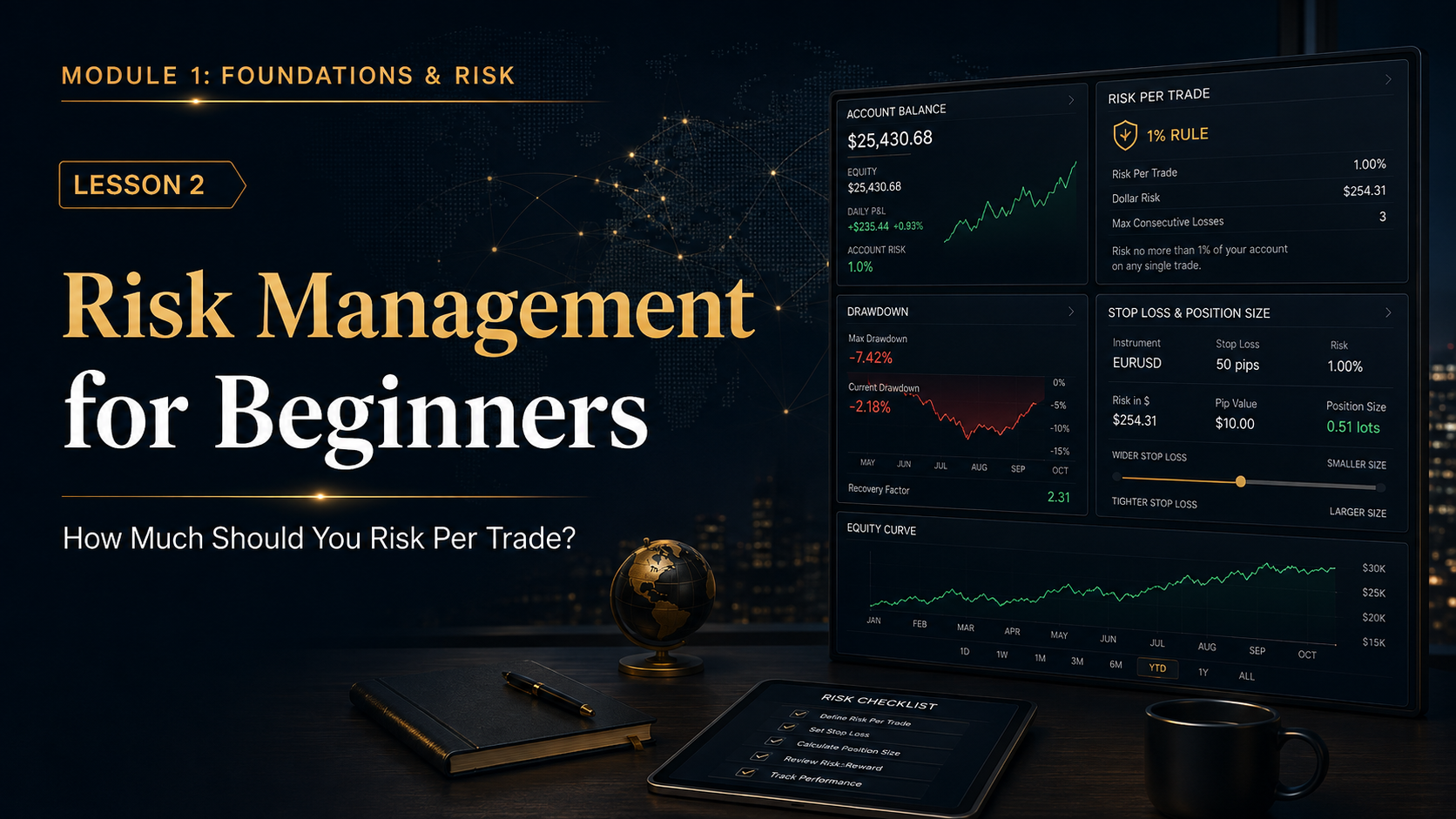
Risk Management for Beginners: How Much Should You Risk Per Trade?
Learn how professional traders control losses, calculate risk per trade, protect capital and avoid the account-destroying mistakes that trap most beginners.
Most beginners enter trading believing the most important skill is finding winning trades.
It isn’t.
A trader can have an excellent entry strategy and still destroy an account if the risk is poorly managed. On the other hand, a trader can survive a series of losses, remain emotionally controlled and continue operating if the risk on each position is kept reasonable.
That is why structured traders begin with a different question.
That single shift in thinking is one of the biggest differences between disciplined trading and gambling.
What You’ll Learn
What Is Risk Management in Trading?
Risk management is the process of controlling how much money you can lose.
That sounds simple, but professional risk management involves several decisions before a trade is ever opened.
Before Entering a Trade, You Should Know:
Trading Is a Game of Survival First
Before you can make money consistently, you have to survive.
Every strategy experiences losing trades. Even a strong system can go through periods where several trades fail consecutively.
Risk management gives you enough room to survive those periods without causing catastrophic damage.
Risks 10% Per Trade
A few losing trades can create major account damage and severe psychological pressure.
Risks 1% Per Trade
Several losses are uncomfortable, but the majority of the trading capital remains intact.
Risk Is Not the Same as Position Size
Beginners frequently confuse risk with lot size.
They are related, but they are not the same thing.
Example
Trader A opens a 1.00 lot EUR/USD position with a 10-pip stop.
Trader B opens the same 1.00 lot position but uses a 100-pip stop.
Are they risking the same amount?
No.
This is why disciplined traders typically determine the stop-loss location first and calculate position size afterward.
Account Risk vs. Market Risk
What You Cannot Control
Price can react unexpectedly to news, liquidity, institutional orders, economic data, geopolitical events and changes in sentiment.
What You Can Control
You control how much capital is exposed if the trade reaches your predefined stop loss.
How Much Should You Risk Per Trade?
There is no universal percentage that is perfect for every trader.
One of the most common guidelines is the 1% rule.
The purpose is not to eliminate losing trades. It is to make those losses survivable.
Example
| Account Balance | Risk % | Maximum Planned Loss |
|---|---|---|
| $5,000 | 1% | $50 |
| $10,000 | 1% | $100 |
| $25,000 | 1% | $250 |
| $100,000 | 1% | $1,000 |
Is 1% Always Safe?
No.
This is an important distinction.
Risking 1% on one isolated trade is very different from opening five correlated trades that each risk 1%.
This becomes especially dangerous when the positions are highly correlated.
Professional risk management considers more than just one trade at a time.
Sometimes Less Than 1% Is Better
There is nothing magical about 1%.
Depending on the trader, strategy or account rules, a smaller risk amount may be more appropriate.
A trader using a volatile strategy may need smaller exposure.
A trader working under strict funded-account drawdown rules may need smaller exposure.
A beginner learning execution may benefit from smaller risk simply because it provides more room to make mistakes without causing significant financial damage.
The Psychological Cost of Risking Too Much
Oversized risk does more than damage an account.
It changes the way you behave.
When Position Size Is Too Large, Traders Often:
Risk Should Feel Boring
A properly sized position should not feel like a life-changing event.
Professional trading should not feel like placing your entire bankroll on one outcome. Your exposure should be small enough that you can continue thinking clearly.
How to Calculate Percentage Risk
What Happens During Consecutive Losses?
Every legitimate trading strategy can experience losing streaks.
This is exactly where proper risk management earns its value.
| Trader | Starting Balance | Risk Per Trade | Approx. First Loss | Effect |
|---|---|---|---|---|
| Trader A | $10,000 | 1% | -$100 | Manageable |
| Trader B | $10,000 | 10% | -$1,000 | Severe damage |
What Is Drawdown?
Drawdown measures how far your trading account falls from a previous peak.
Drawdown gives you information that profit alone cannot.
Why Large Drawdowns Are Hard to Recover From
The deeper the drawdown, the larger the percentage gain required to recover.
| Account Drawdown | Gain Required to Recover |
|---|---|
| 5% | About 5.3% |
| 10% | About 11.1% |
| 20% | 25% |
| 30% | About 42.9% |
| 40% | About 66.7% |
| 50% | 100% |
You do not need to avoid every loss. You need to avoid losses so large that recovery becomes mathematically difficult.
Why Maximum Drawdown Matters
Maximum drawdown is the largest peak-to-trough decline experienced during a period of trading.
The return is the same. The risk required to achieve it is very different.
Stop Loss First, Position Size Second
This sequence is one of the most important habits you can develop.
Same Risk, Different Stop Distance
Imagine you have a $10,000 trading account and you are willing to risk approximately 1%, or $100.
10-Pip Stop
Because the stop is relatively tight, the position size can be larger while still keeping total risk around $100.
50-Pip Stop
Because the stop is wider, the position size must be smaller to keep the same approximate $100 risk.
Why Fixed Lot Sizes Can Be Dangerous
Some beginners decide:
That may feel simple, but different trades require different stop distances.
A 10-pip stop and a 70-pip stop using the exact same position size do not create the same financial exposure.
Position size should respond to the setup and your acceptable risk — not habit, ego or how much money you hope to make.
Risk-to-Reward Is Part of Risk Management
Risk management is not only about limiting losses. It also involves evaluating whether the potential reward justifies the amount being risked.
This does not mean every trade must target exactly 1:2. The larger point is that risk and reward should be evaluated together before entering.
Why You Need a Daily Loss Limit
Risk per trade is only one layer of protection.
A trader can risk responsibly on one trade but still damage an account by taking too many trades in one day.
Example Daily Risk Rules
The Risk Escalation Trap
One of the fastest ways to damage an account is increasing risk after a loss.
This is not risk management. It is emotional risk escalation.
Common Risk-Management Mistakes
This forces the trade around your desired exposure instead of market structure.
Moving a stop to avoid accepting a loss usually increases the original risk.
Adding exposure because you want a better average entry can multiply risk rapidly.
Trying to recover quickly often turns one controlled loss into several uncontrolled ones.
Several positions can effectively represent one oversized trade when the markets move together.
Without a stopping point, frustration can turn into overtrading.
Building Your Personal Risk Framework
Your eventual trading plan should contain clear risk rules that can be followed without debate.
Want Help Building a Risk Plan Around Your Trading?
Financial Markets Academy offers live 1-on-1 mentorship designed to help traders understand market structure, entries, position sizing, risk control and how to build a disciplined trading process around their own development.
Reserve Your Seat →Risk Management Checklist
Frequently Asked Questions
How much should a beginner risk per trade?
Many traders use 1% or less as a general guideline, but there is no universal percentage suitable for every strategy or account. Beginners may benefit from risking significantly less while learning.
Is risking 1% per trade safe?
It is more conservative than large-percentage risk, but total exposure, correlation, strategy volatility and the number of simultaneous positions must still be considered.
Should I use the same lot size on every trade?
Usually not. Different setups require different stop-loss distances, meaning the lot size often needs to change if account risk is to remain consistent.
What is drawdown?
Drawdown measures the decline of an account from a previous peak. Maximum drawdown represents the largest such decline over a trading period.
Why is a 50% drawdown so dangerous?
After losing 50%, the remaining capital must gain 100% simply to return to the original balance.
Should I increase risk after a losing trade?
Increasing risk simply to recover a previous loss is generally an emotional decision and can rapidly increase drawdown.
Lesson 2 Knowledge Quiz
B. Control how much capital can be lost
C. Predict market direction
D. Increase leverage
B. $50
C. $100
D. $1,000
B. Profit amount
C. Logical stop-loss location
D. Maximum leverage
B. Because combined and correlated exposure can increase total account risk
C. Because spreads disappear
D. Because risk percentages cannot be calculated
B. 50%
C. 75%
D. 100%
Key Takeaways
Lesson 3: Position Sizing Explained
Now that you understand how much capital should be placed at risk, the next lesson explains how to convert that risk into an actual trade size using pips, stop distance, lot sizes and account exposure.