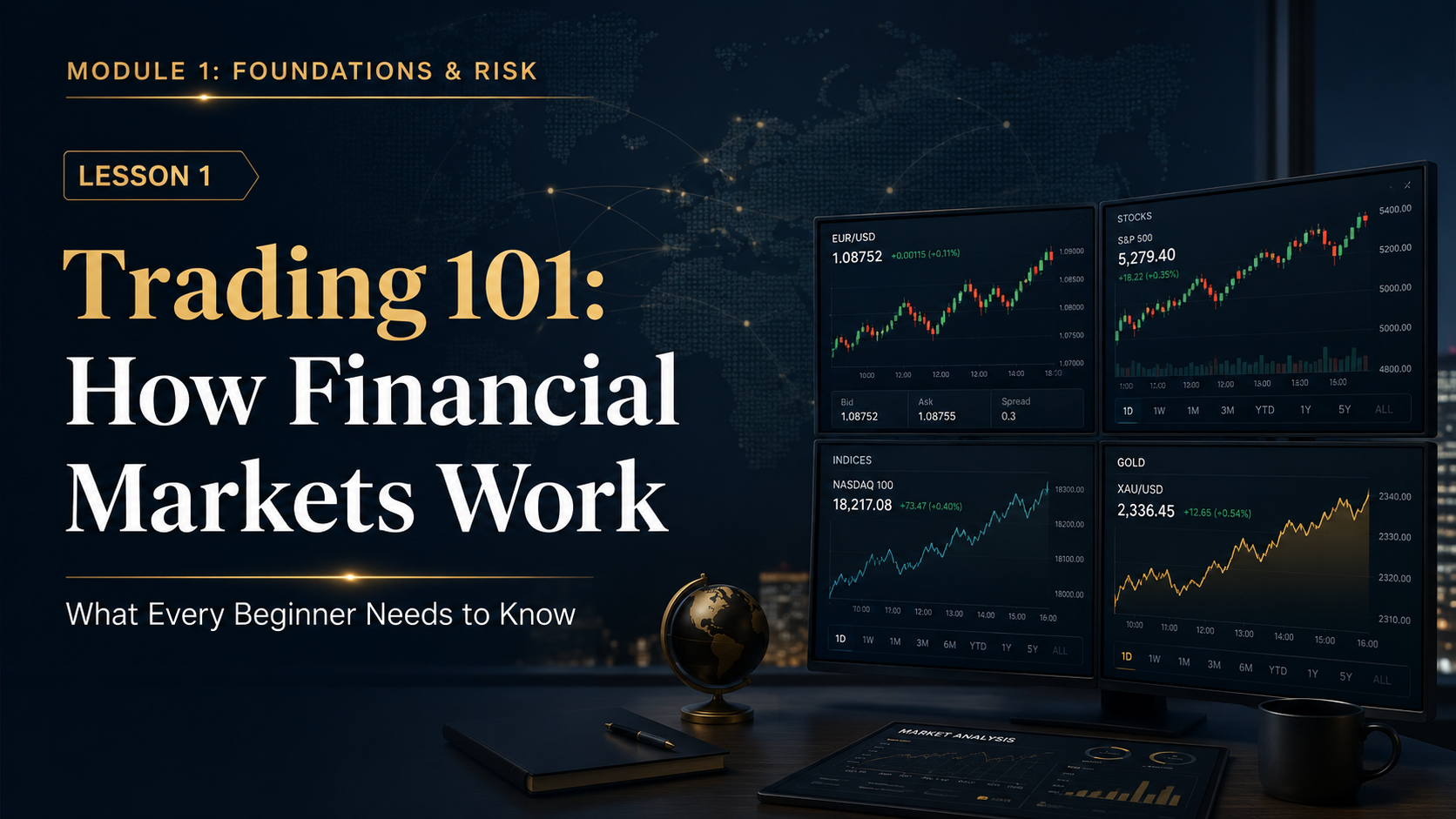
Trading 101: How Financial Markets Work & What Every Beginner Needs to Know
Learn how Forex, stocks, indices, commodities and other financial markets actually work, why prices move, and what every new trader should understand before risking real money.
Trading can look incredibly complicated from the outside.
Charts move every second. Prices rise and fall. Traders talk about pips, lots, leverage, liquidity, spreads, support, resistance, bulls, bears, stop losses and dozens of other terms that can make a beginner feel like they are learning a completely different language.
But underneath all of that terminology, financial markets operate around one surprisingly simple idea:
Everything else begins there. Before you worry about strategies, indicators, entries or trying to predict the next candle, you need to understand the environment you are trading in.
What You’ll Learn
What Are Financial Markets?
A financial market is simply a marketplace where financial assets are bought and sold.
Instead of buying groceries, clothing or electronics, participants buy and sell assets such as currencies, company shares, stock market indices, gold, oil, bonds, cryptocurrencies and financial derivatives.
Some market participants are individual traders sitting at home with a laptop. Others are banks, hedge funds, corporations, investment firms, pension funds, central banks and institutional trading desks moving enormous amounts of capital.
Every participant enters the market for a different reason. One company may need euros to conduct business in Europe. A hedge fund may believe gold is undervalued. A trader may believe the Nasdaq is about to rally. A corporation may be hedging against changes in currency prices.
Once you understand this, charts begin to look different. Instead of seeing random red and green candles, you start asking better questions:
- Who currently has control?
- Where did buyers become aggressive?
- Where did sellers take control?
- Where might traders be trapped?
- Where is liquidity likely sitting?
Why Do Financial Market Prices Move?
Markets move because the balance between buyers and sellers constantly changes.
Imagine a stock is trading at $100. If a large number of buyers suddenly want the stock and there are not enough sellers willing to sell at $100, buyers may need to offer $100.10, then $100.20, then $100.50.
The price rises because buyers are becoming more aggressive.
The opposite happens when aggressive sellers overwhelm buyers.
Prices Can Move Because Of:
Sometimes one major event moves a market. Other times dozens of factors are being priced simultaneously.
This is one reason trading should never be reduced to something as simple as, “The RSI is overbought, therefore I should sell.”
An indicator is only one piece of information. The market itself is much larger.
The Major Financial Markets Traders Should Understand
Most active retail traders spend their time in a handful of major markets. Each one behaves differently and carries its own opportunities and risks.
The Forex Market
Forex stands for foreign exchange. When you trade Forex, you trade one currency against another.
EUR/USD · GBP/USD · USD/JPY · USD/CAD · AUD/USD · EUR/GBP
Consider EUR/USD. EUR represents the euro and USD represents the U.S. dollar.
If EUR/USD is rising, the euro is strengthening relative to the dollar. If EUR/USD is falling, the euro is weakening relative to the dollar.
Stock Markets
When you buy shares of a publicly traded company, you are purchasing ownership in that business.
Stock prices can react to earnings, revenue, product launches, management changes, interest rates, analyst expectations and broader economic conditions.
Stock Market Indices
An index represents a group of stocks instead of one individual company.
Common examples include the S&P 500, Nasdaq and Dow Jones Industrial Average.
Index markets often react strongly to U.S. economic data, Federal Reserve announcements, inflation figures, employment reports and corporate earnings.
Commodities
Commodities are physical resources and raw materials such as gold, silver, crude oil and natural gas.
Gold, often represented as XAU/USD, is particularly popular with active traders.
Gold can react strongly to changes in the U.S. dollar, interest rates, inflation expectations, geopolitical uncertainty and investor risk sentiment.
Cryptocurrency Markets
Cryptocurrency markets include assets such as Bitcoin and Ethereum.
These markets are known for major volatility and continuous trading. Large moves may create opportunity, but speed does not automatically make a market better to trade.
Trading vs. Investing: What Is the Difference?
An investor generally buys an asset because they believe its value will increase over months, years or decades. Short-term price fluctuations may matter much less.
A trader usually attempts to profit from shorter-term movements lasting minutes, hours, days or weeks. Timing, execution and risk become much more important.
A successful trade also depends on where you enter, where your idea becomes invalid, how much you risk, where you exit and whether market conditions still support the trade.
Going Long vs. Going Short
You Expect Price to Rise
If you buy EUR/USD at 1.1500 and price rises to 1.1600, the movement is favorable to your position.
Long = bullish expectation.You Expect Price to Fall
If gold is trading at $3,500 and you sell because you expect weakness, a decline toward $3,450 moves in your favor.
Short = bearish expectation.Understanding Bid, Ask & Spread
When you open a trading platform, you may notice two slightly different prices. These are typically called the bid and the ask.
The difference between the bid and ask is known as the spread. The spread forms part of the cost of executing a trade.
Spreads may become wider during major economic announcements, low-liquidity periods, market openings or periods of extreme volatility.
What Is a Pip?
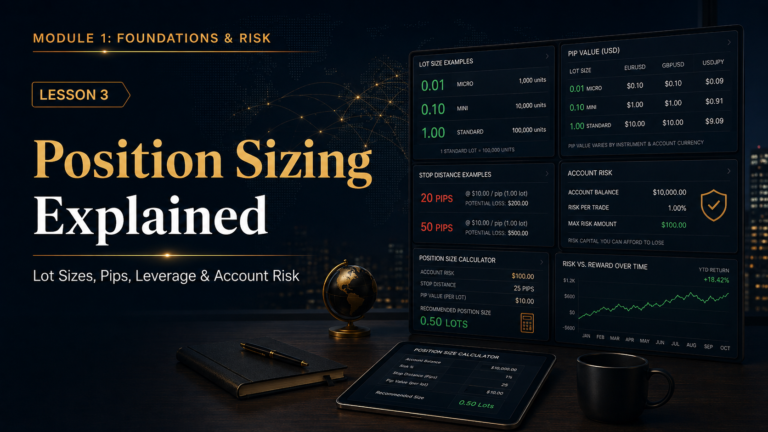
A pip is a standardized measurement commonly used to describe movement in currency pairs.
Traders use pips to describe market movement, stop-loss distance, profit targets and trade results. The monetary value of those pips depends heavily on your position size.
What Is Position Size?
Position size determines how much exposure you have to a market. In Forex, position size is commonly described using lots.
Larger positions create larger profits when you are correct. They also create larger losses when you are wrong.
What Is Leverage?
Leverage allows a trader to control a market position larger than the amount of capital deposited in the trading account.
Beginners often look at leverage as a way to increase profit. Professional traders understand that leverage also increases exposure.
More horsepower does not automatically make you a better driver. It simply increases what can happen when you press the accelerator.
Excessive leverage combined with poor risk management is one of the fastest ways to destroy a trading account.
Why Beginners Focus on Profit Too Early
Almost every new trader wants to know, “How much money can I make?”
A better trader immediately asks, “How much am I risking to make it?”
Both trades offer the same potential profit, but their risk profiles are completely different.
Your First Job as a Trader Is Not Making Money
Without capital, you cannot trade.
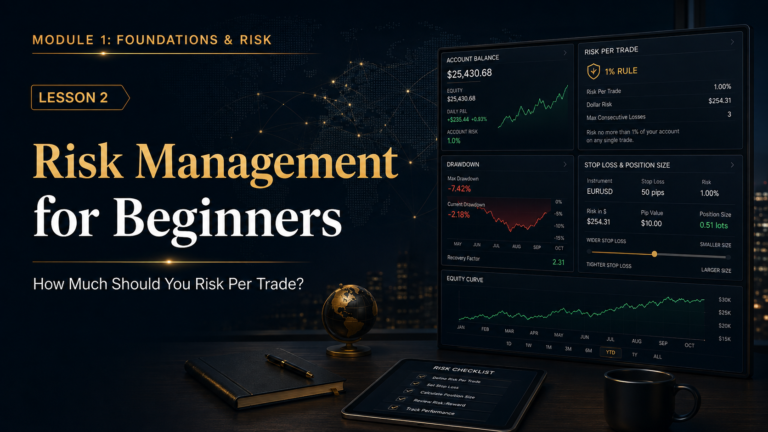
Imagine two traders begin with $10,000.
| Trader | Risk Per Trade | Mindset | After 5 Losses |
|---|---|---|---|
| Trader A | 10% | Wants fast growth | Major account damage |
| Trader B | 1% | Protects capital | Account remains intact |
Losing Trades Are Part of Trading
One of the biggest psychological shocks for beginners is discovering that even good traders lose.
Example: 50% Win Rate
The trader was wrong half the time and still made money. That is why win rate alone does not define whether a strategy is profitable.
Stop Trying to Predict Every Candle
A common beginner mindset is:
That is not professional trading. Trading is about probabilities.
A Serious Trader Asks:
- What is the overall market direction?
- What is the higher-timeframe structure?
- Where are important price levels?
- Has price shown confirmation?
- Is there major economic news approaching?
- Where would this trade become invalid?
- Is the reward worth the risk?
Technical Analysis vs. Fundamental Analysis
Technical Analysis
Technical analysis studies price behavior and chart information.
- Market structure
- Support and resistance
- Trends
- Candlestick behavior
- Momentum
- Indicators
Fundamental Analysis
Fundamental analysis studies the economic or financial forces affecting an asset.
- Interest rates
- Inflation
- Employment
- Central banks
- GDP and growth
- Corporate earnings
What Is Market Structure?
Market structure is the study of how price is moving.
The Three Questions Every Trade Should Answer
Why Am I Entering?
You need a real reason for entering a trade: market direction, structure, a significant price area, confirmation or relevant fundamental context.
Where Am I Wrong?
Your stop loss should represent the area where the original trade idea is no longer valid.
Where Am I Taking Profit?
Before entering, consider your target, nearby market structure and whether the potential reward justifies the risk.
A Simple Beginner Trade Example
Imagine EUR/USD is trending upward. Price pulls back toward an area where buyers previously entered aggressively.
Suppose the trade requires a 20-pip stop and you are willing to risk $100.
Your position size should be calculated so approximately 20 pips against you equals your predefined account risk.
Notice how different this is from simply saying, “EUR/USD looks bullish. Buy.” One is a process. The other is a guess.
Why Trading Plans Matter
A trading plan tells you what you are allowed to do before emotions become involved.
Trading Is a Skill, Not a Shortcut
Social media often presents trading as if success comes from discovering a secret indicator or entry signal. In reality, trading combines several different skills.
Common Beginner Trading Mistakes
Hope is not risk management.
Oversized positions make normal market movement emotionally unbearable.
Entering after a huge move because you fear missing out often produces poor entries.
Trying to immediately win money back changes trading into emotional gambling.
Testing twenty strategies without mastering one creates confusion, not progress.
Your broker’s maximum available position is not your recommended position size.
Demo Trading vs. Live Trading
A demo account lets you practice using simulated capital.
It is useful for learning platform mechanics, order placement, stop losses, take profits, position sizing and strategy rules.
The money is not real, so the emotional pressure is different.
Development should therefore be gradual: learn the mechanics, learn the strategy, learn risk, then prove that you can follow the process consistently.
How Beginners Should Actually Learn Trading
Instead of randomly watching hundreds of disconnected videos, build your knowledge in order.
Understand markets, terminology, execution and risk.
Learn trends, ranges, highs, lows and changes in market behavior.
Build objective criteria for valid trade setups.
Learn position sizing, stops, targets and trade management.
Combine everything into a process you can repeat.
Information Is Not the Same as Experience
You can read every book about driving ever written. Eventually, you still have to sit behind the wheel.
Trading works the same way.
Education gives you the framework. Charts give you experience. Review gives you feedback. Repetition builds recognition.
Professional guidance can also help you identify mistakes that are difficult to recognize by yourself.
Want Personal Help Applying What You’re Learning?
Financial Markets Academy offers live 1-on-1 trading mentorship for traders who want individual guidance, structured education and help applying these concepts directly to the markets.
Reserve Your Seat →Beginner Trading Checklist
Frequently Asked Questions
Is trading difficult for beginners?
The basic concepts can be learned relatively quickly, but developing consistent execution takes practice. Most beginners struggle because they focus on making money before learning risk management and process.
How much money do I need to start trading?
There is no single correct amount. Your capital, broker requirements, personal finances, strategy and acceptable risk all matter. Education should come before funding an account.
Is Forex good for beginners?
Forex can be accessible, but leverage makes proper risk management essential. Beginners should understand position sizing before focusing on profit.
Can you make money trading?
Profitable trading is possible, but never guaranteed. Sustainable performance requires risk management, execution, discipline and a tested trading process.
What should I learn first?
Start with market basics, currency pairs, pips, lots, leverage, stop losses and risk management. Then progress into market structure, price action and trade execution.
How long does it take to learn trading?
Basic terminology can be learned quickly. Building a strategy, gaining screen time and developing discipline takes much longer. Trading should be treated as a professional skill.
Lesson 1 Knowledge Quiz
B. Changes in buying and selling pressure
C. Your broker
D. Trading indicators
B. You expect price to fall
C. You close your account
D. You increase leverage
B. Acceptable risk and stop distance
C. Maximum leverage
D. Another trader’s lot size
B. Yes
C. Only in stocks
D. Only on demo
B. Where your trade idea is invalid
C. Your profit target
D. Your account balance
Key Takeaways
Lesson 2: Risk Management for Beginners
Now that you understand how financial markets work, the next lesson covers the concept that determines whether you survive long enough to become a skilled trader: risk.