Breakeven, Partial Profits & Trailing Stops: How to Manage an Open Trade Without Sabotaging It
Learn when moving to breakeven makes sense, how partial exits change trade mathematics, how trailing stops work and why overmanaging a good trade can be just as damaging as ignoring it.
Once a trade is open, a new problem begins.
Price starts moving. Profit and loss numbers change in real time. Fear appears when the trade pulls back. Greed appears when the trade runs.
Traders who were perfectly disciplined before entry can suddenly begin moving stops, cutting profits, extending targets and reacting to every candle.
The best management decision is sometimes an adjustment. Other times, the best decision is to do absolutely nothing.
What You’ll Learn
What Is Trade Management?
Trade management refers to decisions made after a position has been opened but before it is fully closed.
Those decisions can include reducing risk, taking partial profit, moving the stop loss, trailing behind structure or closing early under predefined conditions.
Start With the Original Trade Plan
Before discussing breakeven or partials, remember what already existed before entry.
Trade management should modify a plan for a defined reason, not replace the plan because the trader becomes nervous.
What Does Moving to Breakeven Mean?
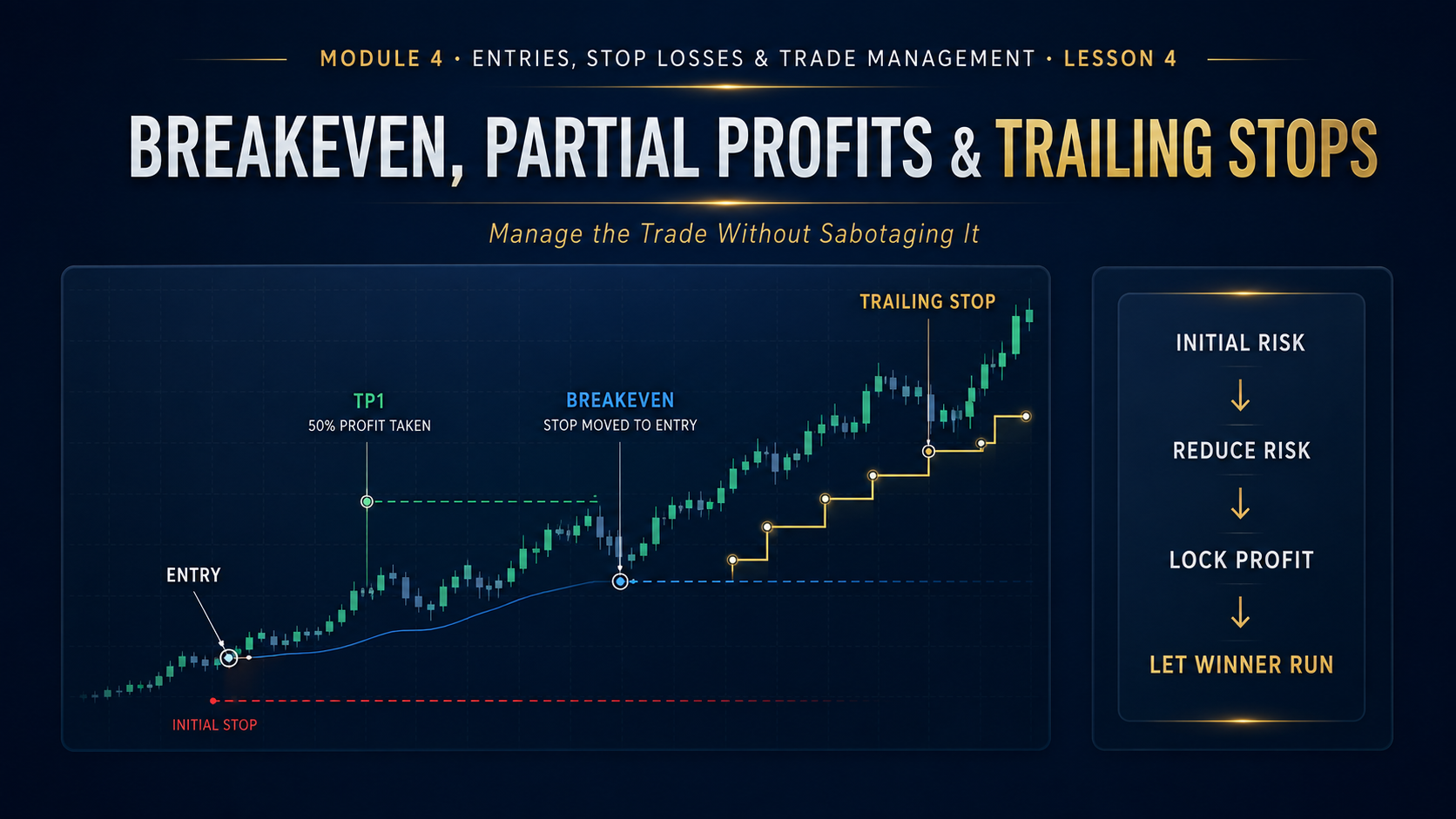
Moving a trade to breakeven generally means moving the stop loss from its original location to or near the entry price.
If price reverses to the entry, the position may close around zero before costs such as spread, commission or slippage.
Is Breakeven Really a “Free Trade”?
Traders often describe breakeven as creating a free trade.
Psychologically, that can feel attractive because the original downside appears to have been removed.
The Danger of Moving to Breakeven Too Early
Markets rarely move in a perfectly straight line.
A good trade can move into profit, pull back toward the entry and then continue toward the target.
The trade did not fail. The management rule removed it while the original thesis was still valid.
Breakeven Should Not Be a Fear Button
“I’m finally in profit. Move the stop now before I lose it.”
“My system moves to breakeven only after price reaches 1R and confirms new structure.”
Common Breakeven Triggers
Different strategies may reduce risk at different moments.
After 1R
Stop changes only after price has moved one unit of risk in your favor.
After New Structure
Stop changes only after price creates a new protected swing.
After TP1
Initial profit is realized before remaining risk is reduced.
The best method is the one supported by your testing and trading plan.
Breakeven May Need to Account for Trading Costs
Entry price is not always true economic breakeven.
Spread, commissions and other transaction costs can mean a stop exactly at entry still produces a small net loss.
What Are Partial Profits?
Taking partial profit means closing only part of the position while leaving the remainder open.
Why Traders Use Partial Exits
Partials Reduce the Reward on the Portion You Close
Partial profit-taking can feel like the best of both worlds, but it changes the mathematics.
If the entire position had remained open to 3R, the result would have been 3R instead.
Example: TP1 + Runner
Taking Partial Profit and Moving the Rest to Breakeven
Some strategies combine partial exits with breakeven.
This can reduce open downside substantially, but the trade-off is a greater chance of the remaining position being stopped before the larger move develops.
Full Exit vs. Partial Exit
| Method | Advantage | Tradeoff |
|---|---|---|
| Full Exit | Simple, captures full planned R if target is reached | No participation if price continues beyond target |
| Partial Exit | Locks some profit while retaining exposure | Reduces average reward if the full move completes |
What Is a Trailing Stop?
A trailing stop is a stop loss that moves in the direction of a profitable trade as price advances.
The goal is to protect increasing amounts of profit while allowing the position room to continue.
Fixed-Distance Trailing Stops
Some platforms can automatically trail a stop a fixed number of pips or points behind price.
Structure-Based Trailing Stops
Instead of trailing a fixed distance, some traders move the stop only when the market creates new protected structure.
Breakeven and Trailing Are Not the Same Thing
Reduce Initial Risk
Stop moves toward the original entry price.
Protect Developing Profit
Stop continues to advance as the trade develops.
The Danger of Trailing Too Closely
A trend needs room to breathe.
A stop that follows price too aggressively can convert every normal pullback into an exit.
The Opposite Problem: Trailing Too Loosely
A trailing stop can also be so far away that very little profit is actually protected.
Again, there is no universal perfect distance. The trailing method should match the strategy’s objective.
Trailing Behind Swing Structure
Swing-based trailing can work well when the objective is to remain inside a developing trend.
Candle-Based Trailing
Some strategies trail behind completed candles rather than larger swings.
For example, a long trade may move the stop beneath the previous completed candle after certain conditions have been met.
R-Multiple Based Management
Some systems manage trades according to predetermined R milestones.
The exact numbers are examples only. The key is that management decisions are defined in advance.
Set-and-Forget Is Also a Management Strategy
Not every system needs active management.
Some strategies simply place the initial stop and take profit and allow one of them to be reached.
Overmanagement: Death by a Thousand Adjustments
Overmanagement happens when a trader constantly changes the position based on tiny fluctuations.
Manage the Chart, Not the Floating P&L
A trader may become increasingly emotional as open profit grows.
Seeing +$500 turn into +$320 can feel like losing $180 even though the trade is still profitable and behaving normally.
What If the Market Structure Changes Before the Target?
Some strategies allow early exits when meaningful evidence appears that the original move is weakening or reversing.
Possible Management Evidence
A single opposing candle is usually very different from a genuine structural change.
Managing Trades Into Major News
Open positions can face sudden volatility around important economic announcements.
Your trading plan should define whether positions are allowed to remain open, whether risk is reduced beforehand or whether no special action is taken.
Complete Bullish Trade Management Example
Complete Bearish Trade Management Example
Four Common Management Styles
| Style | How It Works | Main Benefit | Main Tradeoff |
|---|---|---|---|
| Set & Forget | Initial SL and TP remain | Simple | No adaptation |
| Breakeven | Reduce initial risk after trigger | Protects capital | Can exit valid trades |
| Partial Exit | Close portion at intermediate target | Locks profit | Reduces average R |
| Trailing Stop | Advance stop as trade develops | Can capture larger trends | Can exit on pullbacks |
Common Trade Management Mistakes
A tiny amount of profit does not necessarily mean the trade has developed enough to remove risk.
Partial exits can dramatically alter the average reward of a strategy.
The stop may become too tight for normal market movement.
Dollar fluctuations can trigger emotional decisions that the chart does not justify.
Management rules should not depend on whether the current trade happens to be winning or losing.
Eliminating all pullback risk can also eliminate your ability to remain in larger trends.
The opposite extreme can allow large open profits to disappear even after meaningful structure has developed.
Trade Management Framework
Build Rules for What Happens After You Enter
Financial Markets Academy offers live 1-on-1 mentorship for traders who want to develop structured entry, stop-loss, target and trade-management rules that can be applied consistently in real market conditions.
Reserve Your Seat →Open Trade Management Checklist
Frequently Asked Questions
When should I move my stop to breakeven?
There is no universal point. A trading plan may use an R-multiple, a new structural swing, a first profit target or another tested condition before moving to breakeven.
Can moving to breakeven hurt my results?
Yes. Moving too early can close trades during normal pullbacks even though the original setup remains valid.
What does taking partial profit mean?
It means closing only part of the open position at a target while allowing the remainder to continue toward another objective.
Are partial profits always better?
No. They reduce exposure and lock some profit, but they can also reduce average reward when the market reaches the full target.
What is a trailing stop?
A trailing stop moves in the direction of a profitable trade as price advances, with the goal of protecting more profit while keeping part of the position open.
Should I trail behind every candle?
Not necessarily. Doing so can make the stop extremely sensitive to normal pullbacks. Some strategies instead trail behind meaningful swing structure.
Module 4 · Lesson 4 Knowledge Quiz
B. Doubling the target
C. Removing the stop
D. Increasing the position
B. It guarantees a larger loss
C. It changes the spread permanently
D. It prevents any profit
B. Doubles the position
C. Removes the target
D. Guarantees 3R
B. It guarantees the market will trend
C. It eliminates all losses
D. It ignores the chart
B. Fear of losing open profit
C. The current dollar P&L only
D. Social media opinions
Key Takeaways
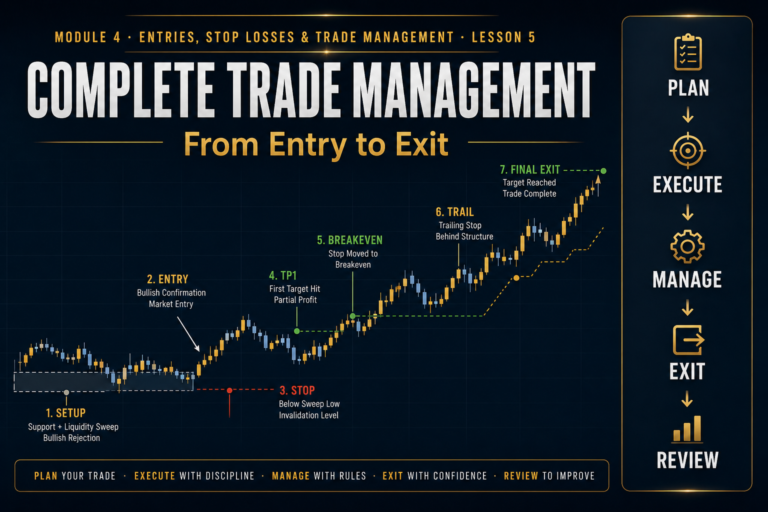
Lesson 5: Complete Trade Management — From Entry to Exit
In the final lesson of Module 4, we bring everything together into one complete execution process — from identifying the setup and entering the trade through stop placement, target selection, open-trade management and the final exit.