Trade Entries Explained: Market, Limit, Stop & Confirmation Entries
Learn the major ways traders enter the market, how execution style changes risk and reward, and why the best analysis can still produce a poor trade when the entry is badly timed.
Finding a good setup is only half the job.
You can correctly identify the trend, support, liquidity, rejection and confirmation — and still turn the setup into a poor trade by entering at the wrong price.
Enter too early and the confirmation may never arrive.
Enter too late and your stop may become large while the remaining reward becomes small.
In this lesson, you will learn the major entry methods and how to choose the one that fits your trading rules.
What You’ll Learn
What Is a Trade Entry?
Your entry is the price at which you open a position.
It sounds simple, but entry price affects almost every other part of the trade.
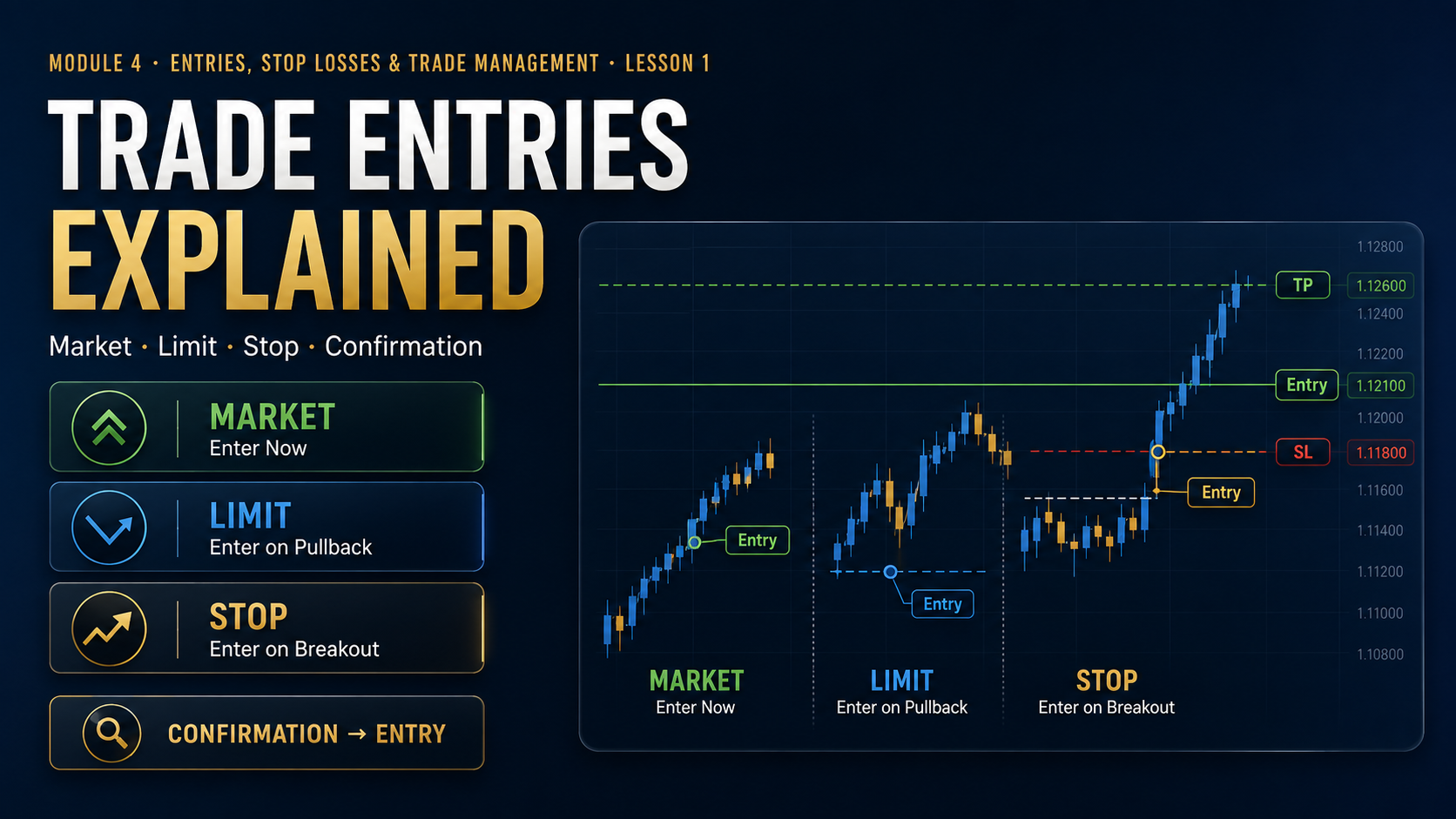
The Three Main Entry Order Types
Enter Now
Attempts to execute immediately at the best currently available market price.
Enter on a Pullback
Waits for price to retrace to a predetermined level before attempting execution.
Enter on a Break
Activates only after price moves through a specified level in the breakout direction.
Market Orders: Entering Immediately
A market order tells your platform to execute the trade as quickly as possible at the best available price.
Traders often use market orders after the confirmation they were waiting for has already occurred.
Advantages of Market Orders
Disadvantages of Market Orders
What Is Slippage?
Slippage occurs when your trade executes at a different price from the one you expected.
This can happen when price moves quickly between the time the order is submitted and the time it is filled.
Slippage can become more significant during fast markets, thin liquidity or major economic releases.
Limit Orders: Waiting for a Better Price
A limit order attempts to enter at a predetermined price rather than immediately.
For a buy limit, the entry is placed below the current market price. For a sell limit, the entry is placed above the current market price.
Current price is above your desired entry. You want price to pull back before buying.
Current price is below your desired entry. You want price to rally before selling.
Example: Buying a Retest With a Limit Order
This may provide a better price than chasing the breakout at 1.1050.
Advantages of Limit Entries
Disadvantages of Limit Entries
Stop Entries: Entering Only After Price Breaks a Level
An entry stop order activates when price trades through a predetermined level.
Placed above current price and activates if price rises through the specified level.
Placed below current price and activates if price falls through the specified level.
Example: Entering Only if Structure Breaks
Imagine you are watching for a bullish reversal.
A buy-stop order can automate that breakout trigger.
The Danger of Stop Entries: False Breakouts
Stop-entry orders can be useful for confirmation, but they can also be triggered by temporary liquidity sweeps.
This is why some strategies require a candle close rather than simply trading through a level.
Market vs. Limit vs. Stop Entry
| Entry Type | Primary Goal | Strength | Main Tradeoff |
|---|---|---|---|
| Market | Enter immediately | Less chance of missing trade | Potentially worse price |
| Limit | Enter on retracement | Potentially better R:R | Trade may never fill |
| Stop Entry | Enter after breakout | Requires price to move first | Can trigger on false break |
Aggressive Entries
An aggressive entry attempts to enter earlier in the setup.
The advantage is an earlier entry. The disadvantage is less confirmation.
Confirmation Entries
A confirmation entry waits for more evidence that the anticipated move is actually developing.
The tradeoff is a later entry, but more evidence supports the setup.
Break-and-Retest Entries
A break-and-retest entry combines confirmation with patience.
The benefit is potentially improved entry price after confirmation. The risk is that price may never return.
Every Entry Method Has a Tradeoff
Better potential price, less confirmation.
More evidence, potentially worse price.
Potentially improves price, but may never occur.
How Entry Price Changes Risk-to-Reward
Consider the same bullish setup with the same stop and target.
| Entry | Stop | Target | Risk | Reward |
|---|---|---|---|---|
| 1.1000 | 1.0975 | 1.1050 | 25 pips | 50 pips = 1:2 |
| 1.1025 | 1.0975 | 1.1050 | 50 pips | 25 pips = 1:0.5 |
Same market idea. Same stop. Same target. Completely different trade mathematics because of the entry.
What Does It Mean to Chase Price?
Chasing occurs when a trader enters after price has moved significantly away from the intended setup area because they are afraid of missing the move.
The setup may still be directionally correct, but the trade may now have poor risk-to-reward.
FOMO Is an Entry Problem
Fear of missing out often appears after a large momentum candle.
The trader sees price moving without them and feels they must participate.
“It’s moving! Get in now before it’s gone.”
“Did my entry condition occur, and does the trade still make mathematical sense?”
Missing a Trade Is Better Than Forcing One
Sometimes price simply leaves without giving you the entry your strategy requires.
That can feel frustrating.
Your job is not to participate in every market move. Your job is to execute your own setup consistently.
Do Not Use Limit Orders Just Because the Price Looks Better
Beginners sometimes place limit orders at arbitrary retracement levels because the entry appears cheaper.
But a cheaper price is not automatically a better trade.
Candle-Close Entries
One of the simplest forms of confirmation is waiting for a candle to close.
Waiting for the candle close helps prevent reacting to an unfinished pattern.
Closing Above or Below the Previous Candle
Some entry strategies use the previous candle as a simple momentum threshold.
A bullish candle closes above the previous candle’s high or relevant structure.
A bearish candle closes below the previous candle’s low or relevant structure.
The exact trigger depends on the trading strategy, but the important point is that the condition is objective before the trade begins.
Complete Entry Example
Same Setup, Bad Entry
Your Entry Must Be Part of the Trading Plan
Do not change entry methods every time the previous one misses a trade.
If you normally wait for confirmation, do not suddenly use an aggressive limit order because you are impatient.
When Is an Entry Too Late?
There is no universal number of pips that makes an entry too late.
Instead, recalculate the trade from the new entry.
Common Entry Mistakes
Anticipating a setup is different from having an entry signal.
An entry becomes less attractive as price moves farther from the planned setup.
A lower price is not automatically a better entry.
Stop-entry orders can trigger during liquidity sweeps.
A breakout can become rejection before the candle closes.
Consistency disappears when entry criteria change based on emotion.
Every new entry price changes the mathematics of the setup.
The Trade Entry Framework
Stop Chasing Trades. Learn Exactly What Must Happen Before You Enter.
Financial Markets Academy offers live 1-on-1 mentorship for traders who want to develop structured entry rules, stop-loss placement, trade targets, risk management and repeatable execution.
Reserve Your Seat →Trade Entry Checklist
Frequently Asked Questions
What is a market order?
A market order attempts to execute immediately at the best currently available price.
What is a limit order?
A limit order waits for price to reach a predetermined entry level. Buy limits are placed below current price and sell limits above current price.
What is a stop-entry order?
A stop-entry order activates after price moves through a specified level. Buy stops are generally placed above current price and sell stops below it.
Is a limit order always better than a market order?
No. A limit order may provide a better price, but the market may never retrace to it or the setup may fail before confirmation develops.
What is a confirmation entry?
A confirmation entry waits for predefined evidence such as a candle close, engulfing candle, structure break or retest before opening the position.
What should I do if I miss my entry?
Reevaluate the setup from the current price. If the new entry no longer meets your risk and reward rules, letting the trade go may be the better decision.
Module 4 · Lesson 1 Knowledge Quiz
B. Wait for a lower price only
C. Guarantee a specific fill
D. Automatically set a target
B. Above current market price
C. Only at the daily high
D. Anywhere without a plan
B. It cannot execute
C. It guarantees too good an entry
D. It removes volatility
B. Waiting patiently for a setup
C. Calculating position size
D. Using support and resistance
B. It guarantees profit
C. It changes the previous candles
D. It removes the stop loss
Key Takeaways
Lesson 2: Stop Loss Placement — Where Your Trade Is Actually Invalid
Once you know how to enter, the next question is where the trade becomes wrong. In Lesson 2, you will learn how to place stops using market structure, swing points, volatility and true trade invalidation instead of arbitrary distances.