
How to Trade the US-Iran Crisis: The Forex and Stock Opportunities Toronto Traders Can’t Ignore Right Now
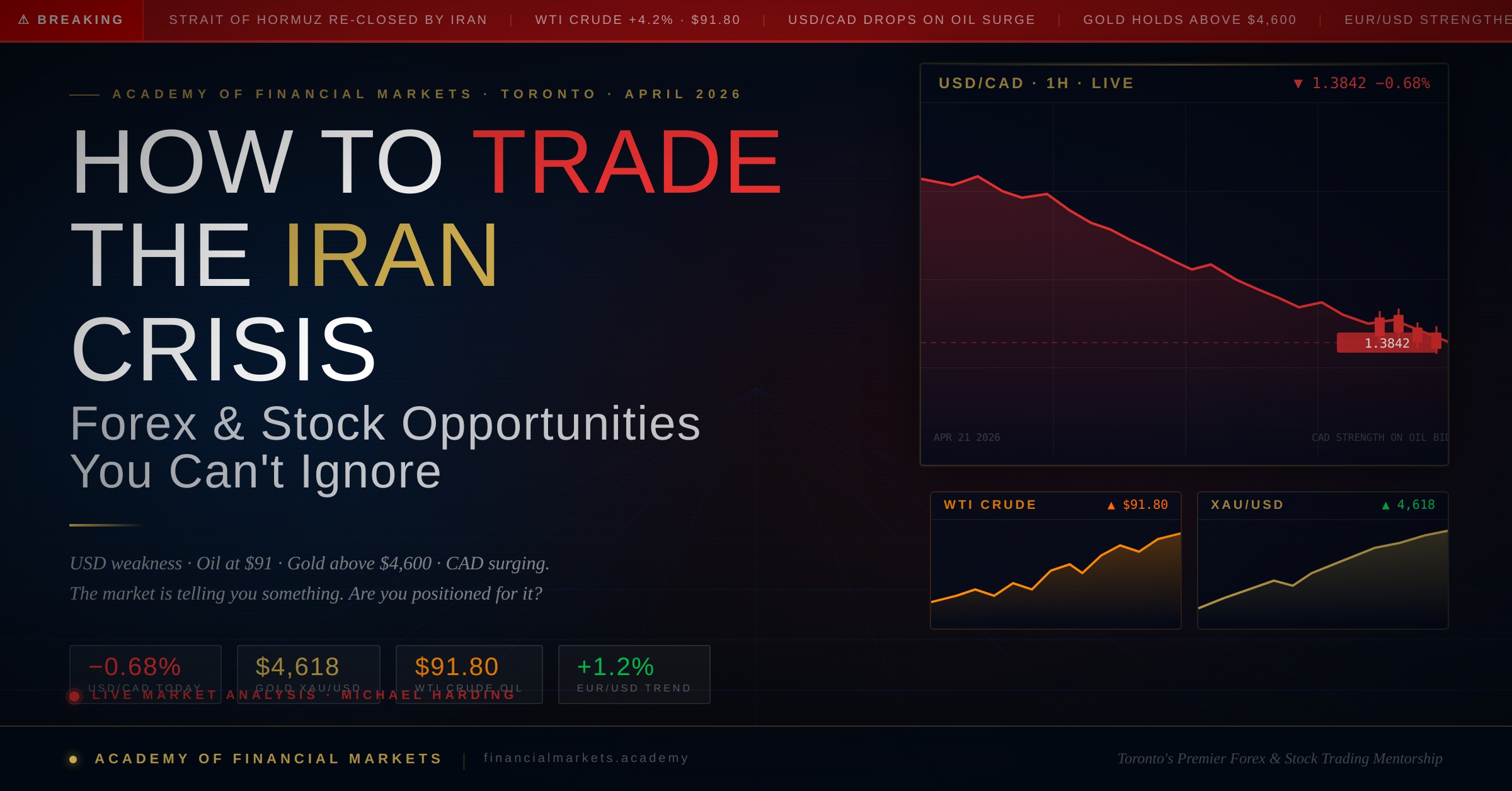
Markets are being driven by one of the most consequential geopolitical crises in recent memory — the escalating US-Iran conflict, a Strait of Hormuz naval standoff, and a ceasefire that markets are watching expire in real time. For traders in Toronto and across Canada, this is not a moment to sit on the sidelines. It is a moment to understand exactly how geopolitical shocks move forex pairs, oil, gold, and equities — and how to position yourself on the right side of that volatility.
At The Academy of Financial Markets, Michael Harding has been guiding Toronto traders through live market conditions — including volatile macro environments exactly like this one — since 2008. This blog post breaks down what is moving markets right now in April 2026, which pairs and instruments carry the highest opportunity, and how traders in our Forex Course in Toronto are being trained to approach it.
Table of Contents
- What Is Actually Moving Markets Right Now (April 2026)
- USD Weakness: Why the Dollar Is Losing Ground
- Oil Prices and the Canadian Dollar: What Toronto Traders Must Know
- EUR/USD and the Euro’s Quiet Strength
- USD/JPY: The Safe-Haven Trade Explained
- Gold Above $4,600: Trading Precious Metals in a Crisis
- US30 and NASDAQ: How to Trade Indices Amid Geopolitical Uncertainty
- The Mental Game: Staying Disciplined When Headlines Are Screaming
- How Michael Harding Trains Toronto Traders to Navigate Markets Like This
- Conclusion
- Frequently Asked Questions
What Is Actually Moving Markets Right Now (April 2026)
If you have been watching your charts this month and wondering why every session feels like a different market, you are not imagining it. April 2026 has been defined by an extraordinary convergence of macro forces:
- The US-Iran conflict, which began with US and Israeli strikes on Iranian infrastructure in late February 2026, has kept global risk sentiment on a hair trigger. A ceasefire was put in place, but as of this week the deadline is expiring — with both sides taking provocative actions including Iran’s re-closure of the Strait of Hormuz on the weekend.
- Crude oil has been surging on the energy supply disruption, trading near the $90–$92 WTI range, with the OVIX (oil’s volatility index) elevated near the top of its recent range around 96.
- The US Dollar (DXY) has been trending broadly lower, losing ground as the prospect of a peace deal reduces safe-haven demand for greenbacks.
- The Euro and AUD have been the standout gainers among major currencies, while the Pound has faced pressure from weak UK retail data.
- Gold is holding above the $4,600 level — a historically remarkable price reflecting sustained macro uncertainty.
- US equity indices snapped a five-day winning streak on Monday April 21 as the Hormuz re-closure rattled risk sentiment. However the broader trend in the S&P 500 remains constructive, with the index near 7,000 again.
- Bank of Canada outlook is moderately improving — the Q1 2026 Business Outlook Survey showed slightly better business sentiment as trade tension concerns ease and government spending supports demand.
For traders who understand how to read macro catalysts and map them onto specific currency pairs and instruments, this environment is full of high-probability setups. The question is whether you have the framework to find them — and the discipline to execute without getting swept up in the noise.
USD Weakness: Why the Dollar Is Losing Ground
The US Dollar has been one of the biggest stories in forex this month. The DXY is in a bearish 3-month and 6-month trend, and the macro narrative driving that weakness is nuanced. Here is what experienced traders need to understand:
Peace-deal optimism reduces safe-haven demand. The Dollar has historically strengthened during risk-off episodes as global investors flee to USD-denominated assets. As markets began pricing in a higher probability of a durable US-Iran peace deal in mid-April, that safe-haven premium began evaporating. Prediction markets showed growing consensus around a deal being concluded by end of May — and markets front-run expectations aggressively.
US PPI disappointed significantly. Last week’s US Producer Price Index came in at only +0.5% month-on-month versus a +1.1% forecast. That miss took further wind out of the Dollar’s sails, reducing rate-hike pricing and the interest rate differential that typically supports USD.
Kevin Warsh’s Fed testimony is in focus. New Fed Chair nominee Kevin Warsh is scheduled to testify before the Senate Banking Committee this week. His prepared remarks signal a commitment to monetary policy independence — but markets will be listening for any signals on the rate outlook that could move the Dollar meaningfully in either direction.
Example: In our Toronto forex mentorship sessions this week, Michael Harding has been pointing students toward USD-weakness setups, including shorting USD/CAD on pullbacks toward resistance levels, and structuring long EUR/USD trades with defined risk using MetaTrader 5. A disciplined short USD/CAD entry near 1.3900 with a 50-pip target would have yielded approximately $337 CAD on 0.5 lots — consistent with the risk-adjusted returns our students are trained to target.
Oil Prices and the Canadian Dollar: What Toronto Traders Must Know
Canada is the world’s fourth-largest oil producer and the United States’ largest foreign oil supplier. That structural reality means the Canadian Dollar (CAD) has one of the tightest correlations with crude oil prices of any major currency. In an environment where oil is elevated and volatile, USD/CAD is a pairs trader’s dream — and a cautionary tale for anyone who trades it without understanding its macro DNA.
With WTI crude trading near $90–$92 and Brent elevated on Hormuz fears, the CAD has been receiving structural support. This is not blind momentum — it reflects a fundamental repricing. When the Strait of Hormuz is effectively closed to commercial shipping, Canadian crude (which routes through entirely different infrastructure) becomes relatively more valuable to global importers. That demand premium flows directly into CAD strength.
The Bank of Canada’s improving business sentiment survey adds a domestic tailwind to the currency. Trade tensions have eased at the margin, and government spending is supporting economic demand. That combination — oil strength plus improving domestic fundamentals — sets up USD/CAD for continued downside bias unless the Middle East situation re-escalates sharply.
Key levels to watch: USD/CAD has been finding technical resistance in the 1.3850–1.3900 zone. A sustained break below 1.3750 would signal a more meaningful CAD strengthening cycle. Traders should watch oil inventory data releases (including the US API Crude Stock Change) for short-term catalysts that can create pip-rich intraday moves on this pair.
Example: A student in our Top Forex Mentorship Program in Toronto identified a high-probability short setup on USD/CAD using Fibonacci retracement after the latest Hormuz closure news, entering at 1.3880 and exiting at 1.3810 for a 70-pip gain — approximately $472 CAD on 0.5 lots.
Trade Live Market Conditions with OxSecurities
Get tight spreads on USD/CAD, EUR/USD, gold, and US indices through our recommended regulated broker — and start applying what you learn in real-time market conditions like April 2026.
Open Trading AccountEUR/USD and the Euro’s Quiet Strength
The Euro has been one of the best-performing major currencies in April 2026, buoyed by a combination of positive Eurozone manufacturing data and the broader Dollar weakening trend. EUR/USD has been trading within a constructive range, with the 1.14 level providing strong support and 1.1650 acting as near-term resistance.
The longer-term picture remains governed by interest rate differentials between the Federal Reserve and the European Central Bank — but in a world where the Fed’s rate path is clouded by below-forecast PPI data and geopolitical uncertainty, the ECB’s relatively hawkish stance on inflation is giving the Euro an edge.
For scalpers and day traders in our Toronto program, EUR/USD continues to offer clean intraday structure. The pair has well-defined support and resistance levels, responds predictably to US data releases, and carries enough daily range (often 80–120 pips in current volatility) to generate multiple high-quality setups per session.
Example: During a live screen-sharing session in our Best Toronto Forex Classes this week, Michael Harding walked a student through a EUR/USD long entry at 1.1490, targeting the 1.1560 resistance cluster. Using Bollinger Bands and RSI divergence to confirm the entry, the trade yielded 70 pips — approximately $472 CAD on 0.5 lots — demonstrating the real-time application of our curriculum to current market conditions.
USD/JPY: The Safe-Haven Trade Explained
USD/JPY is one of the most macro-sensitive pairs in the forex market, and it has been a fascinating study in competing forces this month. The pair is currently trading around the 158–160 range, with safe-haven demand for the Yen providing intermittent support whenever Middle East headlines re-escalate.
Here is the dynamic: when risk sentiment deteriorates (Iran escalates, Hormuz closes, equities dip), money flows into the Japanese Yen as a traditional safe haven, pushing USD/JPY lower. When risk-on sentiment returns (peace deal optimism, equity rally), the Dollar catches safe-haven demand of its own, and USD/JPY can rally. The result is a pair that has been oscillating in a wide range, creating both trend-following and mean-reversion opportunities depending on your timeframe.
From a technical standpoint, USD/JPY has been forming a long-term consolidation structure. Trend traders who went long on the bullish breakout two weeks ago remain in the trade, but momentum has been slow. The more compelling strategy in the current environment for Toronto forex students is to use the pair’s geopolitical sensitivity as a news-trading tool — entering on sharp JPY-strength spikes (USD/JPY dips) when risk-off moves appear technically overextended.
Example: A student applying our Prop Firm Challenge Passing strategies entered a long USD/JPY position at 157.80 after a sharp JPY-strength spike reversed on improving ceasefire news, exiting at 158.50 for 70 pips — approximately $315 CAD on 0.3 lots, well within daily risk parameters.
Gold Above $4,600: Trading Precious Metals in a Crisis
Gold trading above $4,600 per ounce is a number that would have seemed extraordinary even two years ago. It reflects a market in which inflation fears, geopolitical risk, USD weakness, and central bank buying have combined to drive sustained and persistent demand for precious metals.
For forex traders in Toronto who have not yet incorporated gold (XAU/USD) into their strategy, April 2026 is a compelling reason to start. Gold is highly liquid, available on MetaTrader 5, responds predictably to macro catalysts (USD data, Fed speeches, Middle East headlines), and offers significant pip-range per session. In the current environment, intraday gold moves of $40–$80 per ounce are not uncommon — and with proper lot sizing, those moves translate into meaningful CAD returns.
The key discipline with gold in volatile environments is avoiding the temptation to fight the trend. Gold’s longer-term bullish structure remains intact above $4,500. Short-term traders should look for pullback entries toward support levels on the 1-hour and 4-hour charts, using our algorithmic tools to identify high-confluence setups where multiple indicators align.
Example: A student in our algorithmic trading module identified a gold pullback entry at $4,580, using our enrolled algo to confirm RSI divergence and Fibonacci confluence at that level. The trade ran $42 to the upside — yielding approximately $420 CAD on 1 lot, consistent with the real-money results our mentorship students achieve in current market conditions.
US30 and NASDAQ: How to Trade Indices Amid Geopolitical Uncertainty
US equity indices have been riding a remarkably resilient trend in 2026 despite the US being actively engaged in a Middle East conflict. The S&P 500 has been near 7,000, the NASDAQ 100 has formed constructive technical structure, and blue-chip stocks like Goldman Sachs and Tesla — instruments we teach in our Stock Trading Course in Toronto — have been generating clean setups within the broader index trends.
The governing principle for trading equities in this environment is: follow the risk sentiment cycle. When ceasefire optimism builds, risk-on flows push indices higher. When headlines re-escalate (as they did Monday with the Hormuz re-closure), dip buyers get tested. The traders who profit consistently are those who have defined their bias based on the higher-timeframe trend — which remains bullish — and use intraday volatility as an entry engine rather than a reason to exit.
On the US30, Goldman Sachs has been a strong component benefiting from financial sector resilience. On the NASDAQ, Tesla continues to generate momentum-driven intraday setups. Our mentorship curriculum covers how to trade both the index (using contracts for difference on MT5) and individual blue-chip components — giving Toronto students a diversified toolkit for any market regime.
Example: In our Stock Trading Course in Toronto, Michael Harding guided a student through a NASDAQ long on a technical dip, leveraging a 75-point move on the QQQ-correlated instrument for a $562 CAD gain — illustrating how index trading complements a core forex strategy in volatile macro environments.
The Mental Game: Staying Disciplined When Headlines Are Screaming
Here is the part of trading that no indicator can teach you: right now, with ceasefire deadlines expiring and oil prices swinging $3–$4 per barrel on a single naval incident, the emotional pressure on individual traders is intense. The temptation to over-trade, to abandon your system, or to size up on a “sure thing” geopolitical play is real — and it is exactly where most retail traders blow up their accounts.
Michael Harding’s teaching philosophy has always centred on the psychological side of trading as the true differentiator between traders who grow accounts consistently and those who do not. In a volatile macro environment, that philosophy becomes even more critical. The framework we teach at the Academy of Financial Markets is built around three disciplines:
- Pre-trade analysis, not reactive trading. Every position our students take is defined before the market opens — entry level, stop loss, target, and lot size. Headline-driven reactive entries are the enemy of consistent performance.
- Risk management as a non-negotiable. In the current environment we recommend never risking more than 1–2% of account equity on a single trade, regardless of how compelling the setup looks. Volatility amplifies both wins and losses — your position sizing must reflect that.
- Letting winners run. In a trending macro environment like the current USD weakness cycle, the biggest mistake traders make is taking 20-pip profits on setups that could run 100 pips. Defining your exit at technical resistance — not at an arbitrary pip target — is a skill that separates consistently profitable traders from the rest.
This mental game curriculum is not supplemental to our trading program — it is central to it. Every live session with Michael Harding includes a debrief on the psychological decisions made during the trade, not just the technical ones.
Unlock the rest of this lesson free
Sign in to continue, or create a 100% free Academy account and unlock the full member experience.
Sign In & Continue
Access the rest of this lesson instantly.
Free — save your progress across every lesson.
Keep learning
Related lessons
 6 min
6 min
Navigating Forex Trading Stress: Seven Advanced Techniques for Emotional and Financial Resilience
Navigating Forex Trading Stress: Seven Advanced Techniques for Emotional and Financial Resilience Welcome to this transformative…
 3 min
3 min
What Moves The Market?
The Forex market is an international Over-The-Counter Market (OTC). This means that it is a self-regulated…
 3 min
3 min
Understanding Currency Pairs in Forex Trading
Understanding Currency Pairs in Forex Trading Welcome to Lesson 2 of our free Forex Trading Course…
Test Your Knowledge
Take the Final Exam. Earn the Certificate.
When you are ready, take the 30-question Financial Markets Assessment. Score 70% or higher to instantly earn your verified Certificate of Completion. You can retake it free as many times as needed.
Take the Exam →Certificate of Completion
This certificate is proudly presented toPass the 30-question Financial Markets Assessment with a score of 70% or higher.
Ready to go deeper?
Apply this live,
one-on-one.
The reading is free. The breakthroughs come from doing it with a veteran mentor coaching you step-by-step
Reserve a seat →